Aisle, Window, Bulkhead or Exit Row: Picking a Plane Seat
The right plane seat depends on what you need most on that flight: sleep, legroom, bathroom access or a quick exit. Match each seat type to your priority and flight length, and learn when paying for a seat makes sense.
Drafted with AI. This version has not been reviewed by an editor, so it carries no ads — how we work.
The best plane seat is the one that protects what you care about most on that particular flight: sleep, legroom, easy trips to the bathroom, or getting off fast at the other end. No single seat delivers all four, and the trade-offs that matter most, such as fixed armrests, missing floor storage or a lavatory line forming beside your head, rarely show up on a seat map. This guide matches seat types to those priorities and to flight length, so you can pick quickly at booking or check-in. If you need a particular seat for medical or accessibility reasons, skip the general advice here and contact your airline's special assistance team directly, since they can arrange seating that a seat map won't offer.
Start with your one priority
Pick the single thing that would make this flight bearable, then choose the seat that serves it and accept the costs. Trying to optimize everything usually lands you somewhere mediocre on all counts.
- Sleep: you want something to lean against, control over light, and nobody climbing past you. That points to a window seat, away from galleys and lavatories.
- Legroom: your options are exit rows, bulkhead rows, or paying for an extra-legroom economy section. Each comes with conditions.
- Bathroom access and moving around: an aisle seat, ideally not in the row right next to the lavatory.
- Getting off quickly: as far forward as possible, on the aisle, on the side nearest the door you will exit from (usually the left on most jets boarding by a single jet bridge).
Flight length changes the weight of each. On a 90-minute hop, speed of exit and a little legroom outrank sleep. On a 10-hour overnight flight, sleep and bathroom access dominate, and an hour saved at deplaning matters less unless you have a tight connection.
Which seat suits which traveler
| Traveler | Best choice | Avoid | Main trade-off |
|---|---|---|---|
| Overnight sleeper on a long-haul flight | Window, mid-cabin, away from galleys | Rows beside lavatories or galleys; bassinet bulkheads | You must climb past neighbors to get out |
| Frequent bathroom user or someone who likes to stretch | Aisle, two or more rows from the lavatory | Window or middle; the row touching the lavatory wall | Bumped by carts and woken by neighbors |
| Tall traveler wanting legroom | Exit row, or paid extra-legroom economy | Last row, row ahead of an exit row (often limited recline) | Exit row duties, no floor storage, cooler air near doors |
| Business traveler with a tight connection | Forward aisle seat | Rear rows | Forward seats are often the first to carry a fee |
| Nervous flyer bothered by bumps | Over the wing, aisle or window | Far rear rows | Wing blocks the view; engine noise can be louder there |
| Parent with a lap infant on a long flight | Bulkhead with bassinet position (requested from the airline) | Exit rows, which do not accept infants | Fixed armrests, no floor storage, more foot traffic |
Window or aisle, by flight length
On short flights, choose an aisle if you want off quickly or need to stretch, and a window if you want to look out or be left alone. The stakes are low either way: you will probably stay seated the whole time.
On long and overnight flights the choice matters more. A window gives you the cabin wall to lean on, control of the shade, and no one asking you to stand up at 3 a.m. The cost is that every trip to the bathroom means waking one or two people, which many travelers end up delaying until it is uncomfortable. If you drink a lot of water on long flights, as many people do to stay comfortable in dry cabin air, that cost adds up.
An aisle seat lets you get up whenever you like and stretch one leg into the aisle when the carts aren't passing. In exchange, your neighbors will wake you, your elbow and shoulder will be clipped by passing carts and passengers, and sleeping upright without a wall to lean on is harder. A travel pillow that supports your chin helps more in an aisle seat than at a window.
The middle seat and twin-aisle layouts
Middle seats offer none of the advantages above, so take one only if it is the price of sitting with someone. On wide-body jets, look at the layout: in a 2-4-2 configuration, the window pairs have no middle seat at all, which makes them a good pick for couples. On a 3-3 narrow-body, some couples book the window and aisle and leave the middle open, hoping it stays empty. It sometimes does on a quiet flight, but on a full one you will be swapping with a stranger or sitting apart.
Bulkhead seats: more legroom, less storage
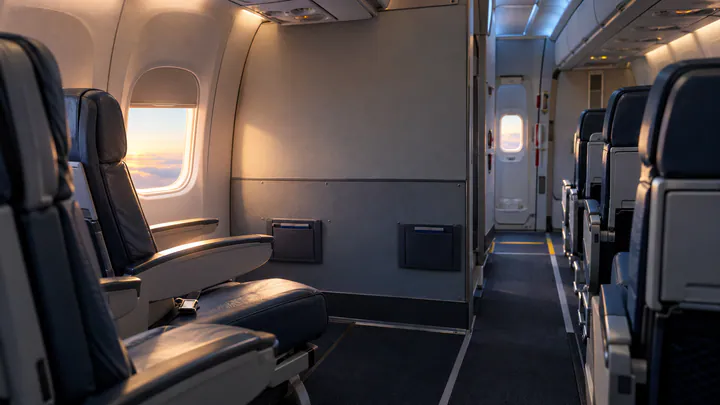
Bulkhead seats sit directly behind a wall or partition, usually at the front of a cabin section. Nobody can recline into you, and you can usually stand up without contorting yourself. Whether you gain legroom depends on the aircraft: some bulkheads have generous space, while others leave less foot room than a standard row because the wall is close and you can't slide your feet under a seat in front.
The trade-offs that the seat map won't show:
- No under-seat storage during takeoff and landing. There is no seat in front of you, so your bag must go in the overhead bin for those phases. Anything you want during the flight, such as headphones, medication, snacks or a book, has to come out of the bin once the seatbelt sign goes off, or stay in a small seat-pocket pouch if there is one.
- Fixed armrests. The tray table and sometimes the entertainment screen fold into the armrest, so the armrests don't lift. If you hoped to stretch across an empty seat beside you, you can't, and the seat cushion can feel slightly narrower.
- Bassinets and babies. On long-haul flights, bulkhead walls often have attachment points for infant bassinets, and airlines tend to hold those seats for families. If you want quiet, a bassinet bulkhead is a gamble.
- Traffic. Bulkheads often sit next to galleys, lavatories or the cabin divider, so people gather and pass close by.
Bulkheads suit travelers who hate being reclined into, parents with lap infants who have requested a bassinet, and people who want to get up easily. They suit poorly anyone who wants their bag at their feet or plans to sleep across two seats.
Exit rows: legroom with obligations
Exit row seats usually have the most legroom in economy, but sitting there is a safety role, not just a perk. Airlines require exit row passengers to be willing and able to assist in an emergency, which means understanding the crew's instructions, opening a heavy door or hatch, and helping others out. Crew members typically confirm this with you before departure, and if you say no or seem unable, they will move you.
Minimum age rules for exit rows vary by airline, and infants, lap children and anyone traveling with someone who needs their help are generally not seated there. Check your own airline's exit row policy before you pay for one, because you can lose the seat at the gate without necessarily getting a refund, depending on the airline.
Other things you agree to, often without realizing:
- Nothing on the floor during takeoff and landing. The area must stay clear, so bags go in the overhead bin, just as in a bulkhead.
- Possibly fixed armrests and armrest trays, particularly in the first exit row on some aircraft.
- Limited or no recline in some exit rows, so the seat doesn't block the row behind. The row directly in front of an exit row also often has restricted recline, which makes it one of the worst seats on the plane for sleeping.
- A cooler seat. Exit doors can feel drafty. Bring a layer.
Exit rows suit tall adults traveling alone or with another able adult who are happy to take on the role. They are the wrong choice for families, for anyone who wants their bag at their feet, and for anyone uneasy about being responsible for an emergency exit.
Front, over-wing or rear
Where your row sits along the cabin affects noise, motion and how fast you get off.
- Front: usually the quietest economy rows on jets with wing-mounted engines, and the first off the plane. Forward rows are often the first ones to carry a seat fee for exactly that reason.
- Over the wing: the plane rotates around a point near the wings, so seats there generally feel less up-and-down motion in turbulence than seats at the back. The downsides are a view mostly of the wing and, on many jets, more engine noise just behind the wing.
- Rear: rows at the back tend to feel turbulence more strongly and are the last off. On jets with engines mounted at the tail, the rear is also the loudest part of the cabin. The very last row often has limited recline because of the wall behind it and usually sits next to the lavatories. The one consolation: rear rows are more likely to have empty seats on a flight that isn't full, since they are booked last.
If getting off quickly matters because of a tight connection, a forward aisle seat can save meaningful time, since passengers leave roughly row by row. If a delay does cost you the connection anyway, what happens next depends on the airline and your ticket, and our guide to refunds and rebooking after a delayed flight covers those options.
Galley and lavatory rows
Rows next to galleys and lavatories bring noise and foot traffic for the whole flight: carts being loaded, meal service preparation, doors opening and closing, call chimes, and a line of passengers standing beside your seat. Galley lights often stay brighter than the rest of the cabin during the night. For short flights this is a minor nuisance. For an overnight flight, put at least two or three rows between you and any galley or lavatory, which you can spot on most seat maps by their symbols.
Check the seat map against the aircraft type
Before trusting any seat map, look at the aircraft type shown on your booking, such as a specific Boeing or Airbus model and variant. Then check that the map you are studying matches that exact type and the airline operating the flight. The same aircraft model can have very different layouts at different airlines, and even within one airline when older and newer cabins are in service at the same time. A codeshare booking may show one airline's name while another airline's plane and cabin actually fly the route.
A few habits help:
- Note the aircraft type when you book and again a few days before departure. Airlines swap aircraft, and a swap can move or remove your chosen seat.
- On the airline's seat map, look for the symbols for galleys, lavatories, exits and bassinet positions, and count rows between them and your seat.
- Look for seats marked as having limited recline or no window. Some window seats sit beside a wall panel with no window at all, which matters if you were counting on the view or the shade.
- Recheck your seat at online check-in. If a swap has put you somewhere worse, that is often the best moment to change.
When paying for a seat is worth it
A quick rule: pay for a seat when the flight is long or overnight, when you have one specific need the default assignment probably won't meet, or when you must sit next to someone. Skip it on short flights where any seat is tolerable. Some fares, often the cheapest ones, don't include seat selection, and the airline assigns a seat at check-in. On a full flight that usually means a middle seat, and people traveling together may be split up.
It helps to think of the fee per hour of flying rather than as a lump sum.
Worked example: is a hypothetical exit row fee worth it?
Say an airline charges a hypothetical $60 for an exit row on a 10-hour overnight flight and the same $60 on a 2-hour flight. On the long flight that works out to $6 an hour (60 ÷ 10). On the short flight it is $30 an hour (60 ÷ 2). The same fee buys five times as many hours of legroom on the long flight (10 ÷ 2), which is why paid seats generally make more sense on long-haul routes.
Now compare a hypothetical $25 standard window seat on the same overnight flight: $2.50 an hour (25 ÷ 10). If sleep is your priority, the cheaper window may serve you better than the pricier exit row, because the exit row may not recline fully, is cooler, and keeps your bag in the overhead bin all night. Paying more only helps when the seat you are paying for matches your priority.
If the per-hour figure looks steep, a free alternative is to check in as early as your airline allows, when more standard seats are usually still open, and to look again at the gate, where agents sometimes release blocked seats close to departure.