
How to Use Vision Boards for Manifestation That Works
Vision boards fail when they stay pretty pictures. Here is how to build one that names specific goals, plans for obstacles, and converts each image into a scheduled action you actually take this quarter.
Rewritten with AI and republished automatically. Our editors set the standards and fix reported errors — how we work.
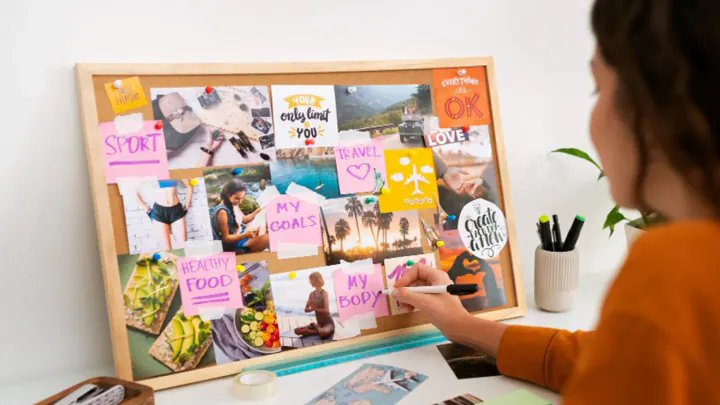
TL;DR: A vision board only works when every image maps to a specific goal, a named obstacle, and a scheduled action. Pick three to five goals, choose one format, look at it for two minutes daily, and end each session by doing one small thing. Pretty collages without next steps change nothing.
What is a vision board, and what does it actually do?
A vision board is a curated visual display of images, words, and symbols that represents specific goals you intend to pursue. It is not a spell and it is not a contract with the universe — it is a physical or digital prompt that keeps a small number of priorities in front of your attention while the rest of life competes for it.
That framing matters because it sets realistic expectations. A board cannot generate opportunity out of nothing. What it can do is make you far more likely to notice an opportunity when it appears, and far more likely to act instead of scrolling past. Think of it the way a chef thinks of a mise en place: the ingredients laid out where you can see them do not cook the meal, but nobody cooks well without them.
Why do some vision boards work and others end up in a closet?
The boards that work name outcomes and the route to them. The boards that fail show only the finish line. This is the single most useful thing to understand about visualization, and it is where most manifestation advice goes wrong.
Work by psychologist Gabriele Oettingen on mental contrasting has been widely discussed for a counterintuitive finding: indulging in pure positive fantasy about a goal can leave people feeling as though they have already partly achieved it, which drains the energy needed to pursue it. The remedy she proposes — often taught as the WOOP sequence of Wish, Outcome, Obstacle, Plan — pairs the desired future with an honest look at what stands in the way, then attaches an if-then plan to that obstacle.
Translate that to a board and the design changes immediately. Alongside the image of the finished thing, you want a visible reminder of the obstacle and the response. That one adjustment separates a mood board from a working instrument.
A note on the Reticular Activating System
You will see the RAS cited constantly in manifestation content as the brain mechanism that "delivers" what you focus on. The honest version is narrower. The RAS is involved in arousal and wakefulness, and popular writing has stretched it into a goal-seeking filter it was never described as. What genuinely happens when you look at a board daily is ordinary selective attention — the same effect that makes you suddenly see your new car model everywhere. That is useful. It is also not magic, and overselling it is why skeptical readers dismiss the whole practice.
How do I build a vision board step by step?
Six steps, and the order matters. Clarify, constrain, collect, contrast, arrange, activate.
- Clarify each goal in one sentence with a number and a date. "I want to be healthier" is unusable. "I want to run 5K without stopping by June 14" gives your brain something to test progress against.
- Constrain to three to five active goals. Everything else goes on a "someday" list kept elsewhere. A board with fourteen goals is a board with none.
- Collect images that carry personal charge. A photo of your own grandmother's kitchen table beats a stock photo of a farmhouse dining room every time. If an image could appear in a furniture catalog, it is probably too generic to move you.
- Contrast each goal with its obstacle. For each image, write the honest blocker on a small card: "I schedule the run and then work runs late." Then write the if-then: "If a meeting runs past 6, I run at 6:30 a.m. the next morning." Pin the card beside the image, or put it on the back if you want the board to stay visually clean.
- Arrange by life area, not by aesthetics. Group career, health, relationships, finances, and craft into distinct zones. Put the single goal that would most change your year in the center, at eye level.
- Activate it with a two-minute daily ritual. Look, breathe, picture yourself doing the work rather than holding the trophy, then name one action for today out loud. Say it, then do it before you leave the room if it takes under five minutes.
Should I make a physical, digital, or hybrid vision board?
Choose physical for stable annual goals and a wall you walk past daily; choose digital for goals that shift every quarter or a life spread across several locations; choose hybrid if you want the tactile version at home and a quiet reminder on your phone.
| Format | Typical cost | Setup time | Best for | Main weakness |
|---|---|---|---|---|
| Poster or foam board collage | $10–$25 in materials | 2–3 hours | Annual goals, households, people who think with their hands | Painful to update; easy to hide when it stops feeling true |
| Cork board with pins | $20–$40 | 1–2 hours | Quarterly rotation, adding obstacle cards | Can drift into a cluttered to-do wall |
| Digital canvas (design app or slide deck) | Free to low | 45–90 minutes | Frequent editing, remote workers, shared goals with a partner | Lives in a tab you never open |
| Phone lock screen or wallpaper | Free | 15 minutes | High-frequency exposure, single dominant goal | Room for one or two images only; blends into background |
| Physical board plus phone wallpaper | $10–$25 | 2–3 hours | Most people, honestly | Requires keeping two versions aligned |
One caution on the digital route: a board saved in a folder is functionally deleted. If you build digitally, set it as a wallpaper, a browser start page, or a pinned tab. Exposure is the entire point.
How often should I look at it, and what should I actually do?
Daily, for two to five minutes, attached to an existing anchor habit. Morning tends to win because the board sets attention before the day's demands arrive, and because it pairs naturally with other morning routines.
During the session, do three things in order:
- Rehearse the process. Picture the specific next action in sensory detail — opening the laptop, the first sentence of the pitch email, the first five minutes of the run.
- Name the obstacle. Say the if-then plan aloud. It takes six seconds and it is the part most people skip.
- Commit to one action with a time. "I will draft the outreach message at 2 p.m." Vague intentions evaporate; timed ones survive.
Then close the loop by protecting the time. Motivation gets you to the desk; structure keeps you there, which is why it helps to pair board practice with the focus rules that actually hold in 2026.
What are the most common vision board mistakes?
Five failures account for almost every abandoned board.
- Borrowed aesthetics. Villas, private jets, laptops on beaches. These images belong to someone else's ambition and generate no pull. Run this test: cover the board and try to name five items from memory. If you cannot, the imagery is not yours.
- Outcome-only imagery. A picture of a published book with no picture of a writing desk, a word count, or a Tuesday evening. Show the reps, not just the result.
- Goals that depend on other people's decisions. You cannot picture a hiring manager into an offer or a person into loving you. Rebuild those goals around the inputs you control.
- Too many goals. Fourteen images means fourteen half-thoughts. Cut to five.
- No review date. Boards go stale. Put a recurring calendar reminder every 90 days to remove what is finished, replace what is no longer true, and be honest about what you never once acted on.
A worked example
Say the goal is to move from a $72,000 salary into work paying closer to $95,000 within a year. A weak board shows a stack of cash and a beach. A working board shows: the specific job title you are targeting, the name of the certification that shows up in those postings, a photo of the colleague-turned-mentor you plan to ask for a referral, and an obstacle card reading "If I feel unqualified and delay applying, I send the application anyway and let them decide." Under it sits the actual number — $95,000 — written large, plus a savings line for the gap months.
Money goals also need a mechanism behind the image. A board can hold the intention; a system moves the money, which is where something like sinking funds for budgeting without the panic earns its keep. None of this is financial advice — it is a planning structure, and your circumstances should drive the numbers.
What else pairs well with a vision board?
Four practices genuinely amplify the board rather than duplicating it.
- Scripting. Write a dated journal entry from twelve months ahead describing an ordinary Tuesday in the life you are building. The mundane details are the useful part.
- Gratitude logging. Three specific entries a week, not vague ones. Specificity is what separates a practice from a chore.
- Short visualization inside meditation. Two minutes of process rehearsal in a settled state is worth more than twenty minutes of daydreaming.
- Rest. Follow-through collapses on insufficient sleep long before it collapses on insufficient belief. If your evenings are ragged, start with recovering from sleep debt before you blame your mindset.
When does this not apply?
A vision board is a poor tool in three situations, and pretending otherwise does readers a disservice.
First, if you are in the middle of an acute crisis — a job loss, a bereavement, a health emergency — a board about a dream future can feel like mockery. Stabilize first. Second, if persistent low mood, anxiety, or burnout is what is actually blocking action, no collage will address it; consult a qualified professional, because motivation tools are not treatment. Third, if your goal is genuinely outside your control, the board will become a daily reminder of powerlessness rather than possibility.
There is also a practical limit worth naming: vision boards are weak at sequencing. They show you five destinations at once and say nothing about which comes first. Pair the board with a plain, ordered list of the next three actions, and you have covered both the emotional and the logistical side of the same goal.
Key takeaways
- A vision board is an attention and planning tool — the images prompt behavior, the behavior produces results.
- Pair every outcome image with a named obstacle and an if-then plan; outcome-only fantasy tends to sap motivation rather than build it.
- Cap the board at three to five active goals, and review it every 90 days without sentimentality.
- Choose the format by how often your goals change: physical for stable annual goals, digital for quarterly ones, hybrid for most people.
- End every two-minute session by naming one timed action, then do the smallest version of it immediately.
- Skip the board and seek qualified support if what is blocking you is health, crisis, or circumstance rather than clarity.
Frequently asked questions
Do vision boards actually work?
Vision boards work when they function as a planning and attention tool rather than a wish list. Research on goal pursuit generally suggests that visualizing the process and rehearsing specific if-then plans supports follow-through, while simply fantasizing about outcomes can reduce motivation. The board is the prompt; the scheduled action is the mechanism.
How many goals should go on a vision board?
Three to five active goals is the practical ceiling for most people. Beyond that, attention fragments and no single image carries enough weight to trigger action. Keep a separate "someday" list for everything that does not have a next step in the current 90 days.
Should I make a physical or a digital vision board?
Choose physical if your goals are stable for the next six to twelve months and you have a wall you pass daily; choose digital if your goals shift quarterly or you work across multiple locations. A hybrid setup — a physical board at home and a digital lock screen — covers both without duplicating effort.
How long should I spend looking at my vision board each day?
Two to five minutes is enough, and consistency matters far more than duration. Anchor the session to an existing habit such as making coffee or sitting down at your desk, and end each session by naming one concrete action you will take that day.
What is the biggest mistake people make with vision boards?
The biggest mistake is building a board out of borrowed aesthetics — stock images of villas, jets, and open laptops on beaches that belong to someone else's idea of success. Borrowed imagery produces no emotional pull and no action, which is why so many boards end up in a closet within two months.
Can a vision board help with goals that depend on other people?
Only indirectly, and this is an important limit. You cannot picture another person into a decision, a hiring committee into an offer, or a relationship into existence. Reframe those goals around the parts you control — the applications you send, the conversations you initiate, the skills you build — and put those on the board instead.
Is a vision board a substitute for professional help or financial planning?
No. A vision board is a motivation and attention tool, not treatment and not a financial plan. If you are dealing with persistent low mood, anxiety, or burnout, consult a qualified professional. For money goals, a board can hold the intention while an actual budget does the work — and nothing here is financial advice.