The Botanist of the Rooftop Greenhouse
On the top of a crumbling tenement, an aging botanist grows plants that shouldn't exist — until a girl from the seventh floor arrives with a jar and a question.
Drafted with AI and published automatically. Our editors set the standards and fix reported errors — how we work.
The elevator in Mr. Ostrower's building had not worked since the winter of the long ice, and he preferred it that way. Eleven flights kept the curious downstairs and the determined honest.
He climbed them each morning with a copper watering can hooked over his elbow, pausing on the seventh-floor landing to breathe, then again on the ninth to admire the way the stairwell paint had bubbled into a map of some country no one had named. At the top he pushed open the iron door and stepped onto the roof, and the wind came at him the way it always did — as if greeting an old dog it had missed.
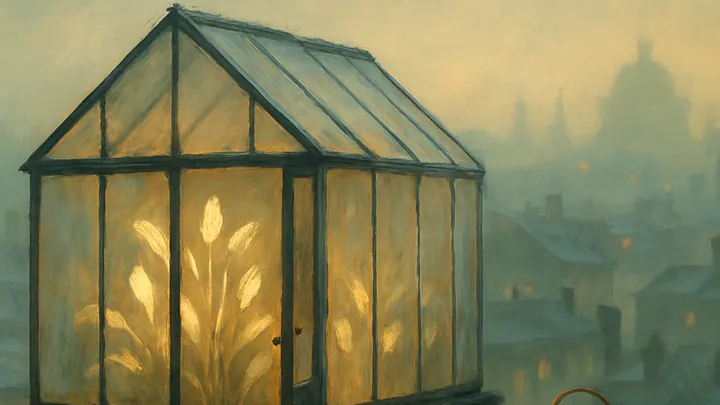
The greenhouse sat in the northeast corner, small as a garden shed, its glass panes clouded with age and breath. He had built it himself the summer he retired, hauling the frame up in pieces, cursing the pulleys, refusing help from the super, who had watched from a lawn chair and offered opinions about angles.
Inside, the plants were waiting.
They always were. The tall one in the blue pot — he called her Agnes — leaned toward the door before he opened it, as though she heard his footsteps on the tar. The little cluster of silver-leafed things by the west pane brightened when he came near, their undersides going the color of a struck match. He did not know what any of them were, precisely. He had been a botanist for forty-one years and could name every genus in the temperate world, and none of these belonged to any of them.
They had simply arrived, one by one, over the years he had lived alone.
The first had come as a seedling in a coffee cup someone left on the roof after a party downstairs — a party he had not been invited to and had not wanted to attend. He'd meant to throw the cup away and instead had watered it, out of the habit of forty-one years, and by the next month it had grown a leaf shaped like a listening ear. He had not been surprised. At seventy-two, very little surprised him anymore, which he considered one of the small kindnesses of age.
The Visitor
The girl came on a Tuesday, which he remembered because Tuesday was the day he watered the ones that only drank on odd weekdays.
He heard her before he saw her — the scrape of small shoes on the top step, the pause of someone deciding whether to be brave. Then the iron door creaked, and a face appeared: perhaps ten years old, freckled across the nose, holding a glass jar in both hands as if it were full of something precious.
"You're not supposed to be up here," Mr. Ostrower said, though not unkindly.
"Neither are you," the girl said. "Mrs. Petranek says the roof isn't structural."
"Mrs. Petranek says a great many things."
The girl considered this and seemed to find it acceptable. She stepped fully onto the roof, closed the iron door behind her with the care of someone raised to close doors, and held out the jar.
Inside was a single leaf. It was the color of pond water and shaped, unmistakably, like a listening ear.
"It grew in my window box," she said. "My mother wanted to throw it out. She said it was a weed. But I thought — " She stopped, and her mouth worked around what she thought. "I thought it looked lonely."
Mr. Ostrower set down his watering can. He took the jar in both hands and turned it in the light. The leaf trembled, though there was no wind inside the glass.
"What floor are you on?" he asked.
"Seven."
"Ah," he said. "That would explain it. Seven is a listening floor. Have you noticed?"
She had not. But now that he mentioned it, she said, yes — the hallway on seven did seem to hush when you walked through it, as if it were leaning in.
"Come," he said, and opened the greenhouse door.
Her name was Yara, and she stayed for an hour that first day, and two the next, and by the end of the month she was climbing the eleven flights three times a week with jars and cups and once a chipped teapot containing something that had sprouted in her grandmother's soup and refused to be eaten.
Mr. Ostrower taught her how to tell which plants drank on which days. He taught her that Agnes preferred to be spoken to in the mornings and ignored in the afternoons, because Agnes was a private soul and required her privacy. He taught her that the silver-leafed cluster responded to humming but not to singing, and that no one knew why, and that this was one of the honest answers a scientist was permitted to give.
"Where do they come from?" she asked him once, sitting cross-legged on the tar with a smear of soil across her cheek.
He thought about the question for a long time. Long enough that she began to think he had not heard.
"I think," he said finally, "that certain things grow where someone is willing to notice them. And there are not many people, in a city this size, who are willing."
She nodded, gravely, the way children nod when they are being trusted with something.
What Grew
The winter that year was harder than the winter of the long ice, and Mr. Ostrower's knees, which had climbed eleven flights faithfully for a decade, began to negotiate. He climbed slower. He rested on the seventh-floor landing longer. Once, on a February morning, he did not climb at all, and Yara found him sitting at the bottom of the stairwell with the copper watering can beside him, looking mildly annoyed at his own legs.
"I'll go," she said. "Tell me what to do."
He told her. Agnes on the odd days. The silver cluster wanted humming. The teapot-thing preferred the shady corner and did not like to be watched while it drank.
She went every morning that winter. And every evening she came back down and sat on the stair beside him and reported: Agnes had leaned. The silver cluster had brightened. The teapot-thing had grown a second leaf, shaped like a small closed hand.
He listened, and nodded, and sometimes closed his eyes.
By spring he was climbing again, though only to seven, where Yara's mother — who had been suspicious and then curious and then, finally, kind — kept a chair for him by the window. From that window you could not quite see the greenhouse. But you could see the light it made against the low clouds at dusk, a faint green glow, like something breathing.
"Do you miss going up?" Yara asked him one evening.
He considered.
"No," he said. "A garden isn't a place. It's an agreement. And ours is doing fine."
She smiled, and pressed her freckled nose to the glass, and together they watched the roof of the building glow softly, as if something up there had finally been noticed enough to stay.