Is Bitcoin Still Worth It? A Clear-Eyed 2026 Guide
Bitcoin in 2026 is a legitimate, volatile, minority-position asset — not a shortcut to wealth. Here's how to size it, where to hold it, what it really costs, and the situations where buying any at all is the wrong move.
Rewritten with AI and republished automatically. Our editors set the standards and fix reported errors — how we work.
TL;DR: Bitcoin in 2026 is a legitimate but violently volatile asset, not a shortcut to wealth. It can make sense as a small, long-horizon slice of a diversified portfolio — after an emergency fund and high-interest debt. Expect drawdowns above 50%, size the position so they don't matter, and treat custody as seriously as the purchase. This is not financial advice.
What is Bitcoin, and what is it actually used for in 2026?
Bitcoin is a decentralized digital currency that runs on a public blockchain maintained by a global network of computers, with a supply capped at 21 million coins. New blocks are added roughly every ten minutes, and no company, bank or government issues or redeems it.
In practice, three uses dominate today. Most holders treat it as a long-term store of value — the "digital gold" framing. A smaller group uses it as a payment rail, usually over the Lightning Network for small, fast transfers. And a large, noisy minority trades it as a speculative asset, often with leverage.
The everyday-payments story is the weakest of the three. Merchant acceptance exists but is uneven, and most people who own Bitcoin never spend it, partly because spending it is a taxable event in many countries. The honest 2026 summary: Bitcoin succeeded as an asset faster than it succeeded as money.
Why does Bitcoin still hold value at all?
Three properties explain the durability: fixed supply, decentralization, and permissionless access. Only 21 million coins will ever exist, the issuance schedule is public and enforced by software, and anyone with an internet connection can hold and send it without approval.
Roughly every four years, a scheduled event called the halving cuts the reward miners receive per block, slowing new issuance further. Because the schedule is known to everyone in advance, it is not secret information — anyone claiming a halving guarantees a price move is selling you a story.
What Bitcoin does not have is cash flow. There are no earnings, dividends or rent to discount. Its price is whatever the next buyer will pay, which is exactly why valuation arguments never fully settle and why volatility is structural rather than temporary.
Can anyone actually predict Bitcoin's price for 2026?
No — and any article giving you a confident number is guessing. Because Bitcoin has no income stream, there is no model that reliably anchors fair value, so published targets from analysts and asset managers are opinions dressed as forecasts.
What is worth watching are the drivers rather than the targets: regulatory clarity in major markets, the flow of money into and out of spot exchange-traded products, interest rates and liquidity conditions, and adoption of second-layer payment technology. Those variables move the price. Predictions merely describe someone's hope.
A more useful planning exercise is a range with a floor you can live with. Ask yourself what you would do if Bitcoin fell 70% and stayed there for three years. If the answer is "panic," the number to change is your position size, not your forecast.
How much Bitcoin should I own?
Our working rule: own an amount that could fall 80% without changing a single financial decision you make. For most households that lands somewhere between 1% and 5% of investable assets, and it comes after the boring foundations are in place.
Those foundations, in order:
- Three to six months of essential expenses in cash you can reach same-day.
- High-interest debt cleared — a 22% credit card is a guaranteed negative return that no asset reliably beats.
- Any employer retirement match captured, because that is the closest thing to free money in personal finance.
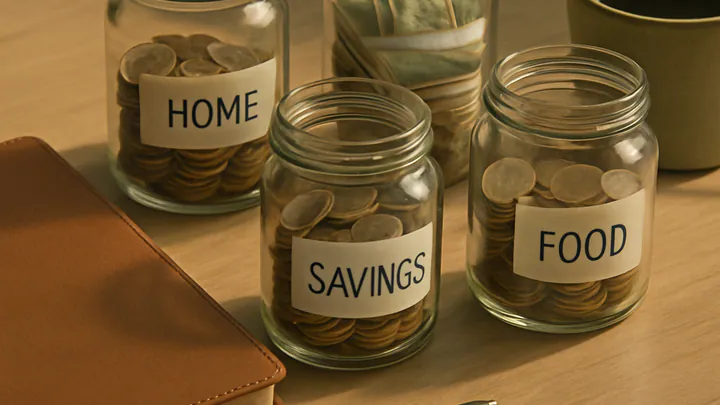
- Planned irregular expenses funded. Our guide to sinking funds for a calmer 2026 budget covers the mechanics of setting those aside.
There is also a non-financial test. If checking the price is disrupting your evenings, the position is too big for your temperament. That is a legitimate reason to cut it in half, and it costs you nothing but upside you were never going to hold onto anyway.
ETF, exchange or self-custody: which way should I hold Bitcoin?
Choose the ETF for clean portfolio exposure inside a brokerage or retirement account, self-custody if you want to hold your own keys or spend Bitcoin, and an exchange only as a staging area rather than a vault. Each option trades a different risk for a different convenience.
| Method | Who controls the coins | Typical cost | Biggest risk | Best for |
|---|---|---|---|---|
| Spot Bitcoin ETF | The fund's custodian | Annual expense ratio, commonly around 0.15%–0.25%, plus any brokerage commission | Trades only during market hours, so weekend moves appear as a Monday price gap | Retirement accounts and hands-off investors |
| Exchange account (custodial) | The exchange | Trading fee plus spread; withdrawal fee to move coins out | Platform failure, freeze or hack — "not your keys, not your coins" | Buying, then moving off-platform |
| Self-custody hardware wallet | You, via a recovery phrase | One-time device cost plus variable network fees | You lose the phrase, you lose the coins — permanently | Long-term holders and anyone wanting censorship resistance |
| Mining or miner equities | You (mining) or the company (stocks) | Hardware, electricity, or ordinary stock costs | Home mining rarely beats simply buying; miner stocks add business risk on top of price risk | Specialists only |
One overlooked detail: an ETF held in a tax-advantaged account defers gains, but you cannot send, spend or verify those coins. Conversely, self-custody gives you control and the option to run your own node at home — which needs nothing exotic, though a stable connection helps.
What does buying Bitcoin really cost?
The headline trading fee is rarely the whole bill. Budget for four separate costs: the platform's trading fee, the bid-ask spread baked into the quoted price, the network fee when you move coins on-chain, and tax on any disposal.
Network fees are the one people forget. They fluctuate with demand for block space, so a transfer that costs cents during a quiet week can cost meaningfully more during a congested one. If you are consolidating small amounts, doing it during low-fee periods rather than at a market peak saves real money.
On tax: in the United States, the IRS treats crypto as property. Selling for dollars, swapping for another coin, or buying a coffee with Bitcoin are all disposals that can trigger capital gains. Broker reporting requirements have been phasing in, but you should still keep your own records of dates, amounts and cost basis. Rules differ by country and by situation — talk to a qualified tax professional rather than a forum thread.
How do people actually lose their Bitcoin?
Far more coins are lost to key mismanagement and social engineering than to any dramatic protocol failure. The blockchain rarely breaks; humans do.
The costly mistakes we see repeated:
- Photographing the recovery phrase. The photo syncs to cloud storage, and the cloud account becomes the single point of failure. Write it on paper or stamped metal; keep copies in two separate physical places.
- Answering "support." No legitimate wallet, exchange or company will ever ask for your recovery phrase. Anyone who does is stealing from you, including the polite ones who message first.
- Skipping the test transaction. Send a small amount first, confirm it arrives, then send the rest. Bitcoin transactions are irreversible, and a mistyped or clipboard-hijacked address is unrecoverable.
- No inheritance plan. If you are the only person alive who knows where the phrase is, your family inherits nothing. A sealed letter with a trusted executor, or a lawyer-held instruction, solves this.
- Leverage. Liquidation happens at the worst possible price on the worst possible night. If a position can be forcibly closed, it is not an investment.
Does dollar-cost averaging really help, and how does the math work?
Yes, in a specific way: buying a fixed dollar amount on a fixed schedule buys more coins when the price is low and fewer when it is high, so your average cost lands below the average price. It removes the decision from the equation, which is its real benefit.
A hypothetical worked example — these are illustrative prices, not forecasts. You buy $300 of Bitcoin on the first of three consecutive months, at $100,000, $60,000 and $80,000.
- Month 1: $300 ÷ $100,000 = 0.00300 BTC
- Month 2: $300 ÷ $60,000 = 0.00500 BTC
- Month 3: $300 ÷ $80,000 = 0.00375 BTC
Total: $900 for 0.01175 BTC, an average cost of about $76,600 — below the $80,000 simple average of the three prices. That gap is the mechanical benefit of fixed-dollar buying, and it grows with volatility.
The honest caveat: dollar-cost averaging does not protect you from a long decline. If the price trends down for years, you simply accumulate more of a falling asset. It reduces timing regret and emotional churn; it does not reduce the underlying risk.
When does buying Bitcoin not make sense?
Skip it entirely if any of the following apply. This is the section most articles leave out.
- You need the money within five years. A down payment, a tuition bill or a planned car purchase has no business sitting in an asset that can halve in a quarter.
- You would borrow to buy it. Buying a volatile asset with a fixed repayment obligation is how ordinary drawdowns turn into permanent losses.
- You are close to drawing on the portfolio. Near retirement, sequence-of-returns risk makes a 70% drawdown far more damaging than the same drawdown at 30.
- Your local rules restrict it. Regulations vary widely by jurisdiction, and enforcement can change faster than markets do. Check before you buy, not after.
- You cannot explain what a recovery phrase is. Learn first, buy second. That order costs nothing; the reverse has cost people everything.
So is Bitcoin still worth it?
If you are looking for fast returns, no — that expectation is what turns Bitcoin's volatility into a personal financial problem. If you are thinking in five- to twenty-year terms, hold a position small enough to ignore, and take custody seriously, then a modest allocation remains a defensible part of a diversified portfolio.
The debate has genuinely moved on since the early years. The question is no longer whether Bitcoin is real; it is how much of your financial life should depend on it. Our answer, for most people, is: a little, deliberately, and with the boring foundations built first.
Financial disclaimer: this article is for informational purposes only and is not financial advice. All investments carry risk, including total loss, and past performance does not indicate future results. Consult a qualified financial advisor and tax professional before making investment, lending or trading decisions.
Key takeaways
- Bitcoin has no cash flow, so its price rests entirely on demand — volatility is a permanent feature, not a phase.
- Size first, forecast never: own an amount that could fall 80% without changing any decision you make, typically 1–5% of investable assets.
- Use an ETF for retirement-account exposure, self-custody for control; treat an exchange as a doorway, not a vault.
- Most losses come from mishandled recovery phrases and social engineering, not from the technology failing.
- Fixed-dollar buying lowers your average cost versus the average price, but it does not rescue a long decline.
- If you need the money within five years, would borrow to buy, or cannot explain a recovery phrase, the right allocation is zero.
Frequently asked questions
Is Bitcoin still a good investment in 2026?
For a long-horizon investor who can tolerate 50%-plus drawdowns, a small position of roughly 1–5% of a diversified portfolio is defensible — but only after an emergency fund is funded and high-interest debt is cleared. Bitcoin is not a savings account, and this is not financial advice.mm It has no cash flow, so its price depends entirely on what the next buyer will pay.
How much Bitcoin should I own?
A common decision rule is to own an amount that could fall 80% without changing a single financial decision you make — for most people that lands between 1% and 5% of investable assets. If a 50% overnight drop would make you sell, the position is too large, regardless of the percentage.
Is a spot Bitcoin ETF better than buying actual Bitcoin?
An ETF is better if your goal is portfolio exposure inside a brokerage or retirement account with simple tax reporting; direct ownership is better if you want to hold your own keys, spend Bitcoin, or hold it outside the banking system. ETFs charge an annual expense ratio and only trade during market hours, so weekend price moves show up as a Monday gap.
Can anyone actually predict Bitcoin's price?
No. Bitcoin produces no earnings, dividends or rent, so there is no valuation model that reliably anchors it — published targets are opinions, not forecasts. Treat any specific number, bullish or bearish, as a scenario rather than a prediction, and plan for a range that includes a deep drawdown.
What is the most common way people lose their Bitcoin?
Losing or exposing the recovery phrase is the leading cause — photographed seed phrases, cloud backups, and social-engineering scams cost more coins than exchange hacks do. Write the phrase on paper or metal, store it in two separate physical locations, and never type it into a website, app or chat.mm No one legitimate ever asks for it.
Do I owe taxes on Bitcoin if I never cash out to dollars?
In the United States, the IRS treats crypto as property, so trading Bitcoin for another coin or spending it on goods is a taxable disposal even if no dollars hit your bank account. Broker reporting rules are phasing in, so keep your own records of purchase dates and cost basis and speak with a qualified tax professional about your situation.
What happens at the next Bitcoin halving?
Roughly every four years the reward paid to miners for each block is cut in half, slowing the rate at which new coins enter circulation until issuance ends near 21 million. Halvings are scheduled and public, so they are not hidden information — the price effect, if any, is debated and has never been consistent.