A Passenger Too Light for the Funicular
A short story about a retiring funicular operator in Valparaíso who, during a fog delay on her last shift, tells her successor about a silent passenger from 1982 and a fault report she never filed.
Drafted with AI and published automatically. Our editors set the standards and fix reported errors — how we work.
Story Time is original short fiction. The characters, places and events in this story are invented.
Fernanda had her hand on the brake lever before I told her to take it off. "You can see the rails," she said, which was true for about eleven meters. After that the track went down into the fog like a spoon into milk, and the lower station was only a voice on the radio saying, for the third time, nada, Ximena, no veo ni la boletería.
"Rule is fifty meters," I said. "Sit. There's tea."
She sat on the crate by the winch the way young people sit, as if the crate might ask her for something. She had a tablet in a rubber case and a lanyard from the municipality and she had already written down, in my presence, the temperature of the motor housing. Tomorrow the Lechuzas line would be hers. Today it was still mine for six more hours, and I had been waiting all week for the fog to give me an excuse.
I poured the tea from the thermos into the two enamel cups, the chipped one for me. Below us the big wheel sat still, the cable coming up through the slot in the floorboards and going out again toward the rails, greased black, tight as a held note.
"Look at the cable," I said.
She looked. "It's fine. I checked the tension this morning."
"I know you did. I want you to remember what it looks like when it's fine."
In 1982 I was twenty-two and I had been on the line four months. Don Abelardo ran the winch then. He had a cough that sounded like a bag of gravel being dropped, and in June it turned into pneumonia, and the municipality did not send anyone, because that was the year the banks fell over one after another and nobody sent anyone anywhere. So I ran it alone. Ticket window at the bottom on the honor system, a tin box, and me up here with the motor.
The motor was already dying. You could hear it in the bearing, a little shriek on every turn, like a gull far off. I knew what I was supposed to do. There was a form, yellow, in triplicate. A fault report on a passenger line meant the line closed until an inspector signed it off, and that winter there were no inspectors, there was a letter on the noticeboard saying that lines closed for faults would be "reviewed for continued operation." Two ascensores on other cerros had been reviewed already. They were still reviewed. Their cars sat at the top with pigeons in them.
And on our hill there was Doña Herminia, who had legs like two loaves and went down to the market every afternoon for exactly one onion so she would have a reason to go. There was Don Rubén with his oxygen bottle on a shopping trolley. There were the Arancibia sisters, who were ninety and eighty-eight and would have died rather than climb two hundred and forty steps, and who said so. The stairs on Lechuzas are not stairs, they are a cliff that someone has been polite to.
"So you didn't report it," Fernanda said.
"Let me get there."
The first time was a Thursday in June, at dusk, with fog like this but lower, so that the top of the hill was clear and the bottom was gone. The bell rang from the lower station, which meant the box had coins in it and someone was in the car. I engaged the motor. It made the gull sound, louder, and then it made no sound at all. It stalled. The wheel stopped. I stood there with my hand on the lever thinking about the yellow form.
Then the cable went slack.
I don't mean it loosened. I mean it lay down. It came up through the slot in loops, like a hose when you drop it, and it lay on the boards around my boots, and outside, through that window, I watched the car come up out of the fog. Slowly. Exactly the speed it was supposed to go. The other car went down past it on the passing loop, also at the right speed, as if someone were lowering it by hand.
Inside the car was Doña Herminia with her onion, two schoolboys hitting each other with their satchels, and a woman in a grey coat who was holding nothing at all.
The car arrived. It stopped where it always stopped, at the mark. The cable pulled itself back up tight through the slot, very quietly, as if it were embarrassed. The schoolboys ran out. Doña Herminia said the ride had been smooth for once, and was the young lady finally learning. The woman in the grey coat walked past my window and up the pasaje between the blue house and the house that was pink then and is green now, and the fog came up the hill behind her and that was all.
Fernanda had stopped writing on her tablet. She had not put it down.
"The motor stalled," she said, "and you're telling me the car came up on its own."
"I'm telling you what I saw. You asked me why there's a gap in the maintenance history in '82. That's why."
She came every evening. Always at dusk, always with the fog. I never saw her get into the car at the bottom, because I never went down; I was afraid that if I left the winch room I would come back and find it had been ordinary all along. Every morning the motor ran, shrieking, and I nursed it like a sick dog and the old ladies went down to the market. Every evening, it stalled, and the cable lay down on the floor, and the car came up with her in it.
The box at the bottom had an extra coin in it each night. An old escudo, from before they changed the money. I have a jar of them at home. I never spent one; you couldn't.
Once I spoke to her. I stood in the doorway as she passed and said, "Señora, do you live up here?" She looked at me. She had a face like anybody's aunt. She smelled of kelp and cold, like the breakwater in winter. She didn't answer. She looked past me, down at the bay, at the cranes in the port and the ships waiting to unload things nobody could afford, and then she went up the pasaje.
Another time I put my hand on the cable while the car was climbing. It was loose and cold and wet, and it moved under my palm with nothing pulling it, like a rope in the sea.
"Who was she?" Fernanda asked.
"I asked Doña Herminia. She said there had always been a woman in grey on the hill, since her mother's time. She said it the way you'd say there's always been a crack in the church. Don Abelardo said a fisherman's widow drowned off the rocks at Playa Ancha in the twenties, but Don Abelardo had a story for every corner." I drank my tea. "I never found out. I didn't need to. I needed the car to go up."
In September Don Abelardo came back, thinner. He listened to the motor for one minute and swore for three. He took a bearing off a winch somebody was scrapping down at the port and machined it to fit on a lathe in his brother's garage. The motor stopped screaming. That evening the fog came in, and the bell rang, and the car came up on the cable like a car on a cable, and she wasn't in it.
She wasn't in it the next night either. I waited all spring.
"And the logbook?"
"For June to September I wrote runs normal." I tapped the green book on the shelf, the current one, the one I'd been keeping since 2009. "Every logbook I've kept since, I've left one page blank at the back. For the report I didn't file."
"That's a falsified record," she said, not unkindly. She was a careful girl. She would be a good operator. "If it happened again, I'd have to report it."
"Would you?"
She looked at the cable. Out the window, the Arancibia sisters were long dead, and Doña Herminia, and Don Rubén, but there was a man in a wheelchair named Gustavo who rode every day at four, and a woman with a dialysis appointment on Tuesdays and Fridays, and the municipality had been talking all year about a minibus route instead, cheaper, a minibus that could not get within three hundred meters of any of their doors.
"I don't know," Fernanda said.
"Good. That's the right answer for now."
The radio crackled. Ximena. Veo el poste. Veo la boletería. Tengo tres esperando.
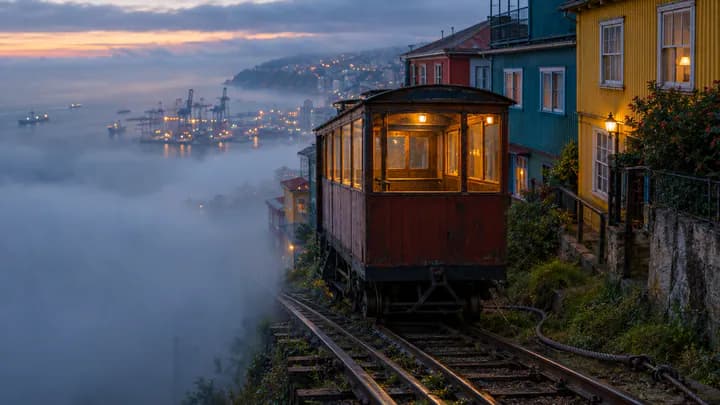
Through the window the fog was going down the hill the way it comes up, in one piece, pulling off the roofs like a sheet. The blue house came out. The green house. The rails, all the way down, shining with wet. At the bottom, three small figures under the station light: a man with a bag of bread, a girl in a school uniform, someone in a dark jacket I couldn't make out.
I took the green logbook off the shelf and opened it at the back to show her the blank page, ruled and empty, with today's date nowhere on it. Then I closed it and put it in her hands.
"What do I write on it?" she said.
"You'll know when to fill it in." I took my chipped cup and stepped back from the lever. "Ring them up, Fernanda. Watch the cable."