What the Presser Told Us on the Wet Day
A short story about a homesick fifteen-year-old in a rain-stopped New Zealand shearing shed, and the old wool presser who tells him a fable about a merino ewe who would not give up her fleece.
Drafted with AI and published automatically. Our editors set the standards and fix reported errors — how we work.
Story Time is original short fiction. The characters, places and events in this story are invented.
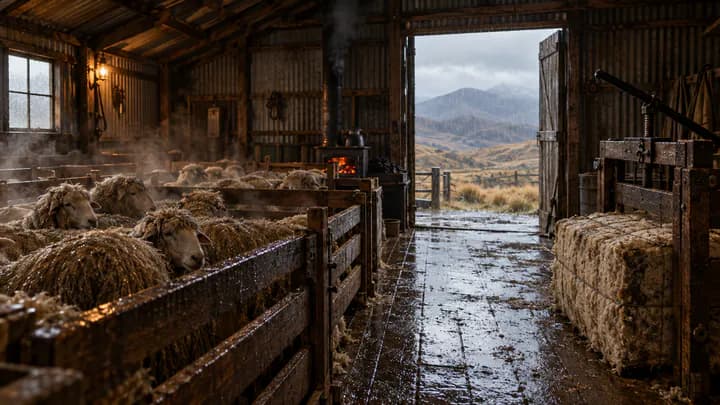
Ces Pirie stopped the shearing at ten past ten, walking the length of the board with one hand up like a traffic officer. “That's it, boys. They're wet.” The rain had been at the iron roof of the Mount Kerrow woolshed since before breakfast, and the sheep in the catching pens had gone dark with it, packed shoulder to shoulder and steaming, so the whole back of the shed smelt of wet jersey and lanolin.
I was fifteen, three weeks into my first season, and my port was already packed under my bunk in the shearers' quarters. The mail truck came up the gorge road on Thursdays, dropped the bread and the papers at the homestead, and left again at seven sharp. I meant to be on it.
I had told Ces the night before. He'd been rolling a smoke on the cookhouse step and hadn't looked up. “Go if you want, son. Pay's at cut-out. You walk off mid-run, you walk off with what you brought.” I'd brought a towel, two shirts, and a tin of my mother's ginger crunch that the gang had finished the first night.
Nobody in that shed had a name for me except Cathedral, because I was from Christchurch and because, Spud Gillanders said, I took about as long to get anywhere. I was the slowest rouseabout on the board. I'd pick up a fleece wrong and it would come apart in my arms like wet bread, and someone would yell, and I'd be late to the next stand with the broom, and Spud would stand over his half-shorn wether going, “Bellies, Cathedral, any time this week.” My palms had blistered in the first three days, and the blisters had broken and blistered again under the broom handle. At night I lay with my hands open on the blanket so nothing touched them, and I did my crying into the crook of my elbow so it would look like I was asleep.
On a wet day there is nothing to do in a shearing shed. The shearers played euchre on an upturned wool pack. Somebody got the transistor going and lost it again in static. The coal range in the corner smoked because the flue had never drawn right, and everyone's eyes ran a bit, which I was grateful for.
Tamati Rewiri didn't play cards. He was the presser, sixty or near it, a big slow man from up the Kaikōura coast with forearms like fence strainers, and on a wet day he stencilled bale numbers. He'd done every bale in the shed by eleven. Then he came and sat on the bale next to mine by the range, wiped his brush on his trousers, and said, without looking at me, “Truck's tomorrow.”
“Yes.”
“You on it?”
I didn't answer, which was an answer. He nodded as if I'd said something sensible.
“I'll tell you about a ewe,” he said.
The Ewe on the Tops
There was a merino ewe on the tops behind this station, he said, before this station was here. A good ewe. Fine in the wool, strong in the leg. And the first spring the musterers came for her she looked at the dogs and the men and the shed down on the flat, and she said, That's mine. It grew on me. Why should I hand it to a man with a handpiece?
So she hid. Up in the Spaniard and the matagouri where the dogs wouldn't go, and she watched the mob go down without her, and she watched them come back up bald and pink and shivering, and she laughed at them.
“Next year the same,” Tamati said. “And the year after. And every year the fleece got heavier.”
By the third year she couldn't run. By the fourth she couldn't keep up with the mob even walking, and the shorn ewes went past her on the track, light as anything, and laughed at her the way she'd laughed at them. Look at the old bale, they said. Look at her go. The kea sat on the rocks and laughed too, because kea laugh at everything. Wool holds water, so every time it rained she was heavy and slow and wet, and if she lay down on the wrong slope it took her an hour to get her legs under her again.
“But she kept it,” Tamati said. “Every year she kept it. It was hers.”
I asked him what the point of that was. My voice came out stupid and high.
He looked at me then. “The point,” he said, “is she was still on the hill.”
Then one November, the week after shearing, a snow came in off the Divide. Late snow, the kind that kills. The shorn mob had nothing on their backs. They crowded into the lee of a rock and shook, and the young ones started going down in the drift. And up on the ridge stood the old ewe in five years of wool, warm as a house, looking down at them. The ones who'd laughed.
“And she had to choose,” said Tamati. He stood and stretched, and his back cracked. The rain on the iron had dropped to a mutter. “Rain's going off. Ces'll want them under cover for the night.”
“What did she choose?”
“Tell you tomorrow,” he said. “After the truck.”
I didn't sleep. I lay with my hands open on the blanket and tried to finish it myself, and couldn't. She walked down into the snow. She stayed on the ridge. She went over the top into another valley and was never seen again. Every ending I made up sounded like something I'd tell myself on the bus home.
At a quarter to seven I was standing in the doorway of the woolshed with my port in my hand. The pens were full of dry sheep now, quieter, and I could see the truck's lights at the homestead gate and hear the engine idling. Ninety yards. I could have walked it in a minute.
The driver hooted once, the way he did, and waited, and then the lights swung onto the gorge road and dropped out of sight. I listened to him change down for the first bend and the second, and then I couldn't hear him.
I put the port behind the wool table and got the broom.
Spud came on at half past seven, saw me, and said, “Morning, Cathedral,” and nothing else, which from Spud was nearly a speech. Ces walked past and set a tin of tar down beside me without a word. That meant I was tar boy as well now.
At smoko I found Tamati behind the press and asked him.
He drank his tea. He picked a burr out of his eyebrow. “Don't know,” he said. “Haven't got to that bit.” Then he looked at me over the mug. “You're still here. You tell me.”
I've run my own gang out of Geraldine for thirty-four years. There's no mail truck now; the kids come up in their fathers' utes, or their own, and they could leave any hour they liked, which makes it harder, not easier. When it rains and the sheep go wet and the shed goes quiet, I sit by whatever's giving off heat and tell them about the ewe on the tops.
Last Tuesday it was a girl from Ashburton, sixteen, three weeks in, blisters like mine. She'd been looking at the car park all morning. When I got to the snow and the ridge, she asked what I had asked.
I told her what I always tell them: that the old ewe walked down into the drift and stood in the middle of the shorn mob, and they packed in against her, and her five years of wool kept every one of them alive till morning. That when the snow cleared she walked into the shed on her own, and the shearer took the fleece off in one piece, and the presser gave it a bale to itself with her name painted on the side.
“That's a nice ending,” the girl said, the way you'd say it about a cake you didn't want.
Davey Rerekura, who has pressed for me nine seasons and heard it a dozen times, didn't look up from his stencilling. “Tell her,” he said.
So I told her. That the man who gave me the story never finished it. That I'd made the ending up, the same one every time, and that I knew it was wrong. A ewe that stubborn doesn't walk into anybody's shed of her own accord, and a story that tidy is no use to someone sitting on a wool bale with their keys in their pocket. I tell it wrong on purpose. The ones who swallow it go home with a nice story, and good luck to them. The ones who pull a face are the ones I keep.
“Then what really happened to her?” she said.
The rain was easing on the roof; you learn to hear it going off. I got up and stretched, and my back cracked, and I nodded past her at the door, where the car park was and the road out beyond it.
“Tell you tomorrow,” I said.