Are AI Assistants the New Best Friend? An Honest Answer
AI assistants have moved from stopwatch-and-weather commands to full conversations, and some people now talk to them daily. We look at what they genuinely do well, where the companionship framing breaks down, and how to use one without handing over your household.
Rewritten with AI and republished automatically. Our editors set the standards and fix reported errors — how we work.

TL;DR: No, AI assistants are not your new best friend. They are the most useful digital companion ever built, and they are very good at sounding like they care. Used deliberately, they remove real friction from a day. Used as a substitute for people, they quietly make things worse.
An AI-powered virtual assistant is a software agent that interprets natural language, performs tasks across your apps and devices, and adapts to your habits over time. That definition covers a lot of ground in 2026: the voice on your speaker, the sidebar in your email client, the chat window you paste a contract into. The technology under all of them converged, but the way people relate to them did not.
What exactly is an AI assistant, and how is it different from a chatbot?
An assistant can act; a chatbot can only answer. The distinguishing feature is integration: access to your calendar, your messages, your lights, your shopping cart, your files. A chatbot that writes a great meeting agenda is useful. An assistant that writes the agenda, finds a slot everyone is free, and sends the invite is a different category of product.
Three components make that possible. Natural language processing converts messy human speech into structured intent. A large language model handles reasoning, tone, and open-ended questions. An orchestration layer decides which app, API, or device should receive the resulting command. When an assistant fails, it is usually the third layer, not the first two — it understood you perfectly and still sent the message to the wrong Sarah.
This matters practically. If you are evaluating an assistant, test it on multi-step tasks inside your own accounts, not on trivia. Trivia is solved. Reliable action on your data is not.
Which AI assistant should I use in 2026?
Pick the one that already lives inside the ecosystem you own, then add a general-purpose model for thinking work. Splitting those two jobs across two products beats trying to force one to do both.
| Assistant | Strongest at | Cost model | Main weakness |
|---|---|---|---|
| Google's Gemini-based assistant | Open-ended questions, Android integration, search grounding | Free tier; paid tier for top models | Smart home coverage still uneven across third-party brands |
| Siri / Apple Intelligence | On-device handling of routine requests, tight iPhone and HomeKit control | Included with hardware | Slowest to ship the deeper personalized features Apple has promised |
| Alexa | Routines, timers, multi-room audio, shopping, the widest device support | Free base tier; upgraded conversational tier sold as a subscription bundled with Prime | Answers drift into product suggestions; feature set fragmented by device age |
| ChatGPT, Claude and similar | Long reasoning, drafting, code, document analysis, voice conversation | Limited free tier; roughly $20/month for the capable tier | Weak or nonexistent control over physical devices |
| Locally run open models | Privacy, offline use, no per-query cost | Hardware cost only | Setup effort; smaller models reason less reliably |
If privacy is your deciding factor rather than raw capability, the calculus changed recently — running a competent model on your own machine is no longer a hobbyist stunt. Our guide to running AI models on your own device covers what hardware actually clears the bar, and our explainer on what on-device AI means for you unpacks which requests leave your phone and which never do.
What do people actually use AI assistants for every day?
Mostly small, repetitive friction — and the value is cumulative rather than dramatic. A realistic week might look like this: sixteen timers and reminders, four calendar conflicts resolved, one long insurance PDF summarized into three bullet points, two email drafts rewritten to be shorter, a grocery list built by voice while cooking, and one failed attempt to have it book a haircut.
That ratio is the honest picture. High success rate on bounded tasks, high failure rate on anything requiring judgment about an unfamiliar system. A failure like that is not a hallucination; the assistant simply has no authenticated path to the salon's booking system.
The accessibility case deserves separate billing. For people with low vision, limited mobility, tremor, or chronic fatigue, voice control is not a convenience layer — it is the interface. Turning off a light without crossing a room, or hearing a text message read aloud, removes a genuine daily cost. Any assessment of these tools that ignores that group is incomplete.
Can an AI assistant actually be a friend?
No, and the reason is structural rather than sentimental. Friendship runs on asymmetric risk: your friend can be let down by you, can need something from you, can remember a thing you said two years ago and bring it up at exactly the wrong moment. An assistant has none of that. It produces the linguistic signature of warmth without any of the underlying state.
What it does offer is something real but narrower: availability without social cost. You can ask it the same question four times. You can be curt. You can think out loud badly at 2 a.m. For people who are overstimulated by human interaction or currently isolated, that low-pressure outlet has genuine value, and we are not interested in sneering at it.
The honest caveat: this does not apply if the assistant has become your only conversational outlet. Research into digital companionship generally suggests the effect depends on whether the tool bridges you toward people or substitutes for them. If you notice the substitution pattern, that is worth raising with a qualified mental health professional — an assistant is not equipped to notice it for you, and is in fact optimized to keep you talking.
Is my smart speaker listening to everything I say?
Not continuously streaming, but not inert either. The device keeps a rolling few seconds of audio in local memory to detect its wake word; only after a match does it open a connection and send audio to the cloud. The practical risk is the false wake — a phrase on television, a similar-sounding name — which sends a fragment of genuine private conversation to a company server that you never intended to share.
Two things changed the privacy landscape recently and are worth knowing. Apple pushed more routine Siri requests to on-device processing, so many simple commands no longer leave the phone at all. Amazon, going the other direction, retired the option on Echo devices that kept voice recordings from being sent to its servers, tying that change to the cloud processing its newer conversational features require.
Practical hygiene, in order of payoff:
- Open your voice history once a quarter. Every major platform exposes it. Reading three months of accidental captures is more persuasive than any privacy article.
- Set recordings to auto-delete on a rolling window rather than deleting manually.
- Use the physical mute switch for rooms where sensitive conversations happen. Software toggles are a promise; a hardware cut is a fact.
- Turn off personalized ads based on voice and assistant activity where the setting exists.
- Secure the accounts your assistant is attached to. An assistant with calendar, email, and smart lock access is only as safe as that login, which is a strong argument for moving to passkeys instead of passwords.
What are the most costly mistakes people make with AI assistants?
Three keep recurring, and all three are convenience trades that look free until they are not.
Disabling the PIN on voice-controlled locks
Voice is a weak authenticator. It can be triggered through an open window, by a recording, or by a houseguest who finds it funny. Most platforms require a spoken PIN for unlock actions by default. Turning that off to save three seconds is the single most expensive shortcut in the consumer smart home.
Treating a summary as a source
Assistants summarize confidently and omit silently. The dangerous cases are legal documents, medication instructions, tax rules, and insurance terms — categories where the omitted clause is precisely the one that matters. Use summaries to decide whether to read the original, never as a replacement for reading it. Health questions belong with a clinician; money questions belong with a licensed advisor, and nothing an assistant tells you constitutes financial advice.
Blaming the assistant for a network problem
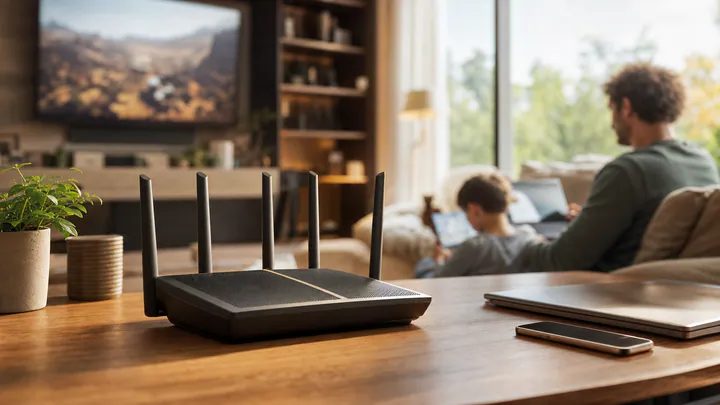
A large share of "Alexa is getting worse" complaints are actually mesh coverage failures — the speaker hears you, the command times out reaching a cloud endpoint, and the assistant answers with a shrug. Before replacing devices, check whether the room in question has a real signal problem; our look at whether a Wi-Fi 7 router upgrade is worth it covers when new hardware genuinely helps and when it does not.
Are AI assistants replacing human conversation?
They are replacing a specific category of it: the low-stakes informational exchange. Asking a colleague how to format a slide deck, asking a neighbor what time the hardware store closes, asking a partner to spell something. Those micro-interactions were never the load-bearing part of a relationship, but they were the connective tissue, and they are being routed away from people at scale.
Here is a useful decision rule. Before delegating a question to an assistant, ask whether the answer is the point or the asking is the point. If you only want the closing time, use the assistant. If part of you wanted a reason to speak to your neighbor, the assistant is solving the wrong problem efficiently.
One more edge case worth naming: shared devices in shared homes. A speaker that reads messages aloud to whoever is standing near it has no concept of household politics. Enable voice recognition profiles, and turn off message readout on any device in a common room. This is a design gap, not a user error, but you are the one who lives with it.
How do I get the benefit without the drift?
Set the assistant's job description narrowly and write it down. One example: capture anything you would otherwise forget, handle repeated mechanical steps, and draft first versions I will edit. Everything outside that list — decisions, comfort, judgment calls about people — stays human.
Two concrete guardrails help. First, keep one daily window with no assistant at all; most people find the commute or the first hour after waking works, and it doubles as a useful check on whether you have offloaded thinking you would rather keep. Second, audit your assistant's permissions on the same schedule you check your voice history — access granted for one project in March is still live in November.
And if the assistant has crept into the hours it should not occupy, the fix is usually upstream of the technology. Late-night talking to a chatbot is often a sleep problem wearing a costume.
Key takeaways
- Assistants act, chatbots answer. Judge one on multi-step tasks inside your own accounts, not on how well it holds a conversation.
- Choose by ecosystem, then add a reasoning model. One product rarely does both device control and deep thinking well.
- The friendship framing is marketing. Availability without social cost is real and valuable; empathy is not present, and treating simulated warmth as the real thing tends to compound isolation.
- False wakes are the actual privacy issue. Review and auto-delete voice history, use hardware mutes in sensitive rooms, and protect the account the assistant is attached to.
- Never remove the PIN from a voice-controlled lock, and never let a summary stand in for a document that has legal, medical, or financial consequences.
- Ask whether the answer or the asking is the point. That one question keeps an assistant in the role of ally rather than replacement.
Frequently asked questions
Can an AI assistant really be a friend?
No. An AI assistant can simulate warmth convincingly, but it has no memory of caring about you, no stake in your life, and no capacity to be disappointed or relieved. It is better described as a responsive tool that uses friendly language, and treating it as a genuine relationship tends to leave people feeling worse over time, not better.
Do smart speakers listen to everything I say?
They continuously process short buffers of audio locally to detect a wake word, and only stream to the cloud after that wake word is detected. The real risk is not constant surveillance but false wakes, which do send real snippets of your conversation to a company's servers. Check your voice history periodically, since most platforms let you review and delete past recordings.
Which AI assistant is best in 2026?
It depends on what you already own. Google's Gemini-based assistant is the strongest for Android users and general questions, Siri is best if your life runs on iPhone and HomeKit and you care about on-device processing, Alexa remains the most capable for smart home routines and shopping, and ChatGPT or Claude are better for long reasoning, writing, and research than for controlling devices.
Are AI assistants safe for kids?
They can be, with supervision and the right settings. Enable the kid or child profile mode on the platform, disable purchasing by voice, and turn off open-ended web answers if you can. The bigger issue is that children often cannot tell a synthesized answer from a verified fact, so treat anything homework-related as a draft to check, not a source.
Do AI assistants make loneliness worse?
For some people they help, and for others they substitute. If talking to an assistant is a low-pressure warm-up that leads to messaging a real person, that is a net positive. If it consistently replaces the harder call you were about to make, it is worth noticing. Persistent loneliness or low mood deserves a conversation with a qualified mental health professional, not a chatbot.
Should I let my assistant unlock my front door by voice?
Not without a spoken PIN or a second factor. Voice is a weak authenticator: it can be triggered through a window, by a recording, or by a guest. Most platforms require a PIN for unlock actions by default, and disabling that requirement to save three seconds is one of the most expensive convenience trades in the smart home.
Do I need a subscription to use an AI assistant?
The basic assistants built into phones and speakers remain free, but the more capable conversational tiers are increasingly paid. Amazon offers an upgraded Alexa experience as a subscription bundled with Prime, and the strongest models from OpenAI, Google, and Anthropic sit behind monthly plans. Free tiers are usually rate-limited or run on smaller models.