Early Childhood Education: What Actually Builds Lifelong Learning
Early childhood education is the birth-to-eight stage that builds language, self-regulation and curiosity. Here is what quality actually looks like on a classroom tour, how the major philosophies differ, and the mistakes that quietly cost children the most.
Rewritten with AI and republished automatically. Our editors set the standards and fix reported errors — how we work.
TL;DR: Early childhood education is the birth-to-age-eight stage where language, self-regulation and curiosity are built. Quality comes from warm, back-and-forth adult interaction, small groups and guided play, not from worksheets or expensive decor. Judge a program by how the teachers talk to children, and start home conversation habits today.
What is early childhood education, exactly?
Early childhood education is a stage of learning that spans birth through roughly age eight and develops language, thinking, motor skills and emotional regulation through play, routine and responsive adult interaction. It includes infant and toddler care, preschool at three and four, and the early elementary grades, though most families use the term to mean preschool.
What separates it from later schooling is the mechanism. Older students learn substantially through explanation and practice. A four-year-old learns through doing, repeating, negotiating and being narrated to by an adult who is paying attention. The curriculum is the day itself: snack, blocks, the dispute over a shovel, the story before nap.
What should a three- or four-year-old actually be working on?
The real targets at this age are oral language, executive function and phonological awareness, not reading fluency or arithmetic. Children who arrive in kindergarten with a wide spoken vocabulary, the ability to wait and switch tasks, and an ear for rhyme and syllables are the ones who learn to read smoothly later.
- Oral language: long, back-and-forth conversations; retelling events; using words for feelings.
- Executive function: holding a plan in mind, waiting a turn, stopping one activity and starting another without collapse.
- Phonological awareness: clapping syllables, hearing rhymes, noticing first sounds. This is ear work, not letter drilling.
- Number sense: counting objects with one-to-one correspondence, comparing more and fewer, recognizing small quantities at a glance.
- Fine and gross motor: scissors, tongs, buttons, climbing, balancing. Hand strength precedes handwriting.
- Self-help and cooperation: coats, shoes, cleanup, sharing, repairing a conflict.
Notice what is missing: a reading level. Teaching a resistant three-year-old to decode words is usually a poor trade against the language and regulation work that the same half hour could have done.
How do the main preschool philosophies differ?
The major approaches differ mainly in how much the adult directs the day and how structured the materials are. All of them can be excellent or mediocre in practice, because implementation quality outweighs the label on the door.
| Approach | Core idea | Suits children who | Watch for |
|---|---|---|---|
| Montessori | Self-directed work with specific, self-correcting materials in mixed-age rooms; long uninterrupted work periods | Like order, repetition and independence | The name is unprotected; verify teacher training and whether the materials are actually used as designed |
| Reggio Emilia–inspired | Project work driven by children's questions; documentation of learning; the environment as a teacher | Are curious, verbal and enjoy long collaborative projects | Requires skilled teachers; weak versions drift into unfocused activity |
| HighScope | Plan–do–review cycle; children state an intention, carry it out, then reflect | Benefit from explicit practice in planning and self-regulation | Needs consistent adult follow-through to avoid becoming a routine children recite |
| Waldorf | Rhythm, imaginative play, natural materials, delayed formal academics and screens | Thrive on predictable rhythm and open-ended play | Later start on literacy may not suit a child already hungry for letters |
| Play-based / eclectic | Centers, circle time and teacher-guided play drawing on several traditions | Most children, in the hands of strong teachers | Quality varies most widely here; judge the teachers, not the brochure |
| Head Start / public pre-K | Publicly funded programs with comprehensive health, family and education services | Families who qualify and need wraparound support | Eligibility rules, waitlists and varying program hours |
What should I look for on a preschool tour?
Watch the adults for fifteen uninterrupted minutes and ignore everything else. If teachers are crouched at child height having real conversations, narrating what children are doing and asking questions they do not already know the answer to, the program is probably good. If adults are mostly managing, warning and directing traffic, no amount of curriculum branding fixes it.
Our short checklist for a visit:
- Staff turnover. Ask how long the lead teachers have been there. Children attach to people, not programs.
- Group size and ratio. Smaller is better at every age, and group size matters as much as ratio. Requirements vary by state and by accreditation body, so ask for the actual numbers in that room.
- Noise quality. A busy hum is healthy. Chaos and dead silence are both warning signs.
- Outdoor time. Ask how much, and what happens in bad weather. Daily outdoor play is not optional.
- Conflict handling. Ask what happens when a child bites or hits. You want a concrete, calm, teaching answer.
- Transitions. The messy minutes between activities reveal more about a room than circle time does.
Accreditation from a recognized body is a reasonable filter, but treat it as a floor rather than proof. Plenty of unaccredited neighborhood programs are excellent, and a badge cannot tell you whether the teacher who greets your child at 8 a.m. is warm.
Why does "serve and return" beat flashcards?
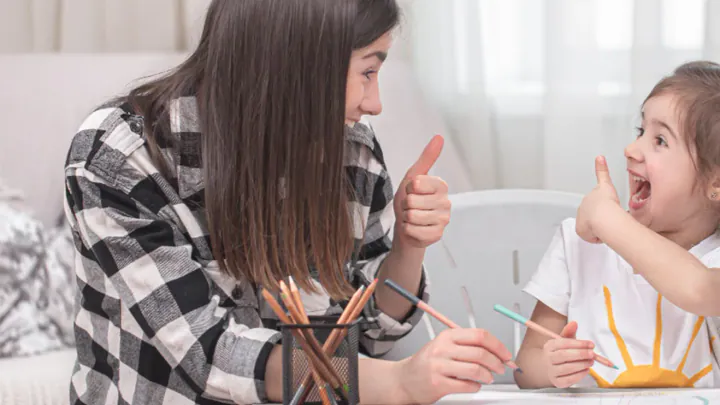
Serve and return is the back-and-forth exchange in which a child gestures, babbles or speaks, and an adult responds in kind, extending the exchange. It is the single highest-leverage practice in early childhood because it builds language, attention and attachment simultaneously, and it costs nothing.
A worked example. A three-year-old points at a puddle and says "big." A flashcard answer is "yes, B-I-G." A serve-and-return answer is: "It is big. Bigger than yesterday's one. Where do you think the water came from?" — then a pause long enough for an answer, then a follow-up. Five exchanges beat fifty labels. Length and reciprocity of conversation matter more than the vocabulary list you had in mind.
This is also why reading aloud outperforms educational apps at this age: the book is a prompt for dialogue. Stopping to ask what a character might be feeling does more than finishing the story on schedule. The same principle works at home over a meal — one reason we like the structure of simple sheet-pan dinners that get everyone at the table on weeknights, when the cooking is low-effort and the conversation is the point.
How much does early childhood education cost, and what are the trade-offs?
Center-based care is one of the largest line items in a young family's budget, and in many US metro areas full-time infant care rivals or exceeds in-state public college tuition. Costs fall sharply as children age out of infant ratios, and public pre-K or Head Start can remove the cost entirely for families who qualify.
Common arrangements, roughly from most to least expensive: full-day center care, licensed family child care in a provider's home, a nanny or nanny share, part-day cooperative preschool where parents staff shifts, and care by a relative supplemented with library story times and playgroups. Cooperatives deserve more attention than they get — the tuition is low because the labor is yours, and the parent education that comes with it is often excellent.
None of this is financial advice, but one practical habit helps: treat tuition, deposits and the summer-gap weeks as a planned expense rather than a surprise.
What are the most common and costly mistakes?
The expensive errors are rarely about curriculum. They are about pushing academics too early, outsourcing conversation to screens, and waiting on a developmental concern.
- Drilling letters with a child who is not interested. It buys a short-lived advantage and can sour a child on reading. Build the ear and the vocabulary first.
- Choosing a program by its building. New carpet and a smartboard predict nothing. Teacher tenure and warmth predict a lot.
- Over-scheduling. Three enrichment classes plus preschool usually produces a tired child and a shorter fuse. Boredom is where pretend play starts.
- Protecting children from every small frustration. The zipper they cannot manage today is the executive-function workout. Staging the environment for independence helps — low hooks, a bench, a bin at child height.
- Ignoring sleep. Short sleep looks exactly like inattention and defiance in a preschooler. Before you investigate a behavior problem, fix bedtime; adults running on fumes should fix their own sleep too, because a regulated adult is a prerequisite for a regulated child.
- Skimping on daylight. Morning outdoor time supports mood, circadian rhythm and physical development for children and caregivers alike, which is the same logic behind the ten-minute morning sunlight habit.
When should you ask for a developmental evaluation?
Ask at the first real concern, not after six months of waiting. In the United States, families can request a free evaluation through the state early intervention system before a child's third birthday, and through the local public school district from age three onward; a physician's referral is not required to make the request. Put the request in writing and keep a copy.
Concerns worth raising include very limited speech, loss of skills a child previously had, no pointing or shared attention, extreme difficulty with transitions, or a persistent gap between your child and same-age peers that a teacher also notices. Nothing here is a diagnosis, and a qualified pediatric clinician or developmental specialist should make that call — the point is that assessment is low-cost and delay is not.
One important qualifier: children learning two languages are not delayed by bilingualism. Total vocabulary across both languages is the fair measure, and mixing languages is normal development, not confusion.
Does early education really pay off later?
Yes for school readiness, and plausibly for long-run outcomes, but the honest version is more complicated than most articles admit. The classic intensive programs studied over decades showed durable benefits in schooling and adult life, and the economic argument that early investment outperforms later remediation is well established.
At the same time, researchers consistently observe convergence: the test-score gap between children who attended a program and those who did not often narrows within the first few elementary grades, and one large state pre-K study in the US found participants doing worse on some measures years later. The likely explanations are uneven program quality and what happens after — a strong pre-K year followed by a weak kindergarten does not compound.
The practical takeaway is not to skip preschool. It is that enrollment alone is not the intervention. Quality, continuity and the conversation happening at home are what carry forward. The habits that make focused work possible later in life start here too, which is the same thread we follow in our guide to focus rules that actually hold.
Key takeaways
- Early childhood education runs birth to age eight; the highest-value targets at three and four are oral language, executive function and phonological awareness — not early reading.
- Judge programs by teacher warmth, tenure, group size and how transitions are handled, not by decor, technology or philosophy label.
- Serve-and-return conversation is the highest-leverage free practice available to any family; length and reciprocity beat vocabulary drills.
- Request a developmental evaluation at the first genuine concern — it is free, needs no referral in the US, and waiting costs more than checking. Discuss concerns with a qualified professional.
- Research is clear on readiness gains but mixed on long-term test scores, so quality and what follows the program matter more than enrollment itself.
- Fix sleep, daylight and routine before you diagnose a behavior problem.
Frequently asked questions
What age range does early childhood education cover?
Early childhood education covers birth through age eight, which includes infant and toddler care, preschool at ages three and four, and the early elementary grades of kindergarten through second or third grade. Most people use the term loosely to mean preschool, but the developmental science treats the whole span as one continuous stage.
Is play-based learning better than academic preschool?
For most three- and four-year-olds, guided play-based learning produces at least as much academic gain as direct instruction and more gain in self-regulation, language and motivation. The key word is guided: adults set up the materials, join the play, and stretch the thinking. Unsupervised free play alone is not an early childhood curriculum.
How do I know if a preschool is high quality?
Watch the adults, not the decor. In a high-quality room, teachers are down at child height having back-and-forth conversations, transitions are calm rather than shouted, group sizes are small, and staff have been there for years. Low turnover and warm, responsive talk predict outcomes far better than bright walls or a technology package.
Does preschool actually help in the long run?
Quality early education reliably improves school readiness, and the strongest long-running programs have shown durable gains in graduation and life outcomes. But test-score advantages often narrow within a few years, and at least one large state program showed worse results for participants later on, so quality and continuity matter more than simple enrollment.
When should I ask about a developmental evaluation?
Ask as soon as you have a concern, not after a wait-and-see period. In the United States, families can request a free evaluation through the early intervention system before age three and through the local public school district after that, without a doctor's referral. Discuss any concerns with a qualified pediatric professional as well.
What can I do at home if I cannot afford preschool?
Talk with your child far more than you talk at them, read aloud daily, and let them do slow real tasks like pouring, sorting laundry and setting the table. Back-and-forth conversation, shared books, outdoor time and a predictable routine account for much of what quality programs deliver.
Should I delay kindergarten for a summer birthday?
There is no universal answer, and delaying is not automatically an advantage. Base the decision on observed self-regulation, language and stamina rather than birth date alone, and ask the child's current teacher what they actually see in a group setting.