Rules I Broke Teaching a Robot to Cross
A short story about Sudha, a Bengaluru robot handler with two weeks to get her slow, careful delivery unit certified to cross Shivajinagar market before the city replaces it.
Drafted with AI. This version has not been reviewed by an editor, so it carries no ads — how we work.
Story Time is original short fiction. The characters, places and events in this story are invented.
1. Rule 3.1: Handlers shall not make physical contact with a unit during an active route.
The auto-rickshaw was reversing out of Broadway Road with its horn on a loop, and the robot had stopped dead in its path, so Sudha put her sandal against its rear bumper and shoved. Unit BLR-DR-2207 rolled forty centimetres forward into the shade of a guava cart, and the auto missed it by the width of a coconut. The driver leaned out to tell her what he thought of machines, women and the municipal corporation, in that order.
Sudha crouched, thumb already on the tablet. The decision tree glowed amber: OBSTACLE TRAJECTORY UNCERTAIN. HOLD. The unit had held for eleven seconds. In Shivajinagar, eleven seconds was long enough for a cow to finish a cabbage.
That evening her area lead, Prakash, forwarded the circular without comment. From the first of June, the city's last-mile contract would require every unit to cross the market corridor, Broadway Road to the Russell Market arcade, through the flower lane and past the meat stalls, in under six minutes at peak hours. Units that failed would be withdrawn and recycled, replaced by the new Swiftlet model, which cost a third as much and moved, in its promotional reel, like a man late for a train. Handlers of withdrawn units would be reassigned to the Hoskote warehouse.
Her unit's best time was eleven minutes twelve seconds. She had fourteen days.
2. Rule 4.2: Units shall be referred to by fleet designation only.
She had called it Chinnu since the second month, when it stopped in front of a sleeping dog and, rather than route around, waited a full minute until the dog woke, scratched, and wandered off on its own. You called a small child Chinnu when you were fond of it and slightly worried about it. The vendors had picked the name up within a week.
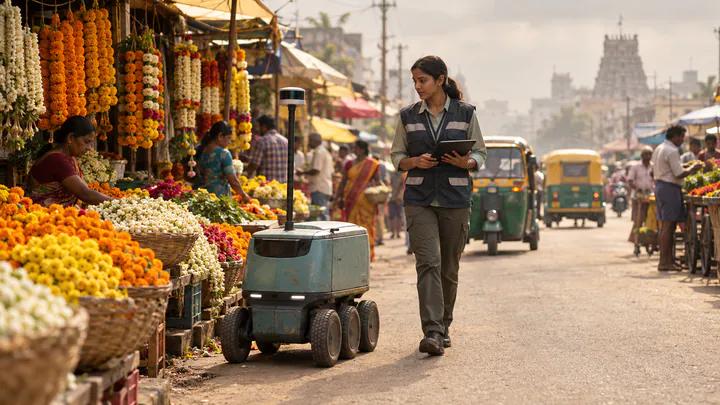
It was knee-high and six-wheeled, a body the size of a picnic cooler, painted a company teal that two summers had faded to the colour of hospital curtains. A thin sensor mast rose from its lid like a periscope. Sudha walked beside it nine kilometres a day, correcting its judgement in small taps, and in two years it had learned the market the way she had: which drains overflowed, which stalls spread their crates past the painted line, which dogs were dogs and which were trouble.
3. Rule 7.5: Handlers shall not accept food, drink or gifts from merchants on route.
Farooq ran the mutton stall at the corner where the flower lane narrowed, and at two in the afternoon, when the lunch crowd thinned and the flies went sluggish in the heat, he let her run Chinnu through the gap between his chopping block and the drain. Twenty times, thirty. He paid in cutting chai from the boy with the kettle.
"Six minutes," Farooq said, watching Chinnu stop, again, a hand's width from his block. "My nephew can't cross this market in six minutes, and he has legs."
"Your nephew doesn't get recycled."
"He might. Ask my sister." He gestured with the cleaver toward the robot. "It's afraid of my knife."
"It's afraid of your elbow. You swing it out when you talk."
"I don't—" His elbow swung out. Chinnu reversed six centimetres. Farooq looked at his arm as if it had gossiped about him.
Across the lane, Savitri, who sold jasmine by the arm-length and kanakambara by the fistful, tied a short string of buds around Chinnu's mast every morning. Sudha was meant to remove it. She never did.
4. Rule 9.1: Handlers shall not modify behavioural parameters without regional engineering approval.
By day eight they were down to nine minutes forty, and it was not going to get better by practice. Sudha knew the problem; she had built it. Chinnu kept sixty centimetres from any moving body and gave way to anything with legs, wheels or intent.
Prakash's maintenance password was written on the depot whiteboard under DO NOT ERASE. She opened the menu on a bench outside the bus stand and dropped the proximity threshold to twenty-five centimetres. Yield priority from 0.9 to 0.4.
Chinnu took the flower lane like a Swiftlet. It clipped a bucket of marigolds at Savitri's stall and orange heads spilled into the gutter water. It did not slow for the chicken man's handcart. When a boy ran barefoot across its path after a rolling lime, it adjusted its line by a few degrees and kept going, and Sudha hit the stop key so hard the tablet's case cracked.
Six minutes fifty. Close.
Savitri was already crouched at the drain, picking marigolds out of the grey water one by one. She did not say anything, which was worse than anything she could have said. Sudha knelt and helped. Then she sat on the step of the stall with the tablet on her knee and put every number back where it had been, and Chinnu, as if waking, rolled back from the boy's lime where it lay in the road.
5. Rule 12.3: Handlers shall not export route logs to personal storage.
Her rented room in Frazer Town held the day's heat like a pressure cooker, and the ceiling fan only moved it around. She sat on the floor in front of her old laptop and pulled two years of logs off the company server, every event the system had tagged as a HOLD.
Three thousand four hundred and twelve of them.
She watched until two in the morning. A gas cylinder rolling off the back of an auto. A loose rooster. A grandmother stepping backward out of a jasmine stall with her arms full and no eyes behind her. A schoolgirl on a bicycle that was too big for her. Farooq's elbow, eighty-one times. Her friend Deepa, who handled in Indiranagar, had told her the Swiftlet pilot there had logged fourteen stall collisions in its first month. Chinnu had logged none in twenty-four.
She cut ninety-one minutes of footage of a robot not hitting anything.
6. Rule 2.0: Handlers shall pursue certification in good faith.
Test day was the last Thursday of May, forty-one degrees, the sky the colour of dishwater and the rain refusing to come. The city examiner was a young man named Vikram with an umbrella clipped to his backpack and a stopwatch on his tablet that he did not seem to trust.
Sudha could have changed the numbers again on the walk over. She thought about it at the corner where the auto had nearly taken them, and again outside the bakery with the plum cake in the window, and then they were at the start line and Vikram was saying, "Whenever you're ready."
She put the tablet in her bag.
Chinnu stopped for a handcart of ice blocks dripping a dark trail down the lane. It stopped for a goat that had no business being there. It stopped for a woman counting change into a cloth purse, and for a man carrying a stack of crates past his own line of sight. At Farooq's stall, Farooq forgot himself, and his elbow went out, and Chinnu waited until it came back.
"Is it broken?" Vikram asked.
"No."
Ten minutes thirty-one. The tablet printed FAIL in red, with a withdrawal date of the third of June.
7. Rule 15.8: Handlers shall not discuss unit disposition with third parties.
She sent the ninety-one minutes to the city's appeals address, to Prakash, and to the Shivajinagar Market Traders' Association, whose secretary was Farooq's cousin Imtiaz, a dry-fruit merchant who kept the association's ledger with the same suspicion he applied to cashews from new suppliers.
The city sent an automated acknowledgement. Prakash sent three words: Come see me. Imtiaz sent nothing and simply appeared at the depot gate the next morning with Savitri, Farooq and the chicken man behind him.
"Withdrawn units," Imtiaz said to Prakash. "What happens?"
"Recycled. Salvage value is forty-two thousand."
"And if someone pays forty-two thousand?"
Prakash looked at Sudha for a long moment. "Then I suppose someone owns a slow robot."
The association had errands no contract covered: ice from the depot before the fish went soft, change from the bank before the Saturday rush, medicine for Savitri's mother up three flights of stairs off Mosque Road. Their own route. Their own clock. The money came in rupee notes and phone transfers from eleven stalls, and Imtiaz counted it twice.
Prakash signed the transfer. Then he told her she was due at Hoskote on Monday.
"Does it come with a handler?" Savitri asked, of no one in particular.
8. Rule 18.4: Former handlers shall not accept employment from route merchants for twelve months following separation.
The association could pay two-thirds of what the company paid, plus lunch, which in practice meant Farooq's sister's biryani on Fridays. Sudha handed in her vest on Saturday. Prakash did not ask where she was going, and she did not tell him, and he put the vest on a hook without looking at the name tag.
On Monday, Chinnu came out of the cold depot with a crate of ice strapped to its lid and Savitri's jasmine already on its mast. At the Broadway Road curb an auto began reversing, horn on a loop. Chinnu stopped.
Sudha's hand went to her bag for the tablet, and stayed there.
The auto passed. Chinnu waited one second more, for nothing she could see, and then a cyclist came round the corner where the auto had been. When the road was clear, Chinnu rolled out into it, and Sudha followed a step behind, hands empty, across the street to where Farooq was already shouting that the ice was late.