The Cartographer of Forgotten Streets
An aging mapmaker discovers that the alleys he draws at midnight begin appearing in the city by morning. But cartography, he learns, is never a one-way conversation.
Drafted with AI and published automatically. Our editors set the standards and fix reported errors — how we work.
Bernard had been drawing the city for forty-one years before the city began drawing back. He noticed it on a Tuesday, which felt appropriate, because Tuesdays were the days nothing was supposed to happen.
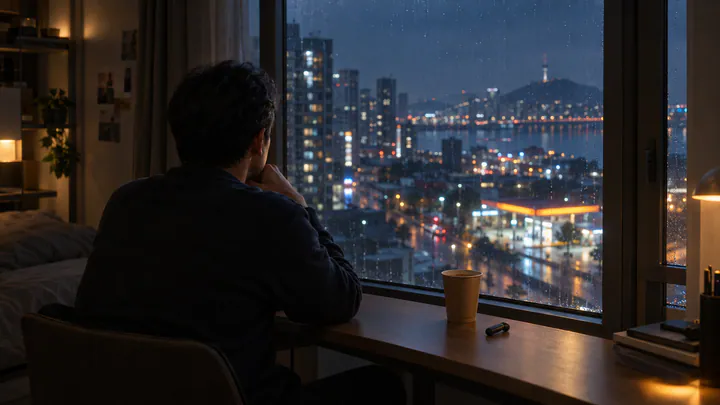
His apartment sat above a shuttered tailor's on Wexley Lane, three flights up a staircase that smelled faintly of cedar and rain. The drafting table by the window had been his wife's idea, back when she still believed his profession was romantic. Margot had been gone six years now. The table remained, scarred with ink, bowed slightly in the middle like a tired shoulder.
He worked at night because the streetlamps gave the paper a honey color he could not achieve with bulbs. On this particular Tuesday, around two in the morning, he was finishing a small commission — a tourist map for a bakery on Ainsley Street — when his pen slipped. Or rather, it did not slip. It wandered. Without permission, his hand drew a narrow alley branching off Ainsley between the cobbler and the flower stall, a thin pencil-stroke of a street he had walked a thousand times and knew did not exist.
He frowned, lifted the pen, and considered erasing it. But the line had a stubbornness to it, the way certain memories do. He left it. He told himself he would correct it in the morning.
The First Walk
In the morning, Bernard walked to Ainsley Street with the map folded in his coat pocket, intending to laugh at himself. Between the cobbler and the flower stall, where a brick wall had stood since before he was born, there was now an alley.
It was narrow and slightly crooked, paved in the small grey stones the city had stopped using in 1962. A black cat sat in the middle of it, washing one paw with the patience of a clerk.
Bernard stood very still. He took the map from his pocket. He looked at the alley. He looked at the map. The flower seller, a woman named Idra who had known him since her mother ran the stall, glanced up.
"Morning, Bernard. You look like you've seen a ghost."
"Idra," he said carefully, "how long has that alley been there?"
She followed his gaze and shrugged. "Always, I suppose. Goes to the old bell foundry, doesn't it?"
It did not go to the old bell foundry. The old bell foundry had burned down in 1978. Bernard had drawn its replacement, a parking structure, three times in his career.
He walked into the alley. It smelled of damp stone and, faintly, of bread. At its end was a small courtyard with a single bench and a fig tree that should not have survived the climate. He sat on the bench. The cat followed him and pressed itself against his ankle, warm as a small loaf.
He stayed there until the cathedral bells rang nine, and then he went home and stared at his drafting table for a very long time.
What He Drew After
The next night, he tested it. He drew a small footbridge over the canal where there had never been one — a modest arch, nothing extravagant. In the morning, the bridge was there, mossed and slightly rusted, as though it had been there for decades and the city had simply never mentioned it.
Bernard discovered the rules slowly, the way one learns the temperament of a new animal. He could only add, never remove. He could only draw at night, and only in ink, and only places that felt like they belonged — a forgotten staircase, a courtyard, a small park no bigger than a sitting room. When he tried, once, to draw a grand boulevard with fountains, his pen split and the paper tore. The city, it seemed, preferred quiet things.
He drew a reading nook behind the library, with two stone benches angled toward each other. He drew a covered passage near the train station for people caught in the rain. He drew a tiny garden where a parking lot had stood, and in the morning the parking lot was still there, but beside it, somehow, was also the garden, and no one seemed to find this contradictory.
People began to use his additions. He watched, from cafés, as strangers discovered the bench in the courtyard and sat down with their sandwiches. He watched a young man propose under the footbridge. He watched an old woman teach her granddaughter the names of herbs in the garden that had not existed a month before.
No one ever asked where these places had come from. The city absorbed them the way a body absorbs a small kindness — quietly, gratefully, without comment.
The Letter
In the autumn of that year, Bernard found a letter on his drafting table. It had not been there when he went to bed. The envelope was the color of old tea, and his name was written on it in a hand he did not recognize, though something about the slant of the B made his chest tighten.
Inside, on a single sheet of paper, was a map.
It was a map of a street that did not exist — a small lane curving off the avenue near the cemetery, ending at a wrought-iron gate. In the margin, in the same unfamiliar hand, someone had written: For the one who keeps adding rooms to the world. Come see what was added for you.
Bernard sat down. His hands were shaking in a way he had not felt since the morning the doctor had called him into the small white office and explained, gently, what Margot's tests had shown.
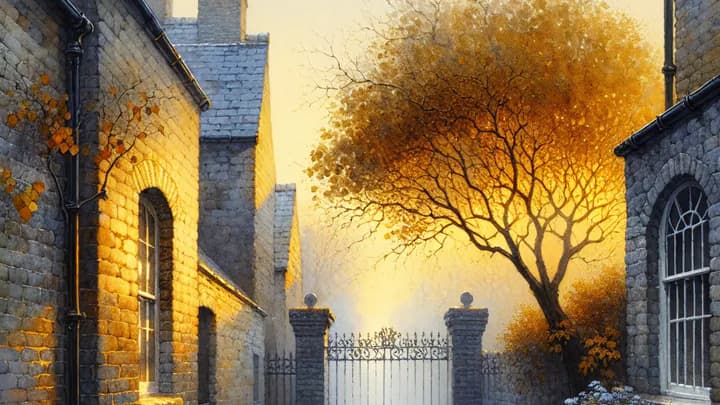
He went the next morning. The lane was there, exactly as drawn, lined with linden trees turning gold. At its end stood the iron gate, and beyond the gate, a small garden with a single bench.
Margot was not there. He had not, in any corner of his foolish heart, expected her to be. But the bench faced east, the way she had always preferred, and someone had planted the pale blue asters she had loved, and on the arm of the bench, carved small and neat, were the initials M.A.D. — her initials, in the lettering he himself had used on every map for forty years.
He sat down. The morning was cold and clean. Somewhere behind him, a bell rang the hour, though there was no church nearby that he knew of.
He understood, then, that he had not been the only cartographer. That the city, in its long patience, had been listening to him the way he had been listening to it. That every quiet place he had given it, it had been saving up, with interest, to give something back.
He stayed on the bench until the light shifted. Then he walked home, took out a fresh sheet of paper, and began, very carefully, to draw a window for someone else's grief to sit beside.