Found Items Nobody at the Baths Lost
A short story about a meticulous locker attendant at a Budapest thermal bath in 1974 whose lost-property ledger fills with unclaimed objects, every one of them from the same uneasy autumn.
Drafted with AI. This version has not been reviewed by an editor, so it carries no ads — how we work.
Story Time is original short fiction. The characters, places and events in this story are invented.
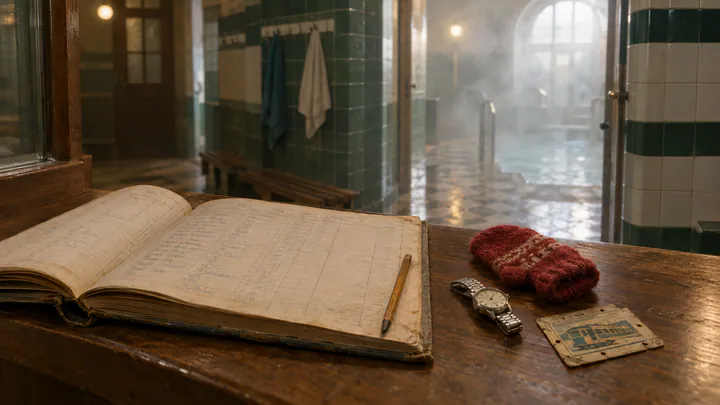
Ledger of Found Property, Women's Locker Corridor, Counter 2. Kept by Zsófia K., attendant. Entries in ink. Margin notes in pencil, which may be rubbed out.
Thursday, 3 January 1974. Item 1974/004. Tram pass, monthly, FVV, October 1956. Holder's name blotted out with ink. Found lying on the counter at 12:31 on my return from the canteen. Corridor empty except for Mrs Halmos drying her hair, who saw nothing, as she sees nothing every week. Disposition: held thirty days per regulations.
Margin: The punch holes stop on the twenty-second. Nobody rode the trams much after that for a while. That is not a thing to write in ink.
Thursday, 10 January 1974. Item 1974/011. Child's mitten, left hand, red wool, darned at the thumb with brown thread. On the counter at 12:28. No witness. Disposition: held.
Margin: Darned by someone who had run out of red. Asked Mrs Gombos whether a family had come through the corridor. She said children are not my department and why am I keeping single gloves in a box meant for umbrellas.
Thursday, 17 January 1974. Item 1974/019. Gentleman's wristwatch, steel case, cracked glass, engraved on the back: Gy. 1951. Hands stopped at ten past four. I wound it. It will not go. On the counter at 12:30. Disposition: held.
Margin: Mrs Gombos: "End of the month, the lot goes to the incinerator." I showed her section 7 of the regulations, thirty days from date of entry, and underlined it so she would not have to look for it. She lowered her voice, which she never does. "Zsófia. Those are from a year nobody looks up." Then she went to check the chlorine levels, though they were checked at nine.
Thursday, 24 January 1974. Item 1974/026. Lady's purse, brown leather, clasp bent. Contents: 3 forint 40 fillér in coins, none minted after 1956; one bath ticket stub, women's side, dated 2 November 1956. On the counter at 12:27. Disposition: held.
Margin: My mother says that in those first days of November people came here because the hot water still ran when the flats had none. I remember the hot water. I was twenty-six and worked at the button factory and did not come here; Rózsa néni had this counter then.
Margin, later: Went down to the boiler-room office after my shift. Third shelf, behind the chlorine forms, the incident book Mrs Gombos once told me does not exist. Rózsa néni's handwriting, all loops. 3 November 1956. Lockers 14 to 22 forced during the night. Reported missing: a monthly tram pass, Mrs Vörös. A child's red mitten, the Fekete girl. A gentleman's watch belonging to Mrs Szabó's husband, who had left it with her while he waited outside. A brown purse. A tortoiseshell comb. A blue silk headscarf. A wedding ring. Seven items. I have four.
I have copied the list into the back of this ledger. In pencil.
Thursday, 31 January 1974. Item 1974/033. Headscarf, blue silk, cigarette burn on one corner. On the counter at 12:26. Disposition: held.
Margin: They come while I am eating soup. Always between twelve and half past. Asked Irénke at the canteen who eats at noon on Thursdays. She ladled my paprika potato soup and said there is a grey man with a men's side ticket who has the same soup, pays in exact coins and leaves half. I asked what he looks like. "Like a man who leaves half." She wanted to know why I was asking. I said a towel had gone missing. She laughed and gave me an extra slice of sausage I had not asked for, which is how Irénke tells you she knows you are lying.
Thursday, 7 February 1974. Nothing handed in.
Margin: I did not go to the canteen. Sat behind the towel cart from noon until one. Nothing came. Mrs Gombos found me there and asked if I was unwell. I said I was counting towels. She looked at the stack, which I had counted twice, and said nothing.
At four she carried the box of held items to the incinerator door. At ten past four I carried it back. Neither of us mentioned it. The box is now under my counter, behind my handbag.
Thursday, 14 February 1974. Item 1974/041. Comb, tortoiseshell, two teeth missing. Handed in at 12:20, in person.
Margin: The ledger has no column for this, so I will write it here. I went to the canteen at noon as usual and let Irénke see me sit down. Then I left the soup and came back by the laundry stairs. He was at the counter with the comb in his hand, setting it down the way you set down something hot.
Grey coat, grey hair cut short, hands chapped red. I took him for sixty.
"It was left in a locker," he said.
"Which locker?"
"Eighteen." Then he heard himself. I had not told him any number.
I asked him to sit on the bench by the radiator, because his hands were shaking and the corridor was warm. He told it plainly, the way you read out a meter. November. Eleven years old. In through the coal chute behind the boilers. The brass locks on this corridor open with a hairpin; they still do, I have reported it twice. He sold what he could at the Teleki tér market for bread and lard. Some things no one would buy.
"The watch," he said. "I dropped it on the tiles when someone came in. It has been ten past four ever since."
The things he had sold, he had spent years buying back at the Ecseri flea market, Sunday after Sunday, from stalls that did not care where anything had been. The purse took him four years. The pass he found in a tin of postcards. "The ring I have never found."
He asked whether I would report him. I asked his age instead.
"Twenty-nine."
I put my pen down. He said, "Reformatory, then the mines at Tatabánya," as if that settled the arithmetic, and perhaps it did.
He began to tell me his name. I said, "Don't." Mrs Gombos reads this ledger on the last day of every month, and I would rather she read a gap than a name. He nodded, as if he had been expecting that answer for eighteen years, and went back to the men's side.
Thursday, 21 February 1974. Item 1974/048. Wedding ring, gold, worn thin, engraved inside: J. 1949. On the counter at 12:24. No note. Disposition: held.
Margin: So he found it. Irénke says the grey man finished his soup today and asked for bread to wipe the bowl.
Wrote seven postcards this week to the addresses in Rózsa néni's book. Plain cards, bathhouse stamp: Property belonging to you is being held at Counter 2, women's side. Please collect with identification. Nothing more. I did not write the year.
Thursday, 28 February 1974. Items 1974/004, 011, 019, 026, 033, 041, 048. Disposition: returned to owner. Ledger balances. Signed, Zsófia K.
Margin: Mrs Vörös died in 1969. Her son came for the tram pass and turned it over and over and asked who had inked out her name. I said it came to us that way.
The Fekete girl is thirty now and drives the number 4 tram. She took the mitten and laughed out loud in the corridor; her mother had smacked her for losing it and she had sworn for a week she hadn't. Her own two children were waiting by the turnstile in matching green hats.
Mrs Szabó came for the watch on Monday. She wound it, it did not go, and she said she would not have it repaired. She took the purse as well. It was hers too, it turns out; Rózsa néni had listed it without a name.
The scarf and the ring belonged to the same woman, on Csengery utca. She opened the door, looked at what I held out and said, "Finally," and nothing else, and closed it gently.
The comb I took on the number 6 to Rózsa néni herself, who is eighty-one and lives with her niece. It had been in her own locker that night; she had never written down her own loss. She put it in her hair at once, the gap where the teeth are missing at the back, where nobody sees.
Mrs Gombos initialled the page this afternoon. "There. It balances." She did not ask by whom. She looked for some time at the column headed Returned by, which I have left empty on all seven lines.
The regulations do not require it.