The Pigeon That Chose the Widow's Roof
A short story about a proud dovecote builder in a Nile Delta village whose champion pigeon, every contest season, comes down on the sagging roof of the widow next door.
Drafted with AI; reviewed by Azka Shahid on . How we work.
Story Time is original short fiction. The characters, places and events in this story are invented.
The year Mahrous finished his first great tower, he had to chase the widow's goat off the scaffolding before he could set the last jar in the crown. The goat had already eaten half the straw meant for the final course of mud. Mahrous threw a clod after it, pressed the jar into place, and stood up on the top ring with the whole of Kafr al-Abraj below his heels: the canal brown and slow, the clover so green you wanted to drink it, and every roof in the village lower than his feet.
They still begin the story with the goat, in Kafr al-Abraj, because the goat belonged to the widow Zeinab, and because everything that came after happened along the roof line between her house and his.
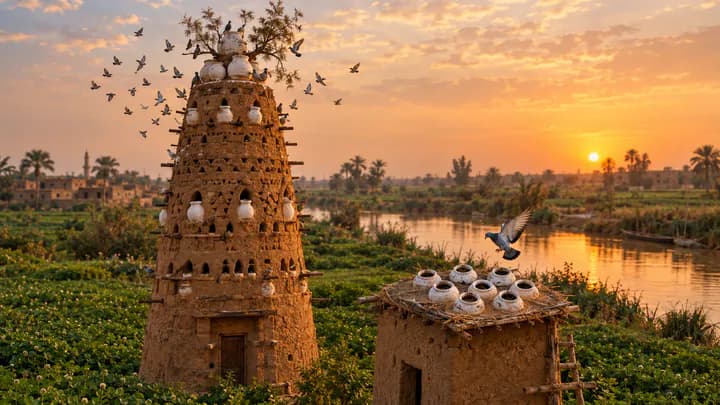
Mahrous built towers the way other men argued: loudly, and to win. His walls swelled at the base like a water jar, pinched to a waist, then flared again into a crown of upturned pots, each mouth ringed in whitewash so the birds could find it in the dusk. Tamarisk sticks bristled from the walls for perching. Men walked from three villages down the canal to measure his towers with knotted string and go home to copy them. He let them. A copy is a compliment that leaves the original standing.
Three hundred pigeons lived in that first tower, and one of them he had raised nearly from the shell: a blue-barred cock with a single white feather in each wing, like a scribe's mark. When the parents neglected him, Mahrous fed him crushed corn and soaked lentils from his own palm, and named him Sultan, because he walked as if the roof owed him rent.
Every year, after the cotton was picked, each keeper in Kafr al-Abraj chose twenty birds and handed them in reed cages to Hassanein, the omda's clerk, who drove them by cart to the iron bridge at the market town and let them go at the dawn call to prayer. At dusk Hassanein walked the lanes with a palm-rib tally stick and counted what came down on every roof. The tower with the most returning birds was crowned with a red cloth tied to its highest jar, and its keeper's name was said first at every wedding until the next cotton.
The rule was older than the omda's grandfather. A bird counts for the roof it lands on. The sky does not read a man's mark.
That first season Mahrous stood on his crown and counted them in himself. Fourteen, fifteen, eighteen, nineteen. Then Sultan, last and lovely, circled the tower twice with the sun behind him, tipped one wing, and came down on the widow's roof next door.
Zeinab's roost was hardly a tower. Her husband Abdelaal had set six old pots into a hump of mud on the roof's corner before he died, and propped a broken sieve over them against the sun. It sagged to the east like a tired donkey. Sultan settled on the sieve and began to preen.
Hassanein notched his stick. "Nineteen for Mahrous," he called up. "And one for Sitt Zeinab."
The miller's tower had twenty. Mahrous said, to the whole lane, "If that bird had come down where he belongs—"
Below, Zeinab was taking washing off a rope. She did not look up. "He came down where he wanted," she said, and folded a shirt.
Mahrous built higher. Over the next years his tower grew a second crown above the first, then a gallery of perches that made it look like a porcupine at prayer. He painted ochre rings around the pot mouths. He mixed his clay with canal mud from the deep bend, where the buffalo did not wade, because it dried harder. Men stopped copying his towers; they could not afford to.
He tried every trick a keeper knows. He shut Sultan's hen in the tower the week of the contest so the cock would hurry home to her. He rubbed anise on his landing ledge. He fasted the birds a day, so they would race for his corn.
Sultan came home each year, and each year he came home to the sieve on Zeinab's roof, sat there long enough for Hassanein to notch his stick, then hopped the gap to his own tower and his hen as if nothing had happened.
The fourth year of it, Mahrous went next door. Zeinab was patting dough on the oven floor, her sleeves pinned back.
"What do you put on that roof?" he said. "Salt? Anise? I won't tell anyone."
"I put nothing on that roof. I can barely put anything in this oven." She slapped a round onto the hot clay. "Abdelaal used to say a bird remembers the first roof that was kind to it."
"My roof hatched him."
She looked at him then, a long, flat look, the way a woman looks at a man who has told her the price of onions she has bought every week of her life. "Did it," she said, and turned the bread.
He did not ask what she meant. He was a man who counted his birds every night, three hundred, and was sure of the number.
By the time his beard was more salt than pepper, they called his tower the Minaret of Mahrous, and people giving directions in the market town said past the bridge, until you see it. His son Gaber did the climbing now. Mahrous's knees complained on the first rung and made speeches by the tenth.
He wanted the red cloth before he could no longer climb up and tie it himself. He said this to no one, which is how everyone knew.
Sultan was old as well. That season he came in last of all the birds in the village, so late the lamps were lit and Hassanein had to squint. He flew low, labouring, and came down on Zeinab's sieve as if it were the only flat place left in the world.
Zeinab was sitting in her doorway shelling beans. Mahrous sat on the step beside hers, which he had not done in twenty years.
"The first summer," she said, without being asked, "there was a wind that came out of the desert and took the sieve clean off this roof. It took a squab off your crown too. He fell into my courtyard with his feathers still in their pins. I kept him overnight in a basket by the oven and gave him bread I'd chewed, and before light I climbed up and put him on your ledge." She split a pod with her thumbnail. "You counted three hundred that night as well. I heard you."
Mahrous opened his mouth and found nothing in it.
"Two white feathers," she said. "Like a scribe's mark."
That winter it rained in the Delta, the heavy kind that comes once in a while to remind the mud-brick what it is made of. When it stopped, half of Zeinab's roost had slid into the lane. Three of Abdelaal's pots lay broken by her door, and the sieve hung by a corner like a torn ear.
Gaber stood in the lane with his hands on his hips. "This year," he said, "he has nowhere to land over there. This year he has to come to you." He was a good son. He said it gently, as if handing his father a gift.
Mahrous looked at the broken pots a long time.
The next morning he had Gaber cart mud from the deep bend of the canal, the good mud, and straw, and a little dung to bind it. He took seven jars from the stack he had been saving for a third crown, the best he had ever fired, smooth as a cheek. Then he went next door and set his ladder against the widow's wall.
Zeinab came out wiping her hands. "Your knees," she said.
"My knees have climbed worse roofs than yours."
"Not for a long time."
"Then hold the ladder, and stop counting them for me."
It took him two days. He scraped Abdelaal's slumped hump back to firm brick, laid a new bed of clay, and set his seven jars into it, mouths to the west where the birds come in. He pushed in three tamarisk perches and ringed each pot mouth in whitewash with a rag wrapped round his finger. He did not add ochre. He mended the sieve with palm fibre and propped it where it had always been, a little crooked, because that was how Sultan knew it. When he came down, his hands were grey to the wrist and his knees had said everything they had to say.
On the day of the contest Mahrous did not climb his tower. He sat on his own flat roof with a cushion behind his back and a jug of water beside him, and Gaber stood on the crown above to count.
The birds came in as the light went copper over the clover. His were quick and clean that year: one, then four, then a rush of eleven, then the stragglers. Nineteen. Gaber called each number down to him.
Sultan came last, as he had the year before, so low that his wingbeats could be heard. He passed over the Minaret of Mahrous, over the red-thread hopes of every keeper on the lane, and dropped onto the widow's roof. He chose the middle jar of the seven, the one whose whitewash Mahrous had gone over twice, and folded himself into its mouth.
Hassanein came round the corner with his tally stick. "Nineteen for Mahrous," he called. "And one for Sitt Zeinab."
In her doorway, Zeinab put her bowl of beans down on the step.
Mahrous drank some water. Then he pressed his grey thumb against the edge of his own roof and made one small mark in the dried mud there, beside nothing, for her count, so that someone on this side of the wall would have it right.