Forty Minutes Before the Narva Platform
A short story about a strict ticket inspector on the last train east from Tallinn, a boy with no ticket and a forged letter, and forty minutes to decide what she saw.
Drafted with AI and published automatically. Our editors set the standards and fix reported errors — how we work.
Story Time is original short fiction. The characters, places and events in this story are invented.
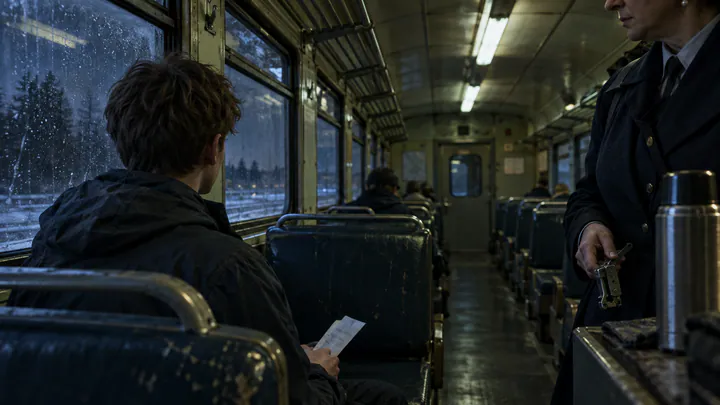
Kadri's clipper bit through the first ticket out of Jõhvi at fourteen minutes past ten, and at the back of the second carriage a boy put his hand flat over a folded paper as if the draught might take it.
There were five other passengers. Two women with string bags of cabbage, a conscript asleep with his beret over his face, the old man who boarded at Jõhvi every Thursday and paid in coins he had counted on the platform. And the boy, who had not been in this carriage at Rakvere. She knew because she had walked it at Rakvere. She walked every carriage at every stop. That was the whole of her method, and it had kept her book clean for thirty-one years.
Sleet slid sideways across the black windows. The fluorescent tube over the boy's seat had flickered since September; she had written it up three times.
“Pilet,” she said, and when he only looked at her, “Bilet.”
Fifteen, perhaps. A jacket too thin for November, the zip broken and held with a safety pin. Hands red to the wrist. He unfolded the paper and held it up with both hands, the way a child holds up a drawing.
The top three lines were typed. The rest was ballpoint. To the conductor. Please permit the minor Artyom Belov, born 1988, to travel unaccompanied to Narva, where he will be received by his mother, L. V. Belova, of Ivangorod. A director's signature, a children's home on a street in Lasnamäe. And a stamp: a circle with the lettering inside it drawn by hand, the ink sunk into the paper in a way no stamp pad had ever managed. In the Estonian line at the bottom, lubatud had two b's.
Narva at 22:54. Forty minutes. At Narva the border guards came aboard the last train, as they had since spring, and sat at the table in the front carriage while people filed past with their documents. A boy with no ticket and a drawn stamp would be with the juvenile inspector by midnight and back in Lasnamäe by morning.
“Who wrote this?” Kadri asked in Russian.
“The director.”
“The director can't spell lubatud.”
He didn't blink. “The director is Russian.”
Which was true of half the directors in Lasnamäe. She kept her face still. She was good at that; passengers said so, not kindly.
In the vestibule between carriages the floor shook loose under her boots and the cold came up through the coupling. She unscrewed her thermos and poured rosehip tea into the lid. Sour and red, the way her mother had made it. Two years and four months to her pension. The flat in Mustamäe was paid off. Nobody had ever written her up for anything.
The rule was simple. No ticket, no valid document: fare plus fine, and hand the person to the police at the terminus. She had handed over students, drunks, a priest once. She had never decided whether any of them deserved it. That was the point of a rule; it decided for you.
22:21. She went back in.
He was eating a heel of black bread out of his pocket, small bites, making it last. She sat down opposite him, which she did not do with passengers, and held out the thermos lid.
He looked at it a long moment before he took it.
“Where in Ivangorod?”
“Gagarina nine. Flat fourteen. Fourth floor, the door is blue, there's no number on it because my uncle took it off to fix it and never put it back.”
Too fast, she thought. Or exactly as fast as a boy who'd stood outside that door. “Why doesn't she come and get you?”
“No visa. No money for a visa.” He blew on the tea. “Nothing.”
“And you? What have you got?”
He took a grey passport from inside his jacket. The alien's passport, stateless, the kind half of Narva carried. No Russian visa in it. She turned the pages to be sure and he watched her do it without hope.
“So you can't cross the bridge.”
“I'm not crossing the bridge.”
The train swung through a cutting and the lights dimmed and came back. The conscript muttered in his sleep.
“Then how?”
He looked at the window, at his own reflection with the sleet running through it. “Uncle Gena meets me at the station. He has a boat. He knows the river.”
The Narva in November, black and fast below the dam, slush gathering at the edges. Kadri had grown up two streets from it. Every winter someone went in.
“Is Gena your mother's brother?”
A pause. The first real one. “He's her friend.”
“How much is Gena's friendship costing?”
He didn't answer that, and the not answering was the truest thing he'd said.
22:33. Vaivara behind them. The railway had given her a mobile phone in the spring, heavy as a brick, for emergencies. She took it out of her bag.
“Your mother's number.”
He said it without stopping to think, the Russian code and seven digits, the way you say a number you have dialled from a phone box with frozen fingers. She keyed it in. It rang. It rang a long time.
“Allo?” A woman's voice, low and thick. Sleep, or a cold, or something from a bottle. Kadri couldn't tell.
“Lyudmila Belova?”
“Who is this?” Then, sharper: “Is it Tyoma? Is something—has he—he wasn't supposed to—”
The cutting near Sirgala took the signal. Three falling tones.
Kadri looked at the phone. He wasn't supposed to. Supposed to come? Supposed to come yet? Supposed to call from the station, not from a stranger's phone? Supposed to stay where he was?
“What did she say?” The boy had both hands around the thermos lid. “Was it her?”
“Someone who knows your name,” Kadri said.
“It was her.” He leaned forward. “What did she say?”
“She asked if you were all right.” Which was nearly true, and she disliked herself for how easily it came out.
He sat back. For a moment he looked about eleven.
“Why did you leave?” she asked. “Not the home. Before the home.”
He pulled his left cuff down over his wrist. He did it the way you scratch an itch, without noticing. She had already noticed. She had noticed when he took the lid.
“It's better at the home,” he said. “It's not the home. I just want to go where she is.”
Every answer fitted. Every answer made the next question harder to ask. If she wanted proof she would not get it before Narva; she would not get it at all. She would get a boy and a boat and a black river, or a boy and a desk and a juvenile inspector, and she would get to choose which, and then go home and sleep.
22:46. The first lights of Narva came up out of the sleet, the chimneys of the power plant, the tower of the castle lit orange, and across the river, close enough to throw a stone at, the dark bulk of the Ivangorod fortress with a few windows burning behind it.
The boy was looking at it. Everyone who rode this line looked at it.
Kadri opened her ticket book on her knee. She wrote Tallinn–Narva. She wrote the date. In the fare box she wrote the full adult fare, ninety-eight kroons, because a boy who travels alone with a letter travels as an adult, and she was not going to have anyone say she had shaded it.
“I don't have money,” he said quietly.
“I know.”
She took her purse out of her coat. A hundred-kroon note, folded twice. She put it into the leather fare bag at her hip and took two kroons back out and returned them to her purse, as she would for anyone. Then she tore the ticket along its perforation, set it in the jaws of the clipper, and punched it. The small sound, the small circle of paper falling to the floor.
“There,” she said. “Now you're a passenger.”
He took the ticket. Something loosened in his shoulders. He glanced toward the door at the end of the carriage, toward the platform, toward Gena.
“Get your bag,” Kadri said, and stood.
He stood too, and when she turned him by the elbow toward the front of the train instead of the door, she felt him understand it through his sleeve.
“You said I was a passenger.”
“You are. You paid. Passengers show their documents.” She held out her hand for the letter, and after a moment he gave it to her. She folded the ticket inside it, so that it would be the first thing anyone saw. “The doors stay locked until the platform. You know that.”
“They'll send me back.”
“Maybe.” The brakes began to take hold, a long iron complaint under the floor. “I'm going to stand there while they read it. All of it. I'll tell them you paid your fare, and I'll tell them what your mother said on the phone, and I'll tell them about your wrist.”
He pulled his cuff down again. This time he knew he was doing it.
“You don't have to do that,” he said.
“I know what I have to do. I've been doing it thirty-one years.”
She opened the connecting door. The cold came in hard, sleet on the coupling plates, the black gap of track sliding beneath. She went first so he could see where to step, and held the far door with her shoulder until he was through. Through the glass of the front carriage she could see the platform lights sliding up, and under the canopy two men in green uniforms stamping their boots, waiting for the train to stop.
Kadri tightened her grip on the letter, and on his sleeve, and walked him toward the table.