The Used Bookshop on Elm Has a Cat
When Pilar inherits her uncle's failing bookshop, she expects dust and debt. She does not expect the cat, who only naps on books their next owner is looking for.
Drafted with AI and published automatically. Our editors set the standards and fix reported errors — how we work.
The lawyer warned Pilar about the leaking roof, the back-tax notices, and the smell of mildew, but nobody warned her about the cat.
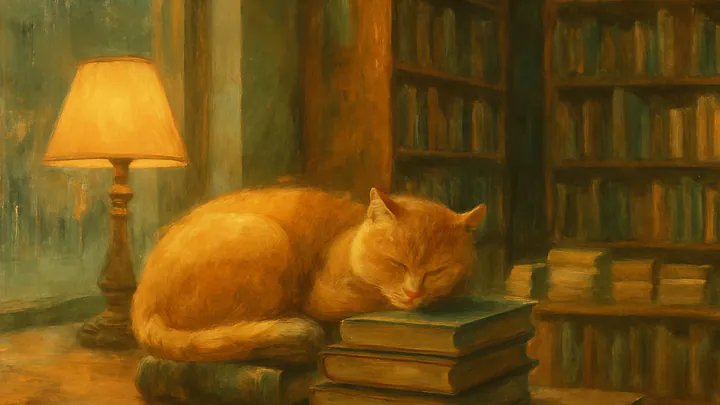
She found him on the second afternoon, after she had finished crying in the stockroom and started crying in the front window instead. He was asleep on a copy of A Field Guide to Northern Mosses, his orange flank rising and falling like he had a contract with the book and intended to honor it.
"You're not on the inventory," Pilar told him.
The cat opened one eye, decided she was furniture, and went back to sleep.
Her uncle Teo had run Elm Street Books for thirty-one years. Pilar had visited every summer until she was twelve and then, for reasons she could no longer remember and now bitterly regretted, she had stopped. The funeral had been small. The inheritance was smaller: a building the bank half-owned, a stock of secondhand books no algorithm could price, and, apparently, a cat.
She named him Mosses, because that was where she had found him, and because she was too tired to be clever.
The First Customer
The bell over the door was the only thing in the shop that still sounded confident. It rang on Thursday morning, and a woman in a damp raincoat came in shaking water off her sleeves.
"Just browsing," she said, the way people do when they want to be left alone.
Pilar nodded and pretended to dust. The woman wandered the poetry shelf, then biography, then drifted toward the back, where Mosses had relocated to sleep on top of a thin blue book Pilar had not noticed before. The woman stopped.
"Oh," she said softly. "Oh, may I—?"
Mosses, who normally objected to being moved with the indignation of a small deposed king, stood, stretched, and walked off the book of his own accord. The woman picked it up with both hands. It was a slim volume of letters by a poet Pilar had never heard of.
"My mother read this to me," the woman said. Her eyes had gone glassy. "I've been looking for this exact edition for eleven years. The cover. The font. I tried everywhere."
Pilar, who had been about to quote her the sticker price of four dollars, found herself saying, "Then it was waiting for you."
The woman paid in cash and left holding the book against her coat like a child. Mosses watched her go and then climbed onto a 1978 atlas and fell asleep on Madagascar.
A Pattern, If You Squint
By the end of the second week, Pilar had a theory she was embarrassed to say out loud.
A teenager came in looking, he claimed, for nothing. Mosses was sleeping on a battered paperback about long-distance hiking. The teenager picked it up, flipped to a dog-eared page, and sat down on the floor to read the whole first chapter without breathing. He bought it with crumpled bills and asked if she had anything else like it. She did, three shelves over. He bought those too.
A man in a suit came in to use the restroom and left with a cookbook from a country he hadn't visited since he was nine. Mosses had been asleep on the cover.
A woman came in looking for a gift for her sister, with whom she had not spoken in four years. Mosses was on a slender novel about two siblings on a train. The woman read the back and started to cry quietly into the K-L fiction shelf. Pilar handed her a tissue and rang her up.
That night Pilar sat on the stockroom floor with Mosses heavy in her lap and a glass of cheap wine in her hand.
"How do you do it," she asked him.
Mosses purred like an idling truck and did not explain himself.
The Ledger
She found her uncle's ledger in the office drawer, behind a tin of cough drops. It was not a ledger of money. Teo had kept the money in a coffee can; the bank had told her so.
This was a ledger of customers. Names, dates, books. Beside each entry, in Teo's careful pencil, a single word or two. Grief. First child. Lost father. Wants to be brave. Going home.
Pilar turned to the back. The last entry was from three days before her uncle died. It said: Pilar. Inheritance. Doesn't know yet.
Beside it, in the column where the book title should have gone, he had written: This one.
She closed the ledger. She opened it again. This one.
She walked out into the shop. Mosses was awake for once, sitting on the counter with his tail wrapped around his feet, watching her with the patient expression of someone who had been waiting for her to catch up.
"Where, then," she said.
He hopped down. He walked, with the unhurried dignity of a creature who knew the floor plan better than she did, to the very back corner of the shop, behind the gardening section, where a low shelf held books nobody ever looked at. He climbed onto the second shelf from the bottom and lay down on a hardcover with a faded green spine.
Pilar knelt. She slid the book out from under him. He allowed it.
How to Stay, the title read. The author's name had worn off. Inside the front cover, in her uncle's handwriting: For the one who comes back.
She sat down on the floor between the gardening books and the cat and opened it.
It was not a magical book. It was a perfectly ordinary book about the small habits of running a small business in a small town: how to greet a regular, how to price a paperback, how to know when to close early because the weather had turned and people needed to be home. It had been written, she guessed, in the 1970s by someone who had loved their work the way her uncle had loved his.
On the last page, in pencil, in Teo's hand: The cat isn't magic. He just pays attention. So can you.
Pilar laughed out loud, the first real laugh in a month. Mosses opened one eye, judged the laugh acceptable, and closed it again.
What She Decided
She did not save the shop right away. The roof still leaked, and the bank still wrote letters in firm blue ink. But she stayed. She learned the regulars' names. She started her own column in the ledger. She wrote, beside each customer, the word she thought belonged to them — homesick, restless, in love badly, in love well — and she watched, and she paid attention, and slowly she began to know which book to put in which hand before they asked.
Sometimes Mosses still chose for her. Sometimes she chose for him. They disagreed about as often as colleagues do.
On the door, beside the hours, she taped a small card she had hand-lettered one slow Tuesday. It read: The used bookshop on Elm has a cat. He is not for sale. Neither are we.
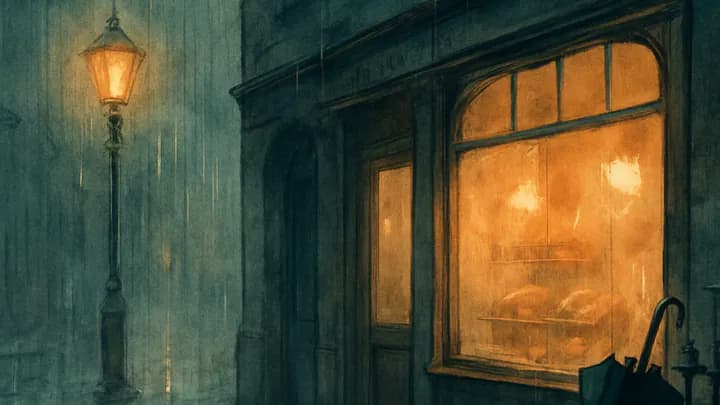
The bell rang. Someone came in out of the rain. Pilar looked up, and Mosses, already awake, was already walking toward the shelf where the next right book was waiting.