Gut Health in 2026: What Actually Works, and What Doesn't
Gut health in 2026 comes down to plant variety, a realistic fiber target, a few servings of real fermented food each week, and steady sleep. Here is what holds up, what to skip, what to do when fiber backfires, and when symptoms need a clinician.
Drafted with AI; reviewed by Najam Kausar on . How we work.
TL;DR: Gut health in 2026 still comes down to unglamorous basics: many different plants each week, a gradual climb to roughly 25–38 grams of fiber a day, real fermented food a few times a week, steady sleep, and daily movement. Skip the test kits and cleanses. Most people feel a difference in two to four weeks.
Gut health has become one of the most commercialized corners of wellness, and the noise has outpaced the evidence. This guide separates the principles that hold up from the products that do not, and gives you numbers and decision rules rather than vague encouragement.
What exactly is "gut health," and what does it include?
Gut health is a shorthand term covering two related things: day-to-day digestive comfort and the state of the gut microbiome. Digestive comfort means regularity, absence of pain or excessive bloating, and how food sits with you. The microbiome is the community of bacteria, fungi, viruses, and other microbes living mostly in your large intestine.
Those microbes ferment fiber you cannot digest yourself, producing short-chain fatty acids such as butyrate that nourish the cells lining the colon. They also synthesize some vitamin K and several B vitamins, and they exchange constant signals with your immune system. A microbiome that is more diverse and richer in fiber-fermenting species is generally associated with better health outcomes, though causation runs in both directions.
Worth naming plainly: there is no validated definition of a "perfect" microbiome. Healthy people in different regions carry very different microbial profiles. Anyone selling you a score against an ideal is selling a number, not a diagnosis.
How can you tell whether your gut needs attention?
Track patterns rather than a score: bloating that builds through the day, irregular stools, reflux, food reactions that come and go, and energy dips after meals. Anywhere from three bowel movements a day to three a week can be normal for a healthy adult; what matters is whether yours are comfortable, predictable, and stable.
Before changing anything, keep a two-week log of meals, symptoms, sleep, and stress. Without that baseline, there is no way to tell whether a change helped or whether you simply had a calm fortnight.
How does the gut-brain axis work, and what can't it do?
The gut and brain communicate through the vagus nerve, circulating hormones, and immune signaling — the gut-brain axis. That pathway explains why stress can trigger cramping or urgency, and why chronic digestive problems often travel alongside low mood. What it does not do is make diet a treatment for mental illness.
Treat gut-focused habits as one supportive lever. If anxiety or depression is the primary problem, the primary care belongs with a qualified mental health professional. Fiber and kefir are not substitutes for therapy or medication.
How much fiber do you actually need, and how fast should you add it?
General US guidance is about 25 grams a day for adult women and about 38 grams for adult men, or roughly 14 grams per 1,000 calories. Most adults eat far less. The practical rule: add about 5 grams per day each week until you reach your target, and raise water intake alongside it.
Adding 20 grams overnight reliably produces gas and bloating. That is your microbes adapting, not damage — but it is also the single most common reason people abandon a fiber goal in week one.
| Food | Serving | Fiber (approx.) |
|---|---|---|
| Cooked lentils | 1 cup | 15 g |
| Chia seeds | 1 oz (2 tbsp) | 10 g |
| Black beans | 1/2 cup cooked | 7–8 g |
| Raspberries | 1 cup | 8 g |
| Medium pear with skin | 1 fruit | 5–6 g |
| Rolled oats | 1/2 cup dry | 4 g |
| Broccoli | 1 cup cooked | 5 g |
Notice the pattern: legumes and seeds do the heavy lifting. A cup of lentils in a soup moves you further than three servings of low-fiber vegetables.
How much water goes with more fiber?
US reference intakes put total daily water at roughly 2.7 liters for women and 3.7 liters for men, and that total includes water from food, which typically supplies about a fifth of it. Coffee and tea count toward it. The more useful signal is urine color: pale straw is fine, consistently dark means drink more. Fiber needs water to form soft, bulky stool, so adding fiber without fluid can trade one problem for another.
How do you eat 30 different plants a week without counting?
The "30 plants a week" target comes from microbiome research linking plant variety to microbial diversity. You do not need to track it — you need to change how you shop. Herbs, spices, nuts, seeds, and whole grains all count as separate plants, which makes the number far easier than it sounds.
A worked example for one ordinary week: oats, chia, blueberries, walnuts (4). Lentil soup with carrot, celery, onion, garlic, thyme, bay leaf (10). A sheet-pan dinner of chicken with broccoli, red pepper, red onion, potato, olive oil, paprika, oregano (17). Chickpea salad with cucumber, tomato, parsley, lemon, olives, feta-free but with sunflower seeds (24). Rye toast, peanut butter, banana, kimchi with cabbage and chili, brown rice (30). That is five repeatable meals, not thirty shopping decisions.
If weeknight cooking is your bottleneck, a sheet-pan dinner is a fast way to stack four or five plants into one tray without planning.
Which fermented foods count, and how often should you eat them?
Live-culture fermented foods — yogurt with live and active cultures, kefir, sauerkraut, kimchi, miso, tempeh, traditional brined pickles — are worth three to five small servings a week. A spoonful of sauerkraut or half a cup of kefir is enough; volume is not the point, consistency is.
The label check matters more than most people realize. Shelf-stable pickles in vinegar are not fermented. Pasteurized sauerkraut in the center aisle has no live cultures. Miso boiled hard in soup loses much of its microbial content, though the fermentation compounds remain. Kombucha varies wildly and some bottles carry a meaningful sugar load, so read the panel.
Prebiotic foods matter as much as probiotic ones, because they feed the bacteria you already have. Garlic, onion, leek, asparagus, slightly underripe banana, oats, and cooled cooked potato or rice all supply fermentable fiber.
What should you be skeptical of in 2026?
Be skeptical of anything that sells a shortcut around food. The gut-health market has expanded much faster than the evidence supporting it, and several popular categories deliver little for the money.
| Approach | Evidence strength | Typical cost | Our verdict |
|---|---|---|---|
| Wide plant variety | Strong and consistent | Grocery budget only | Start here |
| Gradual fiber increase | Strong | Low | Second priority |
| Fermented foods weekly | Promising, low risk | Low | Easy win |
| Probiotic supplements | Strain- and condition-specific | Moderate to high, ongoing | Only with a clinical reason |
| At-home microbiome test kits | Immature; poor reproducibility | High, one-off | Skip for now |
| Cleanses and detox protocols | No credible support | Moderate to high | Skip |
| Self-directed elimination diets | Useful short-term, risky long-term | Low cost, high nutrition risk | Only with a dietitian |
One more category deserves naming: influencer symptom checklists. A list of forty vague symptoms that supposedly prove "leaky gut" is a marketing funnel, not a diagnostic tool. Intestinal permeability is a real, actively researched phenomenon — but it is a finding in specific conditions, not a self-diagnosable syndrome with a supplement solution.
If a clinician does recommend a probiotic, look for a named strain designation on the label rather than a big CFU count: research benefits are tied to specific strains, not to "50 billion CFU, 12 strains." Most strains pass through rather than colonizing, so the effect stops when the product does. Digestive enzymes help mainly with a diagnosed deficiency such as lactose intolerance or pancreatic insufficiency, and evidence for L-glutamine as "gut lining repair" is thin outside specific clinical settings.
What if fiber and fermented foods make your symptoms worse?
This is the edge case generic guides skip. For a meaningful minority of people — particularly those with irritable bowel syndrome — the exact foods recommended above are the trigger foods, because beans, onions, garlic, wheat, and some fruits are high in fermentable carbohydrates (FODMAPs).
A clear decision rule: if you have raised fiber slowly, drunk enough water, and given it three to four weeks, and bloating or pain is worse rather than settling, stop scaling up and get assessed. Do not simply push harder.
A supervised low-FODMAP trial is a diagnostic tool with three phases — restriction, structured reintroduction, and personalization — and it is meant to last weeks, not years. The most common costly mistake is people stopping at phase one, staying restricted indefinitely, losing plant variety, and ending up with a narrower diet and an unresolved diagnosis. Get celiac disease ruled out before cutting gluten, because testing requires that you are still eating it.
This section also does not apply if you have an active inflammatory bowel disease flare, gastroparesis, a recent bowel surgery, or a diagnosed stricture. In those situations, fiber advice must come from your treating team, not an article.
How much do sleep, movement, and stress really matter?
More than most food-focused guides admit. Short sleep and irregular sleep timing are associated with changes in gut function and appetite regulation, and stress measurably alters gut motility — which is why reflux, urgency, and bloating so often spike in a bad week at work.
If your digestion is unpredictable, audit sleep before you audit supplements. Our guides to resetting sleep hygiene and recovering accumulated sleep debt cover the mechanics, and a ten-minute morning sunlight habit is the cheapest way to stabilize sleep timing.
For movement, the goal is regularity rather than intensity. A daily walk after dinner helps motility; easy aerobic work a few times a week, such as zone 2 cardio, is sustainable and does not leave you too depleted to cook.
A 10–20 minute walk after meals is one of the most reliable low-cost options for post-meal bloating and sluggish transit. Very hard, prolonged endurance sessions are the exception: they can trigger gut symptoms rather than relieve them.
On stress, choose the practice you will actually repeat. Formal meditation works for some people; walking, gardening, prayer, journaling, or putting the phone away an hour earlier work for others. Adherence beats method.
For people with IBS, gut-directed behavioral therapies such as cognitive behavioral therapy or gut-focused hypnotherapy have reasonable evidence behind them.
What does a realistic week look like?
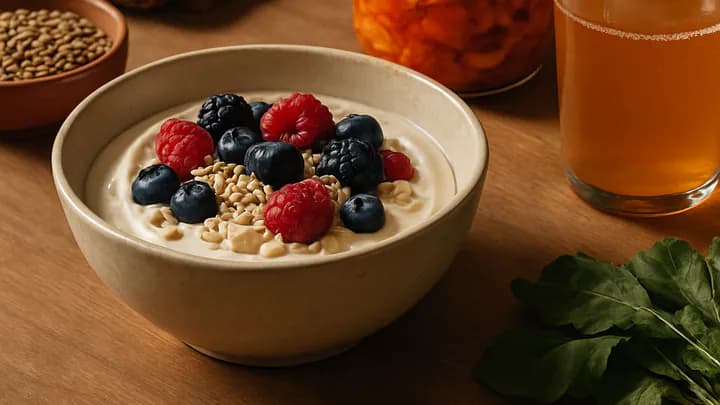
- Breakfast anchor: one fiber-forward default most days — oats with berries and seeds, beans on whole-grain toast, or yogurt with fruit and nuts.
- Lunch and dinner: half the plate vegetables or fruit, a quarter whole grains or starchy plants, a quarter protein — with legumes filling that protein slot several times a week.
- Fermented touch: a spoonful of kimchi or sauerkraut, or a cup of kefir, three to five times weekly.
- Hydration: water as the default drink, especially on the weeks you are adding fiber.
- Movement: a daily walk plus two or three sessions of something you genuinely enjoy.
- Wind-down: a consistent sleep window with dimmed screens in the last hour.
When should you stop self-managing and see a professional?
Book an appointment promptly for any of these: unexplained weight loss, blood in the stool or black stools, persistent diarrhea or constipation, severe or ongoing abdominal pain, difficulty swallowing, iron-deficiency anemia, symptoms that wake you from sleep, or a family history of colorectal cancer or inflammatory bowel disease. New or changing bowel symptoms after age 45 also warrant evaluation rather than a diet experiment.
A gastroenterologist or registered dietitian can distinguish between IBS, celiac disease, lactose intolerance, reflux, and conditions that need imaging or endoscopy. Social media pattern-matching rarely shortens that path, and sometimes lengthens it by months.
Editorial disclosure: this article is for general educational purposes and does not constitute medical advice, diagnosis, or treatment. Nutrition and microbiome science continue to evolve, and individual needs differ. Please consult a qualified healthcare professional — a physician or registered dietitian — before making significant changes to your diet, exercise, sleep, or supplement routine, particularly if you have a chronic condition, are pregnant, or take prescription medications.
Key takeaways
- Plant variety is the strongest lever available: rotate what you buy, and count herbs, spices, nuts, seeds, and grains toward the total.
- Aim for roughly 25–38 grams of fiber daily, adding about 5 grams per week with extra water — legumes and seeds move the number fastest.
- Three to five small servings of genuinely fermented food per week is a low-cost habit; check for live cultures on the label.
- If symptoms worsen after several weeks of more fiber, stop escalating and get assessed — that pattern can indicate IBS, and elimination diets belong under supervision.
- Test kits, cleanses, and one-size-fits-all probiotics are where most gut-health money is wasted.
- Sleep, movement, and stress shape digestion as much as the plate does; audit them first when things go off.
Frequently asked questions
How long does it take to improve gut health?
Most people notice digestive changes within two to four weeks of eating more fiber, adding fermented foods, and keeping meal times consistent. Measurable shifts in the microbiome generally take several months of steady habits, and they partly revert if the diet reverts.
Do I need to take a probiotic supplement?
Most healthy adults do not. Food sources like yogurt with live cultures, kefir, kimchi, and sauerkraut supply beneficial microbes at lower cost, and probiotic evidence is strain-specific rather than general. Talk with a clinician before starting supplements, especially if you are immunocompromised, pregnant, or taking prescription medications.
How much fiber should I eat per day?
General US guidance is roughly 25 grams a day for adult women and around 38 grams for adult men, or about 14 grams per 1,000 calories eaten. Most adults in high-income countries fall well short. Increase by about 5 grams a week rather than all at once.
What foods are hardest on the gut?
Frequent ultra-processed foods high in added sugars, refined oils, and emulsifiers tend to be the most disruptive, along with heavy alcohol use and a persistently low-fiber diet. The issue is usually the overall pattern across a week, not a single meal.
Is bloating always a sign of a gut problem?
No. Occasional bloating is normal and often relates to swallowed air, a large high-fiber meal, hormonal shifts, or eating quickly. Persistent bloating, pain, or a lasting change in bowel habits deserves evaluation by a qualified healthcare provider.
Are at-home microbiome tests worth the money?
For most people, no. The science linking a single stool snapshot to personalized food recommendations is still immature, results can vary between kits and between samples from the same person, and the reports rarely change what a dietitian would advise anyway.
What should I do about my gut after a course of antibiotics?
Return to normal eating as soon as you can tolerate it, emphasizing fiber-rich plants and fermented foods, and give it several weeks. Antibiotics are sometimes essential, so the goal is recovery, not avoidance. Contact your prescriber if diarrhea is severe, bloody, or persists after the course ends.
Can gut health really affect mood?
Research supports a two-way gut-brain connection, but improving your diet is not a treatment for anxiety or depression. Better fiber intake, regular meals, and consistent sleep support overall well-being; mental health conditions need care from a qualified professional.