
Intermittent Fasting in 2026: Benefits, Risks, Who It Fits
Intermittent fasting is a scheduling tool, not a metabolic shortcut. Here is what the evidence supports, which window suits which life, the protein mistake that quietly costs you muscle, and the people who should not try it at all.
Rewritten with AI and republished automatically. Our editors set the standards and fix reported errors — how we work.
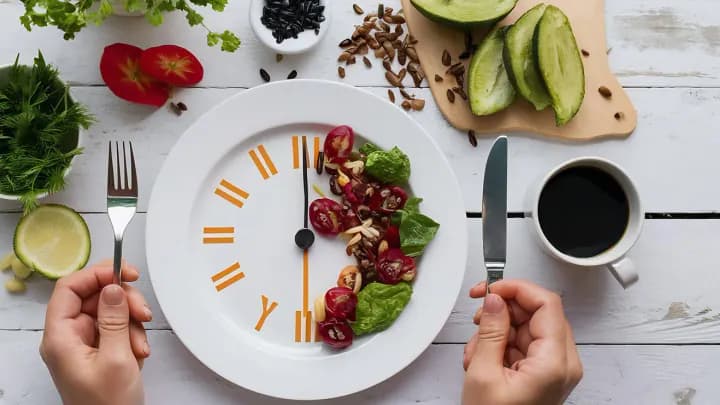
TL;DR: Intermittent fasting is a scheduling tool that helps many people eat less without counting calories, and may modestly improve blood sugar and blood lipids. It is not metabolically magic: with calories matched, it performs about like ordinary dieting. Choose it if structure suits you, skip it if food rules stress you out.
What is intermittent fasting, exactly?
Intermittent fasting is an eating pattern that restricts when you eat rather than what you eat, alternating defined fasting windows with defined eating windows. The most common version, time-restricted eating, simply compresses all food into a daily window of eight to ten hours.
It is not a diet in the traditional sense. There is no banned food list, no macronutrient rule, no points. That simplicity is the whole appeal — and also the reason it fails for people who use the window as permission to eat badly inside it.
The main families are worth naming clearly, because people use "fasting" to mean wildly different things: daily time-restricted eating, whole-day modified fasts such as 5:2, and alternate-day fasting. Their evidence bases and their difficulty levels are not the same.
What does intermittent fasting actually do in the body?
During a fast, insulin falls, the body leans more on stored fat for fuel, and glycogen gradually depletes. Longer fasts raise circulating ketones and catecholamines such as norepinephrine, which is why some people report alertness rather than fatigue after a few weeks of adaptation.
The claims that hold up reasonably well in human research are improved insulin sensitivity, modest reductions in triglycerides and blood pressure, and weight loss driven mostly by reduced total intake. The claims that get oversold are dramatic metabolic rate increases and precise autophagy timelines.
Autophagy — the cell's process of clearing damaged components — is genuinely important biology. But the vast majority of the timing claims circulating online come from animal or cell studies, and measuring autophagy in living humans is hard. Treat it as a plausible side benefit, not a countdown clock.
Which fasting schedule should I choose?
Pick the gentlest schedule that still produces a change in how much you eat. Most people do best on 14:10 or 16:8; the aggressive protocols have higher dropout rates and rarely deliver proportionally more benefit.
| Protocol | What it means | Best for | Main downside |
|---|---|---|---|
| 12:12 | 12-hour fast, 12-hour eating window | Absolute beginners; anyone who snacks late at night | Often too easy to change intake at all |
| 14:10 | 14-hour fast, 10-hour window | Sustainable long-term default for most adults | Requires skipping either late snacks or early breakfast |
| 16:8 | 16-hour fast, 8-hour window | People who are not hungry in the morning; fat-loss phases | Two meals may not cover protein needs |
| 5:2 | Five normal days, two days of about 500–600 calories | People who prefer normal days over daily restriction | Low-calorie days can be genuinely miserable and unproductive |
| Alternate-day | Fast or very low intake every other day | Short, supervised interventions | High dropout; poor fit with social and family meals |
| 24-hour fast | One full day without food, once or twice weekly | Experienced fasters with no metabolic conditions | Risk of rebound overeating; unsuitable on medication |
Does the timing of the window matter?
It appears to. Evidence increasingly favors early time-restricted eating — a window that opens around 8 a.m. and closes by 6 p.m. — over a late window that runs from 2 p.m. to 10 p.m. Human glucose tolerance is better earlier in the day, and eating close to bedtime tends to degrade sleep quality.
That is the single most overlooked adjustment. Two people can both do 16:8 and get different results purely because one eats dinner at 5:30 and the other at 9:45. If you are pairing fasting with a morning sunlight habit, an early window reinforces the same circadian signal.
Is intermittent fasting better than just counting calories?
When calories and protein are held equal, no — outcomes look broadly similar. Trials comparing time-restricted eating with standard calorie reduction generally find comparable weight loss. The honest framing is that fasting is a delivery mechanism for eating less, not an alternative to it.
That is not a knock. Adherence is the variable that decides diets, and for a large group of people "don't eat after 7 p.m." is far easier to obey than "log everything." If a rule about time removes 300 calories a day of unconscious grazing, it worked.
The decision rule we use: if you have tried tracking and hated it, fasting is worth a genuine eight-week trial. If you already track comfortably and hit your targets, fasting adds structure but probably not results.
What is the most costly mistake people make when fasting?
Under-eating protein. Compressing three meals into two usually removes an entire protein serving from the day, and sustained low protein during weight loss means more of that loss comes from lean tissue. The scale moves; body composition quietly gets worse.
A workable target for most adults aiming to preserve muscle is roughly 1.6 grams of protein per kilogram of body weight per day, split across the meals inside the window. For a 70 kg person that is about 112 grams — genuinely hard to hit in two small meals and easy to miss entirely if lunch is a salad.
Two more mistakes deserve naming. The first is breaking a fast on refined carbohydrates alone, which produces a hunger rebound within the hour and is the classic week-two dropout trigger. The second is stacking fasting with a hard training block and poor sleep; if you are already carrying accumulated sleep debt, adding fasting stress rarely ends well.
Who should not try intermittent fasting?
Intermittent fasting is not appropriate during pregnancy or breastfeeding, for anyone with a current or past eating disorder, for children and adolescents, or for people who are underweight or frail. Anyone taking insulin, sulfonylureas, or other glucose-lowering medication faces real hypoglycemia risk and should not fast without medical supervision.
It also deserves caution if you have a history of gallstones, are recovering from surgery or illness, or take medication that must be dosed with food. Please consult a qualified healthcare professional before changing your eating pattern, especially if any of the above applies.
An honest caveat rarely stated in fasting articles: if food rules make you anxious, if you find yourself calculating hours obsessively, or if the window triggers binge behavior when it opens, this tool is the wrong tool for you. That is not a failure of willpower. Some approaches simply suit some nervous systems.
How do I start without feeling terrible for two weeks?
Start at 12:12 and move the window by 30 minutes per week until you reach 14:10 or 16:8. Most of the misery people associate with fasting comes from jumping straight to a 16-hour fast on day one.
- Close the kitchen first. Cutting post-dinner snacking is usually where the real calorie change happens.
- Hydrate and salt lightly. Headaches in the first week are often fluid and sodium related, not hunger.
- Keep black coffee, plain tea, and water. They do not meaningfully break the fast for weight or glucose purposes.
- Break the fast with protein and fiber. Eggs and vegetables, yogurt and berries, lentils, fish and salad.
- Give it eight weeks. Two weeks tells you about adaptation; eight tells you about results.
Worked example: a realistic 16:8 day
Window 10 a.m. to 6 p.m. First meal: three eggs, spinach, whole-grain toast, Greek yogurt with berries — roughly 45 g protein. Mid-window: cottage cheese and an apple, about 25 g. Dinner at 5:30: salmon, lentils, roasted vegetables, olive oil, about 45 g. Total near 115 g protein, high fiber, finished three hours before bed. That is a day that works. A day of coffee until 2 p.m., a sandwich, and a 9 p.m. takeaway is technically 16:8 and delivers almost nothing.
What habits make fasting work better?
Fasting compounds with three other things: resistance training, aerobic base work, and sleep. Muscle is what protects your metabolic rate during weight loss, and steady aerobic work improves the same insulin sensitivity markers fasting targets.
Our practical stack is two or three resistance sessions a week, a couple of easy Zone 2 cardio sessions, a consistent sleep schedule, and an eating window that closes early. Fiber and fermented foods inside the window support the same goals covered in our practical gut health guide. If meal prep is the bottleneck, a rotation of fast, balanced sheet-pan dinners makes an early dinner realistic on weeknights.
How do I know whether it is working?
Judge it on four signals over eight weeks: body weight trend, waist measurement, energy and concentration during the fasting hours, and whether you can hold the pattern socially. If three of the four are positive, keep going.
If you are tracking blood markers with your doctor, fasting glucose, HbA1c, triglycerides, and blood pressure are the reasonable places to look. Do not chase daily scale readings; fasting shifts glycogen and water weight early, which flatters the first week and disappoints the third.
Stop and reassess if you develop persistent dizziness, poor sleep, cycle disruption, hair shedding, declining training performance, or rising preoccupation with food. Those are signals, not obstacles to push through.
Key takeaways
- Intermittent fasting is a timing framework that helps many people eat less without tracking — not a metabolic shortcut that beats calorie control when both are matched.
- An early window that closes by early evening tends to outperform a late one for glucose control and sleep.
- Protect protein: aim for roughly 1.6 g per kilogram of body weight inside the window, or widen the window rather than lose lean mass.
- Break the fast with protein and fiber; refined carbohydrates alone cause the hunger rebound that ends most attempts in week two.
- It is unsuitable during pregnancy or breastfeeding, with a history of disordered eating, or alongside glucose-lowering medication without supervision — speak with a qualified clinician first.
- Give any protocol eight weeks, and judge it on waist, energy, and sustainability rather than the daily scale.
Frequently asked questions
Does intermittent fasting burn more fat than regular dieting?
Not meaningfully, when calories and protein are matched. Head-to-head trials of time-restricted eating versus standard calorie reduction tend to show similar weight loss. Fasting wins when the shorter window makes you eat less without tracking, which for many people it does. That is a behavioral advantage, not a metabolic one.
Does black coffee break a fast?
No. Black coffee, plain tea, and water do not meaningfully interrupt a fast for weight or glucose purposes. Adding milk, cream, sugar, or a splash of oat milk adds calories and a small insulin response. If your goal is simply eating less overall, a splash of milk is a rounding error. If you are fasting for glucose control, keep it black.
How long do I need to fast for autophagy?
Nobody can give you an honest number. Autophagy is a real cellular recycling process, but most of the timing data comes from animal and cell studies, and measuring it in living humans is difficult. Treat autophagy as a plausible bonus, not the reason you fast.
Is 16:8 safe to do every day?
For most healthy adults, yes, provided the eating window supplies enough calories, protein, fiber, and micronutrients. It is not appropriate during pregnancy or breastfeeding, with a history of disordered eating, for people who are underweight, or for anyone on insulin or sulfonylureas without medical supervision. Check with a qualified clinician before starting.
Will intermittent fasting make me lose muscle?
It can, if protein intake drops. Compressing meals often means one fewer protein serving per day. Aim for roughly 1.6 grams of protein per kilogram of body weight spread across two or three meals inside the window, and keep resistance training in the routine. If you cannot hit that target, widen the window rather than accept the deficit.
Is fasting different for women?
It can be. Some women report cycle changes, poor sleep, or heightened hunger with aggressive windows, particularly when training hard or eating too little. A gentler 12:12 or 14:10 pattern with adequate calories is a more sensible starting point, and any menstrual disruption is a signal to stop and consult a clinician.
What should I eat to break a fast?
Start with protein plus fiber and something with volume: eggs and vegetables, Greek yogurt with fruit, lentils, or fish and salad. Breaking a fast with refined carbohydrates alone produces a fast blood sugar rise and a hunger rebound an hour later, which is the single most common reason people abandon fasting in week two.
Can shift workers use intermittent fasting?
Yes, but eat during your active hours rather than forcing an early window. A night worker who eats at 3 a.m. is fighting circadian biology either way; the practical goal is a consistent window that does not fragment sleep. Anchor the last meal at least two to three hours before your main sleep block.