The Beekeeper Who Listened to Letters
On a hillside of clover and clover-bees, an old beekeeper opens the season's mail by holding each envelope to the hive and waiting for what hums back.
Drafted with AI and published automatically. Our editors set the standards and fix reported errors — how we work.
The first letter of the season arrived on a Tuesday, and Odile carried it up the hill in her apron pocket like a warm stone. She had not opened an envelope indoors for forty-one years. Indoors, paper only told you what the writer wished you to know. Outside, near the hives, paper told the truth.
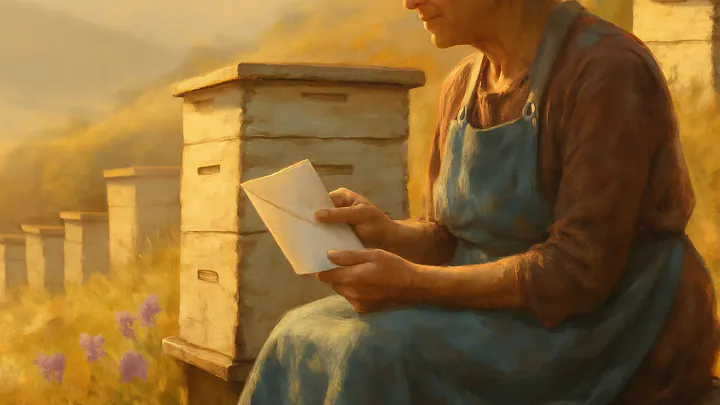
The hives sat in a crooked row along the south slope, six white boxes leaning slightly downhill as if listening to the valley. Clover grew thick around their legs. Odile set her tin of smoker fuel on the stump she used as a table, sat on the upturned crate she used as a chair, and held the envelope flat against the wood of the nearest hive.
She waited.
The hum began low — the ordinary drone of bees about their business — and then narrowed, the way a choir narrows when it finds a single note. The pitch rose, steadied, and split into something braided. Odile closed her eyes. After forty-one years she did not need to translate. The hum entered her chest and arranged itself into meaning the way rain arranges itself into puddles: without being asked, and exactly where the ground allowed.
A daughter writing to her mother. Apology on the surface. Underneath: a request for money she has not yet decided to make. Underneath that: love, the kind that has been folded so many times it has worn through at the creases.
Odile opened her eyes. She slit the envelope with her thumbnail and read the letter, which was addressed to her sister Mireille in the village below. The words on the page said only what the daughter had allowed them to say. But Odile already knew what to tell Mireille when she walked the letter down at dusk: Read it twice. Answer in the morning. She is not asking yet. She is practicing the asking.
It had started by accident, the way most useful things do. Odile had been a postwoman in the years when the route still required a bicycle and a dog who hated the bicycle. When her knees gave out, she retired to the hillside cottage her aunt had left her, inherited the hives along with the kettle and the cracked blue bowl, and learned beekeeping from a book and from being stung.
One spring she had carried a letter up the hill without thinking — a condolence card she meant to send to a friend whose husband had died — and she had set it on the hive while she lit the smoker. The bees, who had been quarrelsome that morning, went quiet. Then they hummed. And Odile, who had carried other people's words on her back for thirty years, understood every layer of what the card meant to say and what it failed to say. She rewrote the card that evening at her kitchen table and sent the new version. Her friend wrote back, months later: Yours was the only letter that found me.
After that, Odile began bringing letters up the hill on purpose. Her own, at first. Then her sister's. Then, slowly, by quiet village arrangement, the letters of anyone who asked. People left envelopes in the wooden box at her gate with a coin tucked inside, or a jar of pickles, or nothing at all. Odile carried each one up to the hives, listened, and walked back down with a small piece of paper folded inside the envelope: What it means. What to do. She never kept copies. She never told anyone what she had heard about anyone else.
The village called her, when it called her anything, la dame aux abeilles. The bees, she suspected, called her nothing at all. They had their own business, and she was simply a warm shape that sometimes brought paper.
The Letter That Would Not Hum
It came in August, when the lavender was past its best and the bees were short-tempered with the heat. A plain white envelope, no return address, addressed in a careful hand to a name Odile did not recognize: Monsieur Tomas Berre, care of Odile Vasseur.
She turned it over twice. Care of meant the writer expected her to pass it on. But there was no Tomas Berre in the village, nor in the next village, nor in any of the villages whose letters she had read over the years. She would have remembered. Names settled in her the way bee stings settled — they left a small permanent mark.
She carried the envelope up the hill anyway.
She sat on the crate. She held the letter against the wood. The bees hummed their ordinary hum, the going-about-business hum, the not-listening hum. She waited longer. She moved to the second hive, and the third. She held the envelope to each in turn. The bees hummed about clover and about a fox who had passed in the night and about the queen of the fourth hive, who was old and would need replacing. They hummed about nothing that had to do with the letter in her hand.
The paper was silent.
Odile sat very still. In forty-one years no letter had refused her. Cruel letters had hummed. Lying letters had hummed — lying letters were among the loudest, the bees making a sound like a kettle just before it boiled. Empty letters, with nothing inside but a blank page, had hummed the loneliness of the sender. Even letters written by the dead, found in attics and brought to her in trembling hands, had given up some small last vibration.
This letter said nothing because it had nothing to say to her.
She understood, slowly, sitting on her crate with the sun pressing on the back of her neck, what that meant. The letter was not for the bees to read. It was not for her to interpret. It was simply a letter, addressed to a man she did not know, asking her to do the one thing she had stopped doing forty-one years ago: carry it.
She slid the envelope into her apron pocket. She walked back down the hill.
It took her eleven days to find Tomas Berre. He lived in a town two valleys over, in a room above a shop that sold nothing in particular. He was perhaps sixty, thin, with hands that had once done careful work and now mostly held cups of tea. When Odile gave him the envelope he looked at the handwriting and sat down on the stairs.
"From my brother," he said. "I haven't — we haven't —" He stopped. "How did you know to bring it?"
"I didn't," Odile said. "The bees told me they didn't know."
He looked up at her. She could see him deciding whether she was mad.
"Read it inside," she said. "Read it twice. Answer in the morning."
She walked back to the bus, and to the train, and to the long road home. The hives, when she reached them at dusk, were settling for the night, humming their low evening hum about nothing in particular. She sat on her crate for a while in the cooling air and listened to them not needing her.
It was, she thought, the kindest thing they had ever said.