The Apartment That Rearranged Itself
When Wren moves into the cheap top-floor flat, the rooms refuse to stay where she puts them. The walls, it turns out, have opinions about loneliness.
Drafted with AI and published automatically. Our editors set the standards and fix reported errors — how we work.
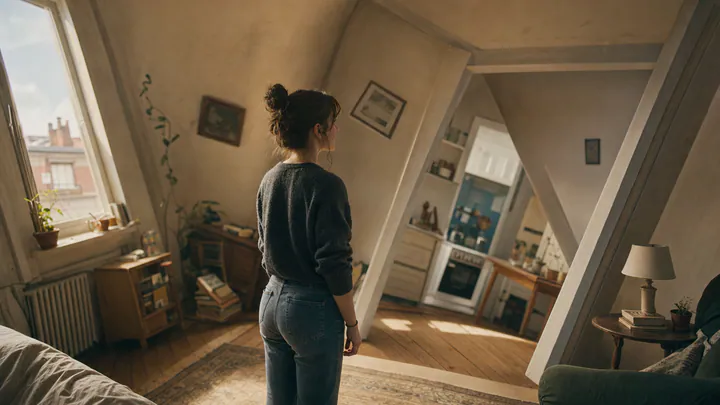
On her first night in the flat, Wren went to bed with the kitchen on her left and woke up with it on her right. She lay very still under the duvet, watching morning light come through a window that had definitely been over the radiator yesterday, and considered the possibility that she had finally, comprehensively lost it.
She got up. She made tea. The kettle was where she'd left it, at least; the kettle seemed to be a fixed point. She drank the tea standing in the middle of the living room, turning slowly, like a compass needle that had lost faith in north.
The estate agent had described the flat as full of character. Wren had assumed that meant damp.
It happened again on Tuesday. She came home from her shift at the print shop, kicked off her shoes by the door, and found that the door now opened directly into the bedroom. The hallway had become a small, apologetic alcove with a coat hook in it. Her shoes sat neatly on a mat that had not existed that morning.
"All right," she said out loud, to no one. "All right. We can do this. People have weirder commutes."
She called her sister Pen, who was three hours behind and unsympathetic.
"You're tired," said Pen. "You moved cities. You don't know anyone. Your brain is doing brain things."
"My brain didn't move the bathroom."
"Your brain absolutely moved the bathroom. That's a classic brain move."
Wren hung up and stood in the middle of her shifting flat and listened. The building hummed, the way old buildings do, with pipes and pigeons and the distant shuffle of other lives. Below her, someone was practicing scales on a clarinet, badly. Above her — but there was nothing above her. She was the top floor. The roof was the roof.
And yet, just then, she could have sworn she heard footsteps overhead. Light, considered footsteps, like someone deciding where to put a chair.
By the end of the week, she had a theory.
The flat moved when she was unhappy. Not dramatically unhappy — she wasn't, in fairness, dramatically anything — but on the nights she came home heavy with the small grey weight of having spoken to no one all day, the rooms shuffled themselves by morning. The kitchen drifted toward the bed when she'd skipped dinner. The bathtub edged closer to the window when she'd cried in it. Once, after a particularly bleak Sunday, she woke to find the living room had grown an entire extra armchair, plump and floral and facing hers across the rug, as if waiting for someone to sit in it.
She sat in it herself, just to be fair. It was very comfortable.
"Thank you," she said to the ceiling, feeling foolish. "That's kind."
The ceiling, reasonably, said nothing.
She met Mr. Aldama on the stairs. He was the caretaker, a small wiry man with a tool belt and the watchful patience of someone who had been listening to a building for forty years.
"Settling in?" he asked.
"The flat," Wren said carefully, "is very characterful."
Mr. Aldama's eyebrows lifted by a fraction of a millimeter. "Ah," he said. "It's doing it to you too, then."
She nearly dropped her shopping. "You knew?"
"I've known for a long time." He set down his toolbox and sat on the step. "It started after Mrs. Ferreira died, up in your flat. Lived there fifty-one years. Husband, then no husband. Children, then grown children. Friends, then fewer friends. By the end, it was just her and the rooms, and the rooms loved her very much."
"Walls don't love people," Wren said, without conviction.
"These ones learned," said Mr. Aldama. "She talked to them. Named the corners. Apologized when she bumped the doorframe. Fifty-one years of that does something." He shrugged. "When she went, the flat got lonely. It's been trying to take care of whoever moves in. Most people don't notice. Or they notice and move out."
"It moved my kitchen."
"It thought you'd like more light in the morning."
Wren sat down on the step beside him. The clarinet, two floors down, was attempting a scale in a key it had not been introduced to.
"What do I do?" she said.
Mr. Aldama considered this seriously, as if she had asked him about a leak. "Talk to it," he said. "Tell it what you want. It's been guessing. It's quite good at guessing, but it would rather know."
So Wren went home and talked to her flat.
She felt ridiculous, at first. She stood in the middle of the living room and said, "Hello. I'm Wren. Thank you for the armchair." Then, because she had started, she kept going. She told the flat about the print shop and the smell of warm paper, about Pen and the three-hour gap, about the boy she had not quite been brave enough to stay in love with, about the way her chest sometimes felt like a held breath she'd forgotten how to release.
She told it she wanted the kitchen to stay put, please, because she liked routine. She told it she didn't need an extra armchair, but she did need a place to put her books. She told it she was going to try, this year, to be the kind of person who invited people over.
The flat listened. She could feel it listening — the particular quality of silence a room has when it's paying attention.
In the morning, the kitchen was where she'd left it. A shelf had appeared along the long wall, exactly book-deep. The extra armchair was gone. In its place was a small round table with two chairs, set as if for tea.
It took her three weeks to invite anyone over. The girl from the print shop, Halmi, who laughed too loud at her own jokes and brought a bottle of something fizzy and pink. They sat at the small round table and ate noodles out of mismatched bowls, and Halmi said the flat had such good energy, and Wren said yes, it did, didn't it.
After Halmi left, Wren stood at the window and watched the city do its evening shuffle of lit windows and hurrying coats. The flat was quiet around her, settled, content in the way of a cat that has been fed and noticed.
"Goodnight," she said to the corners.
The corners, very slightly, seemed to bow.
She did not wake up to find the kitchen had moved. She woke up to find a square of sunlight on the foot of her bed, exactly where she liked it, and a single new hook by the door, at the perfect height for a second coat.