Power Dressing 2026: Redefining Authority Attire at Work
Power dressing has shed the shoulder pads and the rulebook. What still signals authority in 2026 is fit, fabric weight, contrast and consistency — and most of that is decided by a tailor, not a label.
Rewritten with AI and republished automatically. Our editors set the standards and fix reported errors — how we work.
TL;DR: Power dressing in 2026 is not about suits or shoulder pads. Authority now comes from fit, fabric weight, color contrast and consistency. Buy fewer, better pieces, spend the difference on a tailor, choose textiles that behave on camera, and dress one clear step above your room's baseline.
What does power dressing actually mean in 2026?
Power dressing is a way of assembling clothing — structured shoulders, clean lines, deliberate color and precise fit — so that an outfit communicates competence before you open your mouth. The vocabulary has changed since the 1980s corporate uniform, but the grammar has not: structure at the shoulder, a defined waist or a deliberate column, and nothing that looks accidental.
What has genuinely shifted is the source of the signal. It used to be the garment category — you wore a suit, therefore you were serious. Now it is execution. A $200 blazer with a sleeve hemmed to the right length outranks a $1,200 one bought off the rack and never touched. The same pattern shows up in every adjacent trend, from quiet luxury and its focus on cloth and cut over branding to the return of heavier, better-made denim.
Which pieces do the most work in an authority wardrobe?
Five items cover almost every professional situation: a single-breasted blazer with a clean shoulder, a pair of wide or straight trousers with a pressed crease, a column dress or jumpsuit in a matte fabric, a fine-gauge merino crewneck or knit polo, and one pair of leather shoes with a low block heel or flat sole. Everything else is variation.
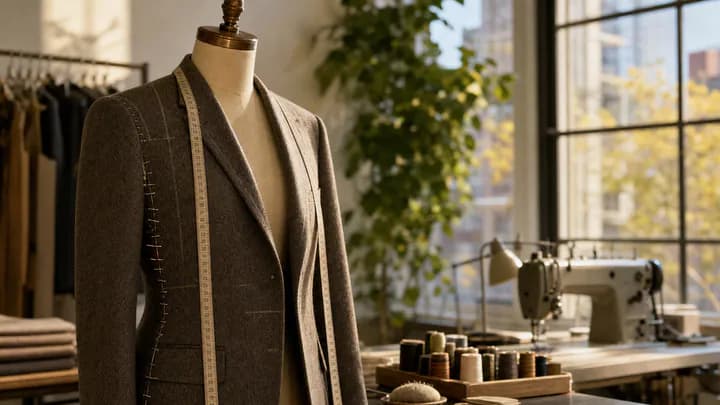
The blazer carries the most weight, so buy it for the shoulders and chest — those are the two measurements a tailor cannot fix affordably. Sleeve length, sleeve width, waist suppression and jacket length are all cheap adjustments. If the shoulder seam sits past your actual shoulder joint or the jacket pulls into an X across the button, walk away no matter how good the price is.
A useful rule when building out from those five: every new piece must work with at least three things you already own. If it only works with one, you have bought an outfit, not a wardrobe. That is the same logic behind a 30-piece capsule wardrobe, and it applies just as cleanly to workwear.
What should I spend, and where is the money wasted?
Concentrate spending on the blazer and the shoes, go mid-market on trousers and knitwear, and go cheap on shirts and tees, which wear out at the collar and cuff regardless of price. Then reserve $50 to $150 for alterations on anything tailored — that line item changes how you look more than any price bracket does.
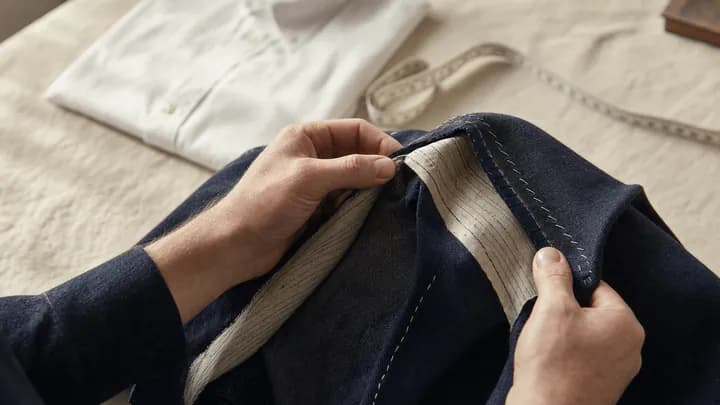
Typical alteration costs in the US run roughly $20–$50 to shorten sleeves, $40–$80 to take in a jacket waist, $15–$30 to hem trousers, and $100 or more to rework a shoulder. That last one is the decision rule: if the shoulder needs work, the jacket is the wrong jacket.
Worked example. Someone with $700 to spend has two options. Option A: a $700 designer blazer, unaltered. Option B: a $320 wool blazer plus $110 of tailoring, $180 trousers, and $90 on resoleable leather loafers. Option B produces more outfits, photographs better and lasts longer, because every garment sits where it should. If that $700 needs to be accumulated rather than spent today, a dedicated sinking fund for wardrobe purchases is a calmer route than financing a suit.
Which fabrics hold up from the boardroom to a video call?
Matte, mid-weight and stable fabrics win in both settings. Worsted wool around 250–280 gsm works year-round in most climates; wool crepe resists creasing better than almost anything; glossy synthetics and tight small-scale patterns are the two things cameras punish hardest.
| Fabric | Best used for | On camera | Creasing | Care reality |
|---|---|---|---|---|
| Worsted wool, 250–280 gsm | Blazers, trousers | Excellent in solid mid-tones; avoid fine stripes | Low | Brush and steam; dry clean 2–3 times a year |
| Wool crepe | Trousers, column dresses | Very good — fully matte, no glare | Very low | Dry clean; never press directly on the face |
| Silk-blend or matte satin | Shirts, shells | Risky under ring lights; matte blends safer | High | Hand wash cold, hang dry, low steam |
| Polyurethane "vegan leather" | Midi skirts, light jackets | Glossy; can blow out highlights | Low | Wipe clean; expect surface cracking after a few years |
| Structured cotton twill | Unstructured blazers, chinos | Good — matte and stable | High | Machine wash cold; needs real pressing |
One caveat on fine wools: a Super 150s cloth feels extraordinary and wears out far faster than a Super 110s. For a jacket you intend to wear weekly, the lower number is the better buy.
What colors read as authoritative — and does it depend on the room?
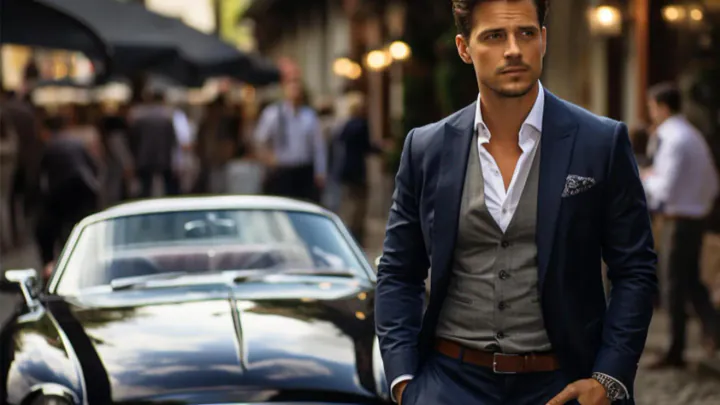
Contrast matters more than hue. A dark jacket over a light shirt creates a strong vertical frame and reads as decisive; a tonal outfit in one color family reads as calm and expensive. Both are legitimate; which one you choose should depend on whether the room needs you to be forceful or reassuring.
Beyond the usual navy and charcoal, deep green, burgundy, rust and ivory all hold authority while distinguishing you from a sea of dark suits. Bold color is best deployed as a single anchor — one saturated blazer over neutrals — rather than spread across a whole outfit, where it starts to read as costume.
The claims you see attaching fixed meanings to colors ("red equals dominance") are generalizations from a narrow research base and are heavily culture-dependent. Treat them as loose starting points, not rules. In a video call specifically, choose your color against your background: mid-tones separate cleanly from both white walls and dark rooms, while black and pure white do not.
How do I dress with authority in an office with no dress code?
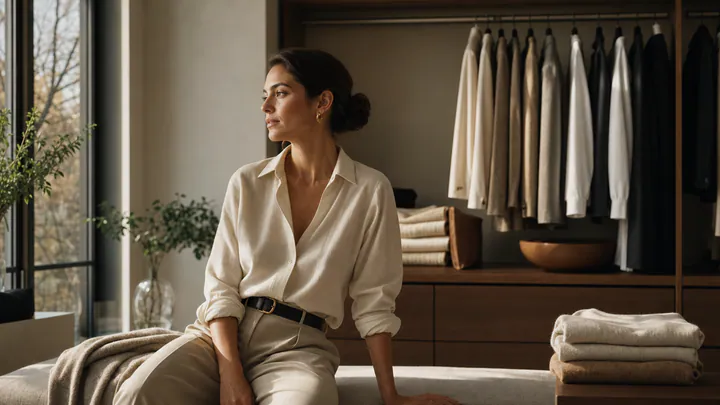
Set your baseline one visible step above the median of the room, never three. In a hoodie-and-sneakers culture, that step is a fine merino crewneck or knit polo with clean trousers and leather sneakers — no jacket required. The goal is to be legible as the most considered person present, not the most formal.
The reliable move in casual environments is a uniform. Two or three near-identical outfits worn on rotation build recognition, remove daily decision fatigue and make you look intentional rather than dressed up. Well-cut dark denim with a knit and a good shoe is entirely viable here — see our guide to denim worth buying in 2026 for cuts that hold a crease of credibility.
This does not apply if your workplace has a fixed dress standard. Hospitals, laboratories, courts, trades, aviation and client-facing roles with issued uniforms leave you very little room, and attempting to out-dress those codes reads as poor judgment. In those settings, authority attire lives in the details you do control: fit of the scrubs or coveralls, condition of footwear, a watch, a bag, immaculate grooming.
Is gender-neutral tailoring genuinely different, or just marketing?
Real unisex tailoring is drafted differently: a straighter chest line, a longer rise, a lower and softer armhole, adjustable waist tabs and a jacket length that works over a range of hip shapes. Done well, one pattern genuinely covers many bodies. A large share of what is labeled gender-neutral, though, is menswear sizing with a new label — which fits some people beautifully and others not at all.
The practical test before buying: raise both arms to shoulder height. If the whole jacket lifts with you, the armhole is cut too low for your frame and the garment will never look sharp seated at a table. Fluid, unstructured tailoring is more forgiving across body types, but it also gives up the shoulder line that does most of the authority work — so keep at least one structured piece in rotation.
Does what you wear really change how you perform?
There is credible psychological research on "enclothed cognition" — the idea that clothing with symbolic meaning can influence attention and self-perception — but the reported effects are modest and some findings have been contested in replication work. Treat it as a plausible nudge, not a lever.
The dependable mechanism is more mundane. Clothes that fit change your posture, and posture changes your breathing and voice. Clothes that do not fit consume attention: you adjust a waistband, tug a hem, cross your arms to hide a gaping button. Removing that friction is worth more than any color theory.
What are the most common power-dressing mistakes?
- Buying the matching suit you'll never wear as a suit. If the jacket goes out five times a week and the trousers twice, they will fade out of match within two years. Buy separates, or buy a second pair of trousers with the suit.
- Over-dry-cleaning wool. Solvent strips the fiber's natural oils. Brush, steam and rest the garment 24 hours between wears; clean it two or three times a year.
- Fine patterns on camera. Narrow pinstripes, small checks and tight herringbone exceed what a webcam sensor can resolve and shimmer as moiré. Save them for the room.
- Skipping the tailor. The single highest-return $40 in any professional wardrobe is a sleeve hem.
- Confusing expensive with authoritative. A visible logo transfers authority to the brand, not to you.
- Neglecting shoes and bag. Worn heels and a slumping tote undo an otherwise precise outfit faster than anything above the waist.
Key takeaways
- Authority in 2026 comes from fit, fabric and contrast — not from a specific garment category or a price tag.
- Buy blazers for the shoulders and chest; alter everything else and budget $50–$150 for it.
- Choose matte, mid-weight, solid fabrics if any part of your week happens on camera.
- Dress one clear step above your room's baseline, then repeat it — consistency reads as intention.
- Test unisex tailoring by raising your arms; if the jacket lifts, the armhole is wrong for you.
- Fixed-dress-code professions are the exception: there, authority lives in fit, condition and grooming.
Frequently asked questions
What is power dressing?
Power dressing is a way of assembling clothing — structured shoulders, clean lines, deliberate color and precise fit — so that an outfit signals competence and authority before you speak. It began as the 1980s corporate uniform and has since loosened into a set of principles rather than a single silhouette.
Is the matching suit still relevant in 2026?
Yes, but mainly for high-formality settings: courtrooms, finance, diplomacy, board presentations, funerals. For everyday office life, most people get more use from separates — one excellent blazer worn over multiple trousers, skirts and knits — because a jacket worn far more often than its trousers will fade out of match within a couple of years.
How much should I spend on a work blazer?
Spend on the blazer that carries your whole week and buy the rest cheaply. A well-made wool blazer that fits your shoulders is worth several mid-priced ones, but only after alterations — budget an extra $50 to $150 for tailoring, which does more for how you look than moving up a price bracket.
Which colors look most authoritative on video calls?
Solid mid-tone colors — navy, charcoal, forest, burgundy, ivory — because webcams handle them without banding or moiré. Avoid fine stripes, small checks and tight herringbone on camera; the sensor can't resolve the pattern and it shimmers. Pure black loses shape in low light, and pure white can blow out under a ring light.
Does what you wear actually change how you perform?
There is credible research on "enclothed cognition" suggesting that clothing carrying symbolic meaning can shift attention and self-perception, but the effects reported are modest and some findings have been debated. The more dependable mechanism is simpler: clothes that fit change your posture and remove the low-level distraction of tugging at a waistband.
How do I dress with authority in a workplace with no dress code?
Set your baseline one step above the room's median, not three. In a fleece-and-sneakers culture, that is a knit polo or fine merino crewneck with clean trousers and leather sneakers — no jacket. Overshooting by a wide margin reads as a mismatch with the culture rather than as seniority.
Is gender-neutral tailoring genuinely different from menswear?
Yes, when it is done properly. True unisex tailoring is drafted with a straighter chest line, a longer rise, a lower and softer armhole and adjustable waist details, so a single pattern works across body shapes. A lot of what is marketed as gender-neutral is simply menswear sizing relabeled, which fits some bodies well and others badly.
How often should a wool suit be dry cleaned?
Roughly two to three times a year for regular wear. Solvent cleaning strips the natural oils from wool fibers and shortens a garment's life; between cleanings, brush the fabric, steam out creases and rest the jacket on a wide hanger for 24 hours after wearing.