The Cartographer of Public Benches
A retired surveyor maps every bench in his city and discovers that some of them refuse to stay where he left them.
Drafted with AI and published automatically. Our editors set the standards and fix reported errors — how we work.
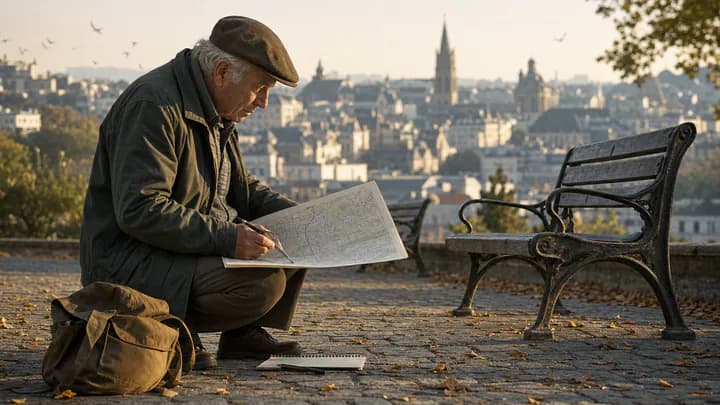
Edwin Marrow had been retired four months when he began to suspect the benches were moving. He did not say so aloud, because he was seventy-two and had recently misplaced his glasses inside the refrigerator, and he understood how these things sounded.
Still, he kept a notebook.
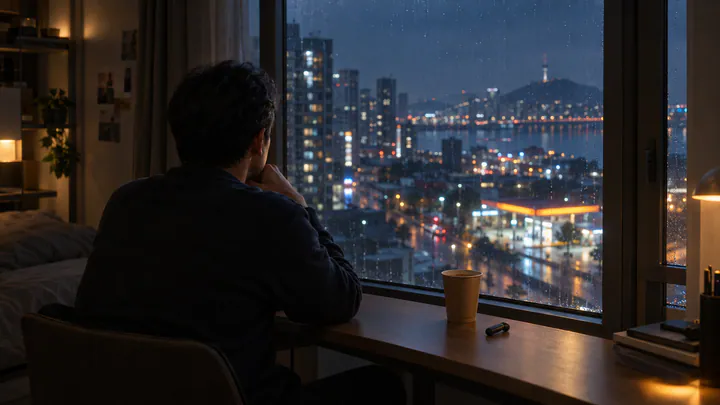
He had bought it the week after Marigold's funeral, when the apartment had grown so quiet he could hear the clock ticking in the hallway and, beyond that, the soft hum of the building's pipes, and beyond that, nothing. He had been a land surveyor for forty-one years. He understood the comfort of grids. So he had decided, in the way grieving men decide things at four in the morning, that he would map every public bench in the city of Aldershaw.
There were, he estimated, around six hundred.
By April he had cataloged ninety-three. Each entry included coordinates, condition, material (wrought iron, slatted pine, the rare and beloved teak), the orientation of the seat, and what Edwin called the view — a single sentence describing what a person sitting there would see. Bench 41: faces the duck pond, slight list to the east, view includes a willow and a child's lost mitten on the railing.
It was a foolish project. He knew that. But it gave the days corners.
The First Discrepancy
The first discrepancy appeared in May, on a Tuesday so bright it hurt to look at the river.
Edwin had walked to Bench 17 — a green wrought-iron piece on the embankment, north of the footbridge — to verify a measurement he'd doubted the night before. He had logged it eleven paces from the lamppost. He paced it again. Fourteen.
He frowned. He paced it a third time, carefully, heel-to-toe. Fourteen and a half.
He sat on the bench. Lampposts did not move. Benches, properly bolted, did not move. Edwin Marrow's stride, refined by four decades of pacing acreage, did not move either. He took out the notebook and, in his small precise hand, wrote: Bench 17 has shifted approximately ten feet north since April 6. Cause unknown.
Then he added, after some thought: Perhaps I am wrong.
He went home and made tea and did not think about it for nearly a week.
The second discrepancy was Bench 52, in the courtyard behind the library, which had rotated forty-five degrees so that it now faced the rose bushes instead of the fountain. Edwin photographed it. He compared the photograph to his April notes. He sat down and read the rose bushes for twenty minutes, watching a bee work the yellow ones, and when he stood up he felt an odd lightness, like the moment after setting down a heavy bag he hadn't realized he'd been carrying.
By June there had been eleven discrepancies.
By July, twenty-three.
The Pattern
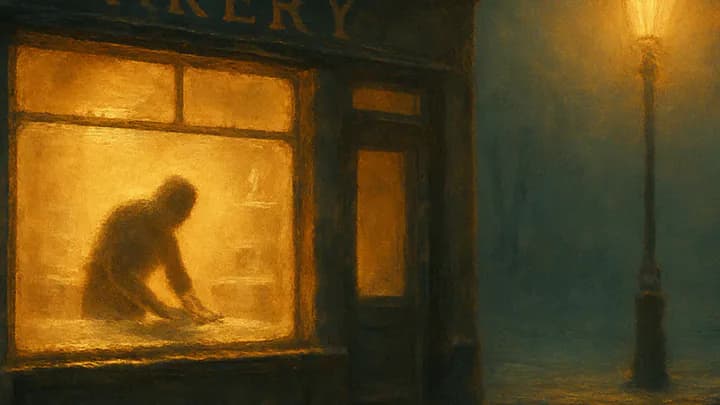
Edwin began to look for a pattern, because that was what surveyors did. He drew the migrations on a master map in colored pencil — red for benches that had moved, blue arrows for direction, small notations for date and distance. The benches were not moving randomly. They were moving toward things. A bench in the train station had nudged six inches closer to the window where the morning light came through. A bench near the school had turned to face the playground. The bench outside the bakery on Cornell Street had crept, over the course of six weeks, almost to the doorway, as though leaning in to smell the bread.
And then there was Bench 204.
Bench 204 sat in the small triangular park three blocks from Edwin's apartment, the park where he and Marigold had walked every Sunday for thirty-eight years. He had cataloged it early on, with unusual brevity: Bench 204: teak, four slats, faces west. View: the magnolia. He had not gone back since.
One morning in August he found himself there without quite deciding to be. The magnolia had finished blooming. The bench had moved.
It had turned, gently, perhaps thirty degrees, away from the magnolia. Now it faced the corner of the park where the path came in — where, if one were sitting on it, one would see whoever was arriving.
Edwin stood very still. He felt the morning around him, the smell of cut grass, the distant hush of traffic, a sparrow muttering in the hedge. He sat down on the bench. From here he could see the gate, and the curve of the path, and the place where Marigold used to appear, swinging the canvas bag she always brought, calling something to him before she was quite close enough to hear.
He sat there a long time.
When he finally took out the notebook, his hand was steadier than it had been in months. He wrote: Bench 204 has rotated to face the entrance. View now includes the gate and the path beyond it. The bench appears to be waiting.
Then, after a moment, he added: So am I.
The Map
Edwin finished the project in October, two days before the first frost. Six hundred and seventeen benches. Three hundred and eight discrepancies. He had developed a theory, which he did not share with anyone, because he had no one in particular to share it with and also because theories of this kind were best kept quiet.
His theory was this: benches, having spent their lives being sat on by people who were thinking about other places, eventually began to lean in the direction of those thoughts. A bench accumulated longing the way a coat accumulated lint. Over time, the accumulation became a kind of weight, and the weight, very slowly, pulled.
It was not, Edwin admitted, a scientific theory.
He donated the finished map to the city archive, where a kind young woman named Priya catalogued it under Marrow, E. — Public Seating Survey, Aldershaw, 2024. She told him it was the most thorough document of its kind she had ever seen. She asked if he planned to continue the project.
Edwin thought about it. He thought about Bench 204, which he had visited every Sunday since August, and which had not moved again, because it no longer needed to.
"No," he said. "I think I'm finished with maps for a while."
"What will you do instead?"
He considered this on the walk home, past Bench 88 (facing the chess players), past Bench 311 (leaning toward the river), past the bakery bench that still listed hopefully toward the door. He thought about how a man could spend his whole life measuring distances and never notice the small, patient ways the world moved to meet him.
By the time he reached his building, he had an answer, though he did not say it aloud.
He was going to sit.