The Lighthouse Keeper's Borrowed Dog
When a stray dog appears on the cliff during a winter storm, an aging lighthouse keeper begins to suspect the animal has come with a purpose all its own.
Drafted with AI and published automatically. Our editors set the standards and fix reported errors — how we work.
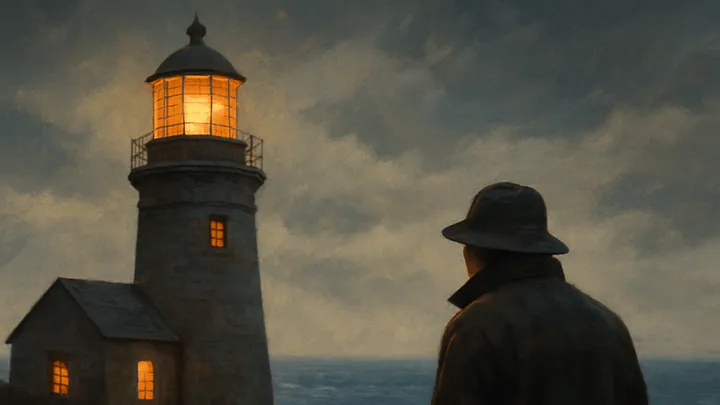
The dog arrived on the cliff the night the barometer fell so fast Halloran thought the needle was broken. He was tapping the glass with his thumbnail when something scratched at the lower door, and because no one had scratched at that door in eleven years, he assumed it was a branch the wind had wrenched loose from somewhere inland.
It was not a branch. It was a wet brown dog with one white sock and an expression of mild, businesslike patience, as if Halloran were running late for an appointment they had both agreed to.
"You can't be here," Halloran said.
The dog stepped past him into the kitchen and sat down on the rag rug.
Halloran shut the door because the rain was coming in sideways now and the wind had begun its long January complaining. He stood with his back to the door and looked at the dog. The dog looked at the kettle.
"I don't have anything for a dog," he said. "I have tinned sardines and oat biscuits and a heel of bread that has seen better Tuesdays."
The dog's tail thumped once against the rug, generous and forgiving.
Halloran fed it sardines on a saucer and watched it eat with the careful manners of an animal that had been someone's once. There was no collar. Its coat, when it began to dry by the stove, was the color of wet bracken. He toweled it as well as he could with an old flour sack, and the dog leaned into him, and Halloran felt, in the small of his back, a tightness he hadn't known was there give way like a knot in a rope.
"You can stay till morning," he told it. "Then we find your people."
The Light
At ten he climbed the iron stairs to check the lamp, and the dog climbed with him, claws ticking on each step. The lantern room smelled the way it always smelled — brass polish, paraffin, the faint mineral tang of glass that had spent a century facing the sea. Halloran ran his palm along the lens housing out of habit. The beam swept out across the black water and came back, swept out and came back, like a hand reaching to be sure a sleeping child was still breathing.
The dog sat at the western pane and watched the rain.
"There's nothing out there tonight," Halloran said. "Anyone with sense is in harbor."
The dog did not turn its head.
Halloran sat down on the small wooden stool he had carried up here when his knees first began to argue with the stairs. He looked at the back of the dog's head and tried to remember when he had last spoken to a living thing for longer than it took to thank the grocer.
"My wife used to want a dog," he said, surprising himself. "I said no because of the stairs. I said no because of the wind. I said no because we were going to move inland when I retired and we could get one then." He paused. "We did not move inland."
The beam swept out and came back.
"Her name was Ellen," he said. "She liked the kind with the long ears. She said they looked like they were listening even when they weren't."
The dog, which had medium ears of an entirely sensible length, turned and regarded him. Then it laid its chin on his boot.
In the morning the storm had blown itself thin and the sea looked apologetic. Halloran walked down the cliff path with the dog at his heel, though he had given it no instruction to heel and owned no lead to enforce it with. He went first to the Pendry farm because the Pendrys had three dogs already and might recognize a fourth.
Mrs. Pendry came to the door in her husband's coat. She looked at the dog and frowned in the polite way of someone trying to be helpful about a thing she could not help with.
"Never seen it," she said. "Not from round here. You sure it's not yours?"
"I don't have a dog."
"You do now," she said.
He went to the village. He asked at the post office and at the chandlery and at the cottage where the woman who minded other people's cats kept a notebook of lost animals in a tin on her windowsill. No one had lost a brown dog with one white sock. No one had even heard of one. The woman with the notebook said, kindly, that strays sometimes came down the coast road from as far as forty miles north, and that the storm might have driven it from anywhere.
"Forty miles is a long way for a dog," Halloran said.
"Dogs do long ways," she said, "when they're going somewhere."
He walked home along the cliff with the dog at his heel and thought about that.
The Letter
That afternoon he went up to the attic for reasons he could not have explained if asked. He had not been up there since the summer he had finally sorted Ellen's clothes into boxes for the church. The dog came up the attic ladder behind him with an athleticism Halloran found indecent in an animal of unknown age.
He opened the trunk at the gable end. He was looking, he realized, for a particular tin — a biscuit tin with a painting of a thatched cottage on the lid, in which Ellen had kept letters she did not want to throw away.
He found it under a folded quilt. He sat on the dusty boards and opened it on his lap, and the dog sat beside him and put its chin on the rim of the tin as if it, too, had been waiting a long time to see what was inside.
There were birthday cards, and a photograph of Ellen's mother as a young woman, and a pressed flower that had gone the color of weak tea. And there was, near the bottom, a letter he had never seen. It was in Ellen's handwriting and it was addressed to him, and the envelope had not been sealed, only tucked closed.
The letter said she had been thinking, lately, that when she was gone he would need something to talk to. It said she had been asking around quietly at the farms up the coast. It said she had picked out a puppy from a litter at a place called Aiken's, a brown one with a white sock, and that she had paid a deposit and asked them to hold it until she gave the word. She was sorry, she wrote, for going behind his back. She knew he would say no to the stairs and the wind. She hoped he would say yes anyway, when the time came.
The letter was dated four months before she died.
Halloran sat for a long time with the paper trembling slightly in his hand. The dog watched him with its grave, patient face.
"You can't be that puppy," he said at last. "That was eleven years ago."
The dog yawned, showing a pink tongue and very white teeth, and laid down across his feet as if the matter were settled and they could now move on to more practical concerns, such as supper.
Halloran folded the letter carefully and put it in his shirt pocket, over his heart, where it made a small dry rustle each time he breathed. He climbed back down the ladder. The dog followed.
That evening, when he climbed the iron stairs to light the lamp, the dog climbed with him, and he did not tell it not to. He stood at the western pane and watched the beam go out across the water and come back, out and back, and he rested his hand on the warm broad head beside his knee.
"All right, Ellen," he said. "All right."
The dog thumped its tail once against the floor, generous and forgiving, and the sea, for the first time in a long while, sounded like company.