The Repair Shop for Borrowed Things
When Nila inherits her grandmother's strange little shop, she discovers it doesn't fix what's broken — it returns what was borrowed and never given back.
Drafted with AI and published automatically. Our editors set the standards and fix reported errors — how we work.
The key didn't fit the lock until Nila apologized to it. She stood on the cracked stoop of 14 Hensley Lane in the rain, feeling foolish, and whispered, Sorry I'm late, and the brass tongue slid home as if it had been waiting all along.
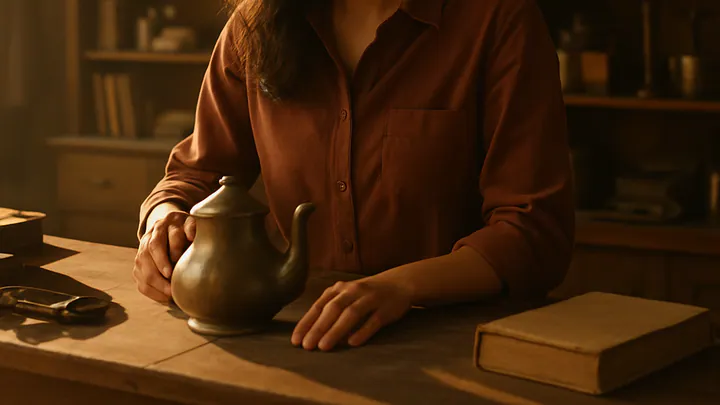
Inside, the shop smelled of beeswax and old paper. Her grandmother had been dead eleven days, and already the air had begun to forget her — but not entirely. A teacup sat on the counter, half full, the surface still trembling faintly, as though someone had set it down only a moment ago and stepped into the back room.
Nila set down her suitcase. Hello? she said, because the trembling tea unnerved her.
Nothing answered. She hadn't expected anything to. She had expected dust, a leaking roof, perhaps a cat. Her mother had warned her the shop was a money pit, that Gran had been sentimental and stubborn and a little bit cracked, and that the kindest thing Nila could do was sell the building to the developer who'd been circling like a polite vulture for two years.
Nila intended to. She had the paperwork in her bag. She'd come for one weekend, to clear out the personal things, to say a private goodbye, and then to sign.
That was the plan.
The sign over the door said REPAIRS — BY APPOINTMENT, which Nila had always found funny as a child, because Gran had never seemed to repair anything. People came in with empty hands and left with empty hands. They sat at the little table by the window and drank tea and sometimes cried, and Gran would nod and write something in a leather book and then say, Come back Thursday. On Thursday they would come back, and Gran would hand them — nothing. Just a small paper envelope, folded shut, light as breath.
And the people would weep, or laugh, or press the envelope to their chests like it was an organ they'd been missing.
Nila, age nine, had once asked what was in the envelopes.
Borrowed things, Gran had said. Returned.
Nila, age twenty-eight, opened the leather book on the counter and found it half-finished. The last entry was in Gran's careful handwriting, dated two days before her death:
Mr. Adeyemi — the laugh his sister took with her when she left for Karachi in 1974. Ready Thursday.
Nila read it twice. Then she sat down on the stool behind the counter, because her knees had decided to do that.
The First Appointment
The bell over the door rang at ten the next morning. Nila had slept poorly upstairs in Gran's narrow bed, and she'd come down still in her socks, planning to make coffee and call the developer. Instead she found a small woman in a yellow raincoat standing in the middle of the shop, dripping politely onto the rug.
I have an appointment, the woman said. Your grandmother told me Thursday.
My grandmother — Nila began, and then couldn't finish.
The woman's face did something complicated. Oh, she said. Oh, I'm so sorry. I didn't know. She turned to leave.
Wait, Nila said. Please. What were you here for?
The woman hesitated at the door. She was older than Nila had first thought, with rain on her glasses and a coat too large for her shoulders. I lent my mother my patience, she said. When she was dying. I gave her all of it, because she needed it, and she was frightened. And I haven't got any of it back since. Not for my husband, not for my children, not for myself. I snap at the dog. I cry in the car park. She laughed, a wet, embarrassed laugh. Your grandmother said she could find some of it. Just a little. Enough.
Nila looked at the leather book. There, three pages back: Mrs. Halloran — the patience she lent her mother in the last winter. A teaspoon's worth. Ready Thursday.
The shop was very quiet. The half-finished cup of tea on the counter had stopped trembling. It sat perfectly still, as though waiting to see what Nila would do.
Nila did not know how to find a teaspoon of someone's patience. She did not know how any of this worked, or whether it worked at all, or whether her grandmother had been a kind woman running a long and harmless theatre for the lonely. She suspected she would never know.
But she knew where Gran kept the envelopes — a drawer beneath the counter, lined with felt. She opened it. Inside lay one small paper envelope, folded shut, with HALLORAN written on it in pencil.
Nila's hand shook as she lifted it. It weighed nothing. It weighed everything. It felt, in her palm, like the moment just before a held breath is let out.
She held it across the counter. Thursday, she said. As promised.
Mrs. Halloran took the envelope in both hands. She did not open it. She closed her eyes, and after a long moment she said, very softly, Oh. There you are.
When she left, she forgot to pay. Nila didn't remind her. She wasn't certain what the price should have been, or whether prices were the point.
The Book
That night Nila sat at the little table by the window and read the leather book from the beginning. There were forty years of entries. A boy's courage, lent to a friend on a bad night in 1989. A woman's singing voice, lent to her daughter for a school play and never quite reclaimed. A father's softness, lent to a war and lost in transit, recovered piece by piece over the course of a decade.
Some entries had a small tick beside them — returned. Some had a question mark — still looking. A few, very few, had a thin line drawn through them, and beside the line, in Gran's smallest hand: could not be found. Comforted instead.
Nila read until the streetlamp outside flickered off and the dawn came up grey and gentle over the lane. She thought about the developer's paperwork in her bag, and the flat she rented in the city, and the job she didn't love, and the man she had nearly married who had said, kindly, You give too much of yourself away, Nila. There's hardly any of you left.
She had thought, at the time, that he was being unkind. Now she wondered if he had been the first person to tell her the truth.
She opened the leather book to a fresh page. She picked up Gran's pen. The nib was worn soft from forty years of careful writing.
She hesitated. Then she wrote, in handwriting that was not yet steady but was trying:
Nila — the certainty she lent her mother, at sixteen, that she would become someone her mother could be proud of. Still looking.
She closed the book. Outside, somewhere down the lane, a door opened and a kettle began, faintly, to sing.
She went to unlock the shop.