The Tea Shop at the Edge of Tuesday
When Marisol stumbles into a tea shop that only exists between Tuesday and Wednesday, she discovers the proprietor is brewing something stranger than oolong.
Drafted with AI and published automatically. Our editors set the standards and fix reported errors — how we work.
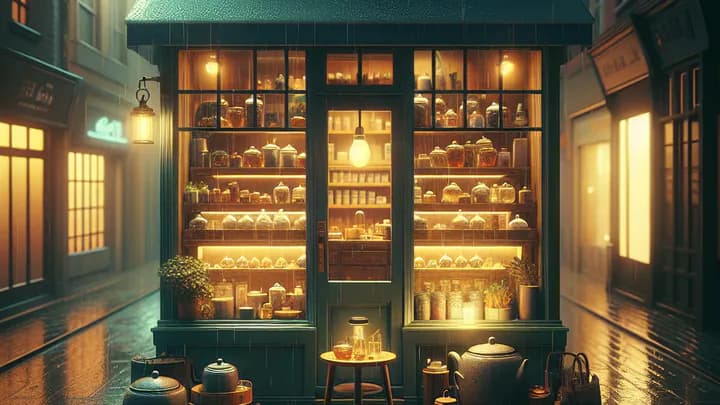
The door wasn't there on Monday, and Marisol was almost certain it wouldn't be there on Wednesday, but on Tuesday at 11:47 p.m. it sat between the laundromat and the shuttered florist as if it had always belonged.
She would have walked past it — she had walked past this stretch of Ardmore Avenue every weeknight for six years — except that the rain had started doing that needling thing that gets inside collars, and the door was propped open, and a square of warm yellow light spilled onto the sidewalk like someone had dropped a folded blanket there.
A wooden sign above the lintel read, in careful chalk: OPEN BETWEEN DAYS. MIND THE STEP.
Marisol minded the step. She went in.
The shop was narrower than it had any right to be and longer than the building could possibly allow. Shelves climbed the walls in uneven tiers, holding tins and glass jars and little paper packets tied with twine. The air smelled of bergamot and woodsmoke and something else — something like the inside of a library after closing, when the books finally relax.
Behind the counter, a woman in a mustard cardigan was scooping loose leaf into a brass scale. She was perhaps fifty, perhaps seventy; her hair was the color of a steel kettle and pinned up with what looked like a chopstick.
“You're soaked,” the woman said, not unkindly. “Sit. I'll bring you something.”
“I didn't — I haven't ordered.”
“No,” the woman agreed. “But I've been brewing yours for about eleven minutes, so it would be a shame to waste it.”
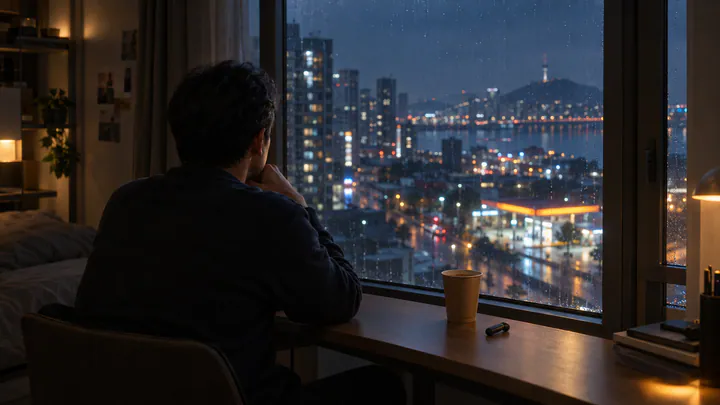
Marisol sat at a small round table by the window. There were six tables, all empty, each with a candle burning low. Outside, the rain hushed against the glass. She watched a bus glide past without sound, as though the street were behind several panes.
The woman set down a cup. The tea inside was the deep amber of a held-up jewel.
“What is it?” Marisol asked.
“Tuesday,” the woman said. “Mostly. A pinch of Sunday afternoon for sweetness. Don't drink it too fast.”
Between Days
Marisol took a sip. It tasted, impossibly, like the kitchen of her grandmother's house in Ponce — the cinnamon her abuela kept in a tin shaped like a rooster, the slow churn of a ceiling fan, the particular green of the curtains when sun came through them at four o'clock. She set the cup down very carefully, because her hands had started to shake.
“How,” she said.
The woman pulled up the chair opposite and folded her hands. “The shop opens in the gap. Every day has one — a sliver between when it ends and when the next begins. Most people fall asleep through theirs. Some don't.” She looked at Marisol with mild, level interest, the way one looks at a kettle to see whether it has decided to whistle. “You haven't slept properly in a while.”
It wasn't a question, so Marisol didn't answer it. She thought about the spreadsheet still glowing on her laptop at home, and the email she had not yet sent to her brother, and the dish in the sink that had been there since Saturday and was now, philosophically speaking, a roommate.
“What do you sell?” she asked instead.
“Tea,” the woman said. “But the leaves I use are — well. People leave things behind, in the gap. Moments they didn't have room for. A laugh someone swallowed. An afternoon a child meant to remember and didn't. A goodbye that came out wrong. I gather them. I dry them. I blend them.”
“That sounds like theft.”
“It would be, if I kept them.” The woman smiled, and it changed her face entirely, the way a lamp changes a room. “I give them back. Just to different people. The ones who need a sip of something they've forgotten how to feel.”
Marisol looked down at her cup. It was half empty now, though she didn't remember drinking that much.
“What happens if I finish it?”
“You'll go home. You'll sleep. You'll wake on Wednesday and the door will not be here. You'll remember the shop the way you remember a dream — vivid in the shower, faded by lunch.” The woman tilted her head. “Unless.”
“Unless what?”
“Unless you leave something behind too. Then you'll remember. Then you might find your way back.”
Marisol considered this. Outside, the silent bus had been replaced by a silent cat, picking its way along the curb with the dignity of a small ambassador.
“What sort of thing?”
“Whatever you have too much of. Whatever's grown heavy.”
She thought of the email. She thought of the dish. She thought, then, of the thing under the email and the dish: the long flat hum of a year spent being competent and not much else. Of telling her brother she was fine because the word fine was shaped like a door she could close.
“I have,” she said slowly, “a Tuesday in February. Two years ago. I sat in my car in a parking garage for forty minutes because I couldn't think of a single place I wanted to drive to.”
The woman nodded as though this were a perfectly reasonable item to bring to a counter. She produced, from somewhere beneath the table, a small empty jar with a cork stopper.
“Breathe into it,” she said. “Just once. The jar will know what to take.”
Marisol felt foolish. She breathed into the jar anyway. The glass fogged, then cleared, and at the bottom there was now a thin curl of grey, like the smoke off a snuffed wick. The woman corked it and set it on a shelf behind her, between a jar labeled laughter at a funeral, age 9 and one labeled, simply, April.
“There,” she said. “Someone, somewhere, is going to need that. A person who's forgotten how to sit still. They'll drink it and remember that sometimes the answer is to be lost for forty minutes and then go home.”
Marisol finished her tea. It tasted, at the bottom, like her own kitchen — but a kitchen she hadn't lived in yet. A kitchen with a window box. A kitchen where someone was humming.
“What do I owe you?”
“You already paid.”
She stepped out onto Ardmore Avenue at — her phone insisted — 11:48 p.m. The rain had stopped. The door behind her was already a wall, brick and old paint and a faded advertisement for a dance studio that had closed before she was born.
On Wednesday morning, Marisol washed the dish. She sent the email to her brother — a real one, three paragraphs, ending with I miss you. She walked to work past the laundromat and the shuttered florist and the brick where the door had been, and she did not stop, but she touched it lightly with two fingers, the way you might touch a friend's shoulder in passing.
She remembered. That was the thing. She remembered.
And somewhere, on some other Tuesday at the edge of itself, a stranger she would never meet was lifting a cup to their lips and tasting forty quiet minutes in a parking garage, and finding, to their own surprise, that it was exactly what they needed.