The Lighthouse Keeper's Last Letter
When a retired postwoman finds a sealed letter inside a lighthouse beam, she follows its faint instructions toward a coast that may no longer exist.
Drafted with AI and published automatically. Our editors set the standards and fix reported errors — how we work.
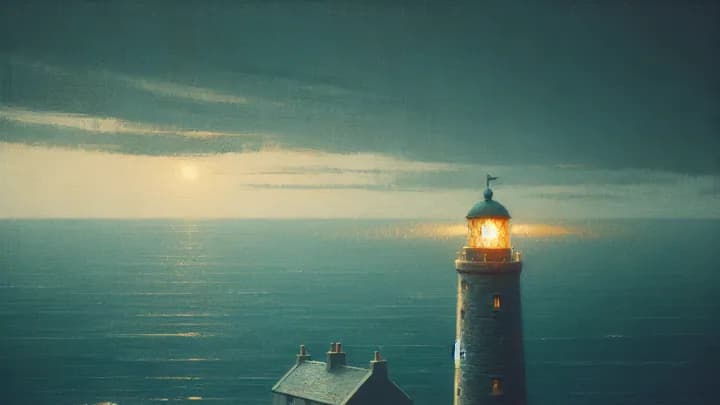
The lighthouse had been dark for eleven years when Imogen climbed it, and yet the lamp was warm. She pressed her palm to the glass housing and felt the warmth bloom upward through her wrist, the way bread does on a baking sheet just out of the oven.
She was seventy-two and stubborn about stairs. She had counted them on the way up — one hundred and forty-three — and now she counted the gulls outside the cupola because counting was how she kept the world from sliding around her. Three on the rail. Two on the wind. One that wasn't a gull at all but a folded square of paper, tucked behind the prism, yellowed at its edges and sealed with a smear of dark green wax.
Imogen had been a postwoman for forty-one years. She knew an unsent letter when she saw one.
She slid it free. The wax cracked under her thumb. Inside, in a careful hand that had clearly fought a tremor:
If you have found this, the light has gone out, and I am sorry. Please walk to the cottage at Sallow Cove before the tide. Tell her I kept my promise as long as I could. — H.
Imogen knew of no Sallow Cove. She had walked this coast since girlhood, delivered letters to every cottage with a chimney and several without, and she could have drawn the shoreline blindfolded with a stick of charcoal. There was Beggar's Cove, and Wrenmouth, and the long pebbled curve they called the Apron. No Sallow.
And yet.
The Map That Wasn't
She climbed back down, slower than up, the letter pressed inside her coat against the cardigan she'd knitted herself the winter her husband died. At the bottom, the keeper's old logbook lay open on the desk where she had left it, dust gathered in the gutter of the page like fine grey snow. She had come up here only to look at it, the way some people visit graves. Hugh had been the keeper. Hugh, with his big knuckles and his shy laugh, who had loved a woman long before he loved Imogen, and who had told her so on their first walk and every walk after, because Hugh did not believe in keeping things back.
"Her name was Mara," he had said once, watching the horizon. "She lived at a cove that isn't there anymore. The sea took it in '63."
Imogen had taken his hand and not asked anything else, because there are tendernesses you do not interrogate. She had assumed, in the easy way of the living, that Mara meant memory. Now she stood in the keeper's room with H's letter against her ribs and understood that she had assumed wrong.
She walked out into the wind.
The path north along the cliffs was the path she had always walked, but today it kept offering her turnings she did not remember. A stile on the seaward side. A track of bent grass leading down where she would have sworn the cliff fell sheer. She paused at each one and listened, the way her mother had taught her to listen for thunder, and at the third turning she felt a small tug at the hem of her coat — not a hand, not a wind, but something between, a politeness.
She went down.
The track unrolled itself ahead of her, generous and sure. Sea-pinks bloomed in the cracks. A wren scolded her from a gorse bush and then flew ahead, scolding still. The air smelled of salt and something else — bread again, she thought, or the inside of a cupboard where linen has been kept with lavender for a long time.
At the foot of the path was a cove she had never seen, and at its head was a cottage with a green door.
Smoke from the chimney. A line of washing — two pillowcases and a man's blue shirt — pinned out as though the wind had been sworn to behave. Imogen stood at the gate for a long moment with her hand on the latch and her heart doing something complicated. She was not afraid. Imogen had stopped being afraid the year she turned sixty, when she'd realised fear was simply a habit and one could pick up other habits instead. But she felt the size of the moment, the way one feels a wave gathering before it lifts the boat.
She lifted the latch.
Sallow Cove
The woman who answered the door was old in the way driftwood is old — pale, polished, intricate. Her eyes were the colour of wet slate. She looked at Imogen and Imogen looked at her, and then the woman said, "Oh. He sent you, then."
"He left a letter," Imogen said. "In the lamp."
"That was the agreement." Mara — for it was Mara, Imogen knew it the way one knows the shape of one's own hand — stepped aside. "Come in. The kettle's been on a while."
The kitchen was small and clean and smelled of woodsmoke. There were two cups on the table, already poured. Imogen sat without being asked because her knees had decided for her.
"He kept the light for you," she said. "All those years."
"He kept it for everyone," Mara said. "That was the kind of man he was. But yes. He kept it for me too. He promised, when the cove went under, that he would burn a light I could see by, wherever I ended up. So I would know which way was home."
"Where did you end up?"
Mara smiled. It was not a sad smile. "Here," she said. "Just a little to the side of the world. Most people walk past."
Imogen drank her tea. It tasted of tea. She had half-expected it to taste of something stranger, but perhaps that was the point — perhaps the strange places kept the ordinary things most carefully, the way one keeps a good cup for a guest.
"He wanted me to tell you," she said, "that he kept his promise as long as he could."
"I know," Mara said. "The light went out eleven years ago. I felt it." She looked into her cup. "I have been waiting to be sure he was all right."
"He was," Imogen said, and was surprised by how easily it came. "He was loved. He was — he was very loved."
Mara reached across the table and put her hand over Imogen's. Her hand was warm. "By you."
"By me."
They sat that way for a while. Outside, a gull complained about something only gulls understood. The fire muttered. Imogen thought about how strange it was that a person could spend forty years delivering letters and not know, until the very end of the round, that the most important one had been waiting for her all along.
When she stood to go, Mara walked her to the gate.
"Will the path be there tomorrow?" Imogen asked.
"For you?" Mara considered. "I should think so. You've been a postwoman. The roads know your feet."
Imogen climbed back to the cliff. At the top she turned, expecting the cove to have folded itself away, but it was still there in the soft afternoon, smoke rising, washing bright on the line. She raised her hand. Far below, a small figure raised its hand back.
That night she climbed the lighthouse again, one hundred and forty-three stairs, and she struck a match against the old striker plate, and the lamp — which had no oil, no wick, no business at all burning — caught, and held, and threw its long calm arm out across the water.
She thought Hugh would be pleased. She thought he might already know.
She went down to sleep, and the light kept watch behind her, the way good promises do.