The Stamp That Belonged to No Bakery
A short story about a Tashkent bread-stamp carver, a lost pattern from a closed bakery, and two families who both swear it is theirs, told backwards from the day the stamp is delivered.
Drafted with AI. This version has not been reviewed by an editor, so it carries no ads — how we work.
Story Time is original short fiction. The characters, places and events in this story are invented.
Friday. Delivery day.
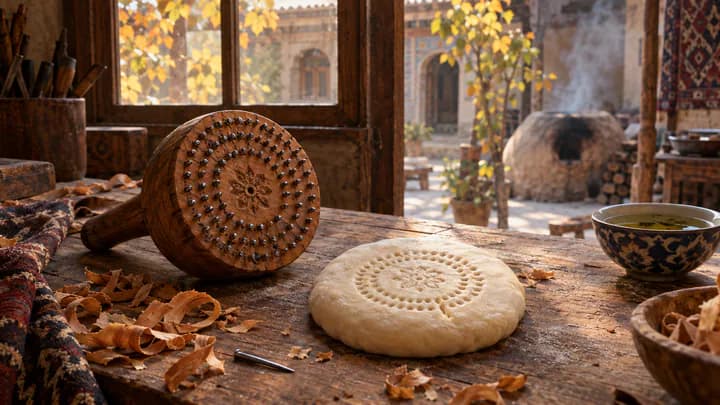
Dilshod pressed the new chekich into the round of dough and held it there for a slow count of three, the way a baker would, and Usmon-aka leaned in so far that his skullcap nearly brushed the bench. When Dilshod lifted the stamp, the pattern sat in the pale dough: three rings of points around a rosette like a split pomegranate, and at the top of the outer ring, one smooth place where a point should have been.
"There," said Usmon-aka. He put his thumb on the smooth place, then took it away as if it were hot.
Jasur stood by the door with his envelope, in a pressed shirt too thin for October. Outside, the loudspeaker on the bazaar pole was reading out the district's cotton figures, and a donkey cart knocked over the gutter stones of the lane.
"It is exactly as she wanted?" Jasur asked. He was asking Dilshod, but he was looking at the old baker.
Dilshod turned the stamp over so they could both see its face. Apricot wood, oiled twice, thirty-five steel points filed bright. Between two of them at the top, a clean drilled hole with nothing in it. The thirty-sixth nail had been riding in his waistcoat pocket for three weeks. He could feel it there now, against his ribs.
"I cut the hole," Dilshod said. "I did not fill it."
Usmon-aka breathed out through his nose. He had brought a loaf from his own tandoor that morning, still warm in a cloth, and had set it on the bench the way a man sets down a document. Thirty-six points on it, every one. "My father would have put a nail there."
"He did," said Dilshod.
"My grandmother never did," said Jasur, quietly, as if apologising for her.
For a moment nobody touched the envelope. Then Usmon-aka tore his loaf in two and held half out to the young man. "Tell her," he said, and stopped, and tried again. "Tell Saodat-opa the bread on Ko'kcha was good because of the flour. Not because of any stamp."
"I'll tell her you said the stamp was hers too, aka."
"I didn't say that."
"No, aka."
When they had gone, Dilshod swept the shavings into the stove and ate the half loaf Usmon-aka had left on the bench, which was very good.
Wednesday. Two days before.
The bakery on Sebzor was lit before the call to prayer, and Usmon-aka's two sons were already slapping rounds of dough onto the curved clay wall of the tandoor, their forearms wrapped in wet cloth against the heat. Sesame popped. Coal smoke hung under the vine trellis. Dilshod waited until the old man had pulled the first batch with his long iron hook before he took the unfinished stamp out of his coat.
Usmon-aka looked at it without taking it. "You came to show me my father's work in another man's hand."
"I came to show you the hole."
The old man took it then. He turned it to the light from the oven mouth, found the empty place with a fingernail, and went very still.
"In the war," Dilshod said, "your father's oven stayed lit after closing. Three nights a week."
"For the hospital orders."
"Were you there?"
"I was nine. I carried." Usmon-aka's jaw worked. "There was a woman. She came in with flour in a pillowcase. I thought she was some cousin of my mother's." He handed the stamp back abruptly. "My father never stole a thing in his life."
"No," Dilshod agreed. "I don't think he did."
"Then whose is it?"
Dilshod wrapped the stamp in its cloth. "Come to my workshop Friday morning. Bring a loaf. We'll press them side by side, and you can tell me."
The Saturday before.
Gulnora sold dried apricots and raisins under the dome at Chorsu, in sacks rolled down at the neck like sleeves. She weighed out half a kilo for him before he had asked for anything, because his wife bought from her and that was how it worked.
"Your mother lived on Ko'kcha in the war," he said. "Before the earthquake took the old street."
"Everyone's mother lived somewhere before the earthquake." She tied the paper. "Why?"
He drew the pattern on the back of his receipt with a carpenter's pencil: the pomegranate, the three rings, the gap at the top.
Gulnora stopped tying. "The loaves with the door," she said.
"The door?"
"That's what we children called them. They came on a tray, wrapped in a tablecloth, to the houses where the men had gone. Nobody paid. Mother said the open place was for whoever was coming home." She smoothed the receipt flat with her palm. "My father didn't come home. We ate the bread anyway."
"And after the war? Hamid-aka's bakery?"
"Same pattern. No door." She shrugged. "Mother said that was proper. The war was finished. You don't leave a door open forever, the dust gets in."
She would not take money for the apricots. He left it under the scale pan anyway.
Ten days before.
Usmon-aka did not knock. He stood in the workshop doorway with the courtyard light behind him and said, "I hear you are cutting my father's stamp for a boy from across the canal."
Dilshod set down his drill. On the bench lay the blank: a disc of apricot wood, the pattern pencilled on it, the first ring of holes started. "Sit, aka. There's tea."
"I didn't come for tea. Half the bakers on this side of Chorsu buy from you. They buy because your stamps are honest. They will want to know why you are selling Hamid the baker's pattern to strangers, forty years after he cut it."
Dilshod poured anyway, two piyolas, and set one at the edge of the bench where the old man could reach it without seeming to.
"How many points on your father's stamp?"
"Thirty-six. I counted them every morning when I was a boy."
"And before the war? What did his bread carry before the war?"
Usmon-aka opened his mouth and closed it. "A plain ring," he said finally. "Like everyone's."
The tea steamed between them. Out in the lane, a neighbour was splitting kindling, each stroke a flat clap.
"I'm going to finish it," Dilshod said.
"Then the bakers can decide whom to trust." Usmon-aka turned to go, came back, drank the tea in one swallow because it was rude not to, and went.
Three weeks before. The first visit.
The young man did the talking, and the old woman sat on the stool by the stove with her hands folded on a bundle in her lap.
"The Ko'kcha bakery," Jasur said. "Hamid the baker's. It closed after the earthquake. My grandmother wants the pattern for the bread at my wedding, in November." He put an envelope on the bench. Forty rubles. Dilshod made stamps for bakers at four.
"Hamid's pattern," Dilshod said slowly. He remembered it. As a boy he had bought that bread on the way to school, and pressed his thumb into the points while it was hot. "His son still bakes. On Sebzor."
"Show him, Jasurjon," said the old woman.
Jasur unwrapped the bundle. Inside was a chekich so old the handle had split along the grain and been bound with wire. The points were rusted brown, and they were not proper stamp nails at all but square-headed gate nails, filed down by hand. Dilshod counted them twice.
Thirty-five. And at the top of the outer ring, a gap, with no hole beneath it, only bare wood.
"My husband's gate," said Saodat-opa. "When he went to the front, I pulled them out one by one. I had thirty-five. I drew the pattern with thirty-six, so I left that place for him to finish." She looked at the stamp, not at Dilshod. "Hamid let me bake at night. I never sold a loaf. Who would I sell it to? Everyone was in the same courtyard."
"And after?"
"After, I stopped. Hamid came to my gate, with no nails in it, and asked if he could use the pattern. Then he asked if he could close the door." She lifted one shoulder. "I said it was his oven. The war was over. My Akmal wasn't coming."
"Does his son know that?"
"I don't think Hamid told anyone. He was not a man for telling." Now she looked up. "His son will say I took it from them. Let him. I'm not cutting anything for a quarrel. I only want my grandson's bread to have it."
Dilshod turned the old stamp in his hands. He thought of Usmon-aka's loaf, perfect, every point present. He thought of the honest thing, which was not one thing.
He took his pencil and drew the pattern on a fresh blank, three rings, the rosette, and at the top of the outer ring he made a small firm mark where the gap belonged.
"I'll drill this one," he said, touching the mark. "Hamid-aka's hole. And I'll leave it empty."
Saodat-opa considered the blank for a long time. Then she nodded once, as if pricing something at the bazaar and finding it fair.
When they had gone, Dilshod counted out thirty-six new nails from his tin into a saucer, took one back out, and put it in his waistcoat pocket, where it would stay until Friday.