Five Pesos a Song on My Grandmother's Porch
A short story about a boy in a Cebu barangay who spends eighteen years keeping his grandmother's coin-operated karaoke machine alive while the ports in its background videos call him away.
Drafted with AI. This version has not been reviewed by an editor, so it carries no ads — how we work.
Story Time is original short fiction. The characters, places and events in this story are invented.
The coin slot jammed in the middle of Manong Berto's birthday song, and twenty people on my grandmother's porch turned to look at me. I was twelve. Manong Berto stood holding the microphone with his mouth still open on the word he had been about to sing, the screen frozen on a white bridge strung with cables like a harp.
"Jomar," Lola Dading said, not loudly. She never had to.
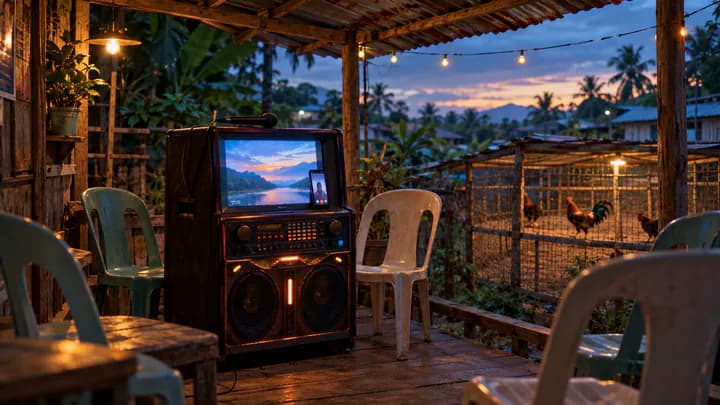
I got the butter knife from the kitchen and the flashlight with the cracked lens. Behind the house, the roosters in the pens started up as if they had been insulted. I lay on my back on the floorboards under the machine, slid the knife into the slot, and felt something flat and wrong sitting where a five-peso coin should drop. I wiggled it free. A steel washer, the size of a coin, greasy from somebody's pocket.
Lola held it up to the porch light like evidence. "Who is feeding my machine hardware?"
Everybody looked at Berto's nephew, who looked at the cock pens.
The song restarted from the top. Berto sang it the whole way through, the old one about a man doing things his own way, and the men by the gate went quiet the way they always did for that song, half joking, half not. The background video showed container ships sliding past cranes, then the white harp bridge again, then a city with water running between the streets. I sat on the step and watched it instead of Berto. The machine gave him ninety-eight. He bowed to it.
Lola paid me one five-peso coin per repair. I usually fed it straight back into the slot, because at ten o'clock, when the barangay tanod came up the lane tapping his flashlight against his palm, Lola always sang the last song herself. Number 2114. Matud Nila. She never looked at the book. The machine gave her eighty-seven every single time, and every single time she told it that it was deaf.
In 2010 we carried the machine down the lane to Manang Gloria's house, because her husband had died and a wake needs noise to keep the sleep away. Four of us lifted it onto a pedicab. I walked beside it with one hand on the casing as if it were a sick relative.
The coffin sat in the front room under fluorescent tubes. Outside, the men played cards on a folding table and the women sorted bread rolls and the jar for contributions sat by the door. I had the admission letter from the maritime college in Cebu City folded into my back pocket. Bachelor of Science in Marine Engineering. I had read it so many times the creases were going soft.
Around midnight, Manang Gloria asked for Usahay. She did not sing it. She handed the microphone to her son and sat with her hands in her lap, and he sang it badly and slowly, and nobody laughed. The background video was a harbour at dawn. A tugboat pushing something huge.
On the walk home, pushing the empty pedicab, Lola asked, "Your mother sent for the tuition?"
"She sent what she could."
Lola nodded. We both knew what my mother could send from her employer's flat in Hong Kong, and we both knew what the machine earned on a good weekend, and we both knew the amplifier had burned out in the rains in July and we had eaten rice and dried fish for nine days until I found the part in a stall in Carbon Market.
"The machine will be fine," she said. That was all. She did not say stay. She did not say go. She left a gap exactly the size of either word and waited to see which one I would put in it.
I put the letter inside the songbook, between the Visayan ballads and the English love songs, and I did not enrol.
I took the weekend courses instead, the ones a man could pay for in pieces. Basic Safety Training. Engine watchkeeping. Every few years I paid again to renew the certificates, the way you water a plant you have never moved outside. In between, I fixed electric fans and rice cookers out of a stall near the highway, and I fixed the machine every time somebody spilled Tanduay on the keypad or a typhoon came through or a child fed it a bottle cap.
My friend Ramil shipped out in 2016. At his going-away party he punched in a song, some slow thing about leaving, and when the white harp bridge came up behind the lyrics he pointed at the screen with the microphone.
"That's Rotterdam," he said, into the mic, so the whole lane heard. "The Erasmus Bridge. My ship goes under it."
I had been looking at that bridge since I was twelve and had never known it had a name.
"Come," Ramil said to me later, by the cock pens, not into the mic. "The agency needs wipers. You have the papers."
"Who fixes the slot?"
He looked at me the way you look at a man who has told you his dog will die without him, when everybody knows the dog will just get a little thinner.
Typhoon Odette came in December 2021, a week before Christmas. It peeled the tin off half the lane in one night and dropped it in the Mahiga creek. I had wrapped the machine in a blue tarpaulin and lashed it to the house post with nylon rope, and in the morning, with our kitchen roof in the neighbour's yard, I unwrapped it and it was dry.
There was no power for weeks. On the fifth night Manong Berto, white-haired now and down to three roosters, rolled his generator up the lane, and the whole street came, and nobody paid, and I didn't stop them.
Rhea Mae from next door was eleven. She had been handing me screwdrivers since she was eight, without being asked, always the right one. That night she took the microphone and punched in 2114 without looking at the book, and sang Matud Nila in a thin, serious voice, and the machine gave her eighty-seven.
The porch went wild. Lola laughed until she had to sit down.
Later, when the generator was cooling and the lane was dark, Lola said, "Your papers. Are they still alive?"
"The safety training expires in March."
She folded the tarpaulin into a square, then a smaller square. "Rhea Mae was holding the Phillips before you asked for it," she said. "Did you notice?"
"I noticed."
"Hm," she said, and went in.
In February I sat Rhea Mae on an upturned bucket in front of the open machine.
"Four screws at the back. Not the silver ones on the side, those hold nothing, they're decoration. Count them when they come out. Put them in the cup."
She counted out loud. Her fingers were steadier than mine had been.
"Speaker wire. Red to red, black to black. If it hums, it's the ground. If it crackles, it's the joint. Hold the iron here, not there, unless you want a scar like this." I showed her my thumb.
"Washers," she said, without being told, and fished a magnet on a string into the coin slot and pulled out two. She held them up for Lola to see.
"Who is feeding my machine hardware?" Lola said, and Rhea Mae said it with her, word for word, because the whole lane knew that line.
I renewed the certificate in March. In April I went to the agency on Osmeña Boulevard and signed on as a wiper on a container ship out of Singapore. Lola ironed my shirts for the medical exam and did not say anything about any of it, except to ask whether they fed you rice on those ships or only bread.
In October we came up the Nieuwe Waterweg at night and tied up in Rotterdam, and in the morning, at the end of my watch, I climbed to the deck with my phone at two bars and called the porch.
It was Lola's birthday. I could hear it before anyone spoke: Berto's roosters, plastic chairs scraping, somebody's baby, the machine's tinny welcome music. Rhea Mae's face filled the screen, too close.
"He's on! He's on!"
The cheer came through the phone as pure static. Somebody tilted the camera and I saw the porch at night, the string lights, Manang Gloria, the new tin roof, Lola in a white blouse in the good chair.
"Where are you?" Lola said.
I turned the phone around. Across the water, white against a grey Dutch morning, was the harp bridge.
The porch went silent, then louder than before.
"Punch it in," I said.
Rhea Mae held the phone against the microphone, and I heard the coin drop clean, no catch, and the opening chords of 2114 came through crackling like a radio in a storm. A dockworker in an orange vest glanced up at me from the quay. I sang it anyway, all of it, a beat behind the music because of the delay, my voice going out over the wet cranes and coming back to me thin through a phone in a lane in Mandaue.
At the end there was a pause while the machine thought about it.
"Ninety-one!" Rhea Mae shouted.
Behind her I heard Lola, clear as anything over the static, telling the machine it had never been able to hear properly and now it was guessing.