The Astronaut's Wife Learns to Garden
While her husband circles the Earth for eleven months, Nora inherits a stranger's garden and a strange invitation to grow into someone new.
Drafted with AI; reviewed by Azka Shahid on . How we work.
On the morning her husband left the planet, Nora burned the toast and did not cry. She had promised herself she would not cry until at least Tuesday, and it was only Monday, and the toast was a reasonable thing to be upset about instead.
Daniel had been a small figure inside a very large white suit, waving from a screen. Then he had been a light on a rocket. Then he had been nothing she could see, only a voice she would receive on a delay for the next eleven months, saying things like the sunrise here happens every ninety minutes and I miss the smell of rain.
She scraped the toast into the sink and stood at the kitchen window. The house they had bought six weeks before launch was still a stranger to her. The previous owner, a woman named Alma Reyes, had died in the upstairs bedroom at ninety-one, and her children had sold the house furnished because none of them wanted the furniture and none of them wanted the garden.
The garden was the reason Nora had said yes.
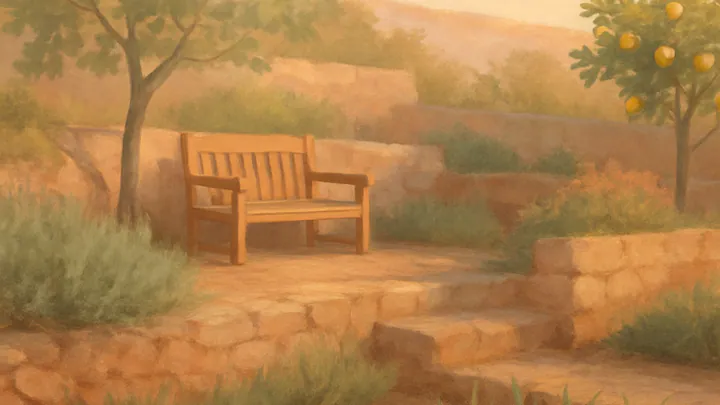
It sprawled behind the house in three uneven terraces, held together by low stone walls that had begun, in places, to lean. There were fig trees and a lemon tree and a tangle of rosemary the size of a small car. There were beds that had once been tidy and were now a green riot she could not name. There was a wooden bench under a fig, and a watering can shaped like an elephant, and a shed with a padlock for which Nora had never been given a key.
June
She began by sitting.
Every morning, after Daniel's voice arrived in her earbud — cheerful, tinny, twelve seconds behind — she carried her coffee to the bench under the fig and sat for an hour. She did not weed. She did not prune. She watched.
She watched a wren build a nest in the rosemary. She watched the fig leaves turn their pale undersides up before a rain. She watched a neighbor's orange cat cross the wall at exactly seven-forty each day, as if commuting.
“What are you doing out there?” Daniel asked one night, his voice arriving through the small speaker she kept on the kitchen counter. “Your sister says you've barely left the house.”
“I'm learning the garden,” Nora said.
A pause. Not the delay — a real pause.
“Learning it how?”
“I'm letting it introduce itself.”
He laughed, kindly. He had a good laugh, even routed through half a continent of relay stations. “Nora. It's plants. You point a hose at them.”
“Mm,” she said, and did not argue, because he was very far away and because she suspected he was wrong.
July
The lemon tree began to drop fruit she had not noticed ripening. She gathered them in a bowl and did not know what to do with so many lemons, so she left them on the porches of houses she had not yet visited, with notes that said from the Reyes garden, because she felt that was still whose garden it was.
A woman two doors down knocked the next morning. She was maybe seventy, in a linen shirt, holding the bowl back, washed.
“You're the astronaut's wife,” the woman said, not unkindly. “I'm Consuelo. I was Alma's friend for forty years. She would want you to have the key to the shed.”
She held out a small brass key on a length of green ribbon.
“How did you —”
“She gave me a copy in case she locked herself out. Which she did, constantly.” Consuelo smiled. “I've been waiting to see who would move in. I wanted to be sure.”
“Sure of what?”
“That you would sit before you cut anything.”
Nora took the key.
Inside the shed she found what she had somehow expected: neat rows of tools hung on nails, each one labeled in a careful hand. Seed packets in a tin, sorted by season. A notebook, its cover soft with use, in which Alma had written, for sixty years, what she planted and where and what the weather had done to it. The final entry read: March — too dry. The figs will be small but sweet. Ask Consuelo about the roses.
Nora sat down on the shed floor and, finally, cried.
October
She planted garlic in October because the notebook told her to. She pruned the roses in a way Consuelo showed her, holding the shears at an angle Nora would not have guessed. She learned that the rosemary was actually three plants that had grown into each other, and she did not separate them, because they seemed happy.
Daniel's voice, when it arrived, sounded thinner. Not sadder — thinner, like something stretched.
“I can see your town when we pass over at night,” he said. “I think I can, anyway. There's a cluster of lights that could be it.”
“I'll leave the porch on,” she said.
“Nora.” The delay. “Are you all right? You sound — I don't know. Different.”
She considered. Above her, through the kitchen window, the fig tree was letting go of its leaves one at a time, unhurried.
“I think I've been waiting my whole life,” she said. “For you to come home from something. For a baby that didn't arrive. For a job I liked. I think I've been waiting so long I forgot I was doing it.”
“And now?”
“Now I'm doing something else.”
The pause was long enough that she wondered if the signal had failed.
“Good,” he said finally. His voice was warm. “That's good, Nora. Tell me about the garlic.”
April
He came home in April, thinner than his voice had been, his legs unsteady in gravity. She drove him from the base in silence, letting him look at the trees, at the sky from below, at her hands on the wheel.
At the house he stood a long time in the kitchen, adjusting.
“Come outside,” she said.
She led him down the stone steps to the middle terrace. The garlic had come up in green spears. The roses had opened, absurdly early, in three colors she still could not name. The wren was back in the rosemary, or perhaps it was a different wren; Nora had stopped trying to tell.
Daniel stood on the path and looked, and looked.
“You did all this,” he said.
“No,” Nora said. She took his hand — his real, heavy, gravity-bound hand. “It was already here. I just stopped waiting long enough to notice.”
Somewhere above them, unseen in the daylight sky, the station he had left was still going around and around, ninety minutes to a sunrise. Down here the fig tree was putting out its first small leaves, and the orange cat was crossing the wall, exactly on time.