Why the Salt Camel Walks Alone
A short story about a Gobi herder who tells his restless granddaughter an old fable on a windy winter night: a caravan girl, a stubborn salt camel, and a stick she has to decide whether to use.
Drafted with AI and published automatically. Our editors set the standards and fix reported errors — how we work.
Story Time is original short fiction. The characters, places and events in this story are invented.
The wind got under the door flap and slapped it twice against the frame before I could knot the cord, and from the bed Khulan said, "Tell me a story. Not one about a good child."
"All my stories are about good children. Otherwise why would anyone tell them?"
"Then one where the child is bad and nothing happens to her."
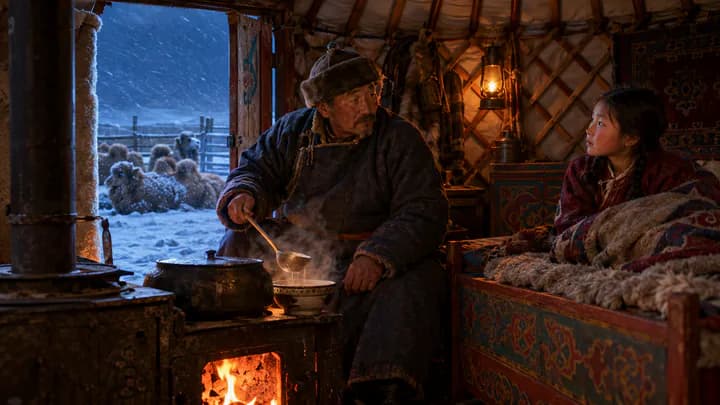
I fed two cakes of dried dung into the stove and listened to them catch. The milk tea was rising, so I lifted ladlefuls high and poured them back to make it foam, the way her grandmother used to. Outside, the camels were folded down against the corral wall with their backs to the north. Thirty-one of them. I had counted twice before dark.
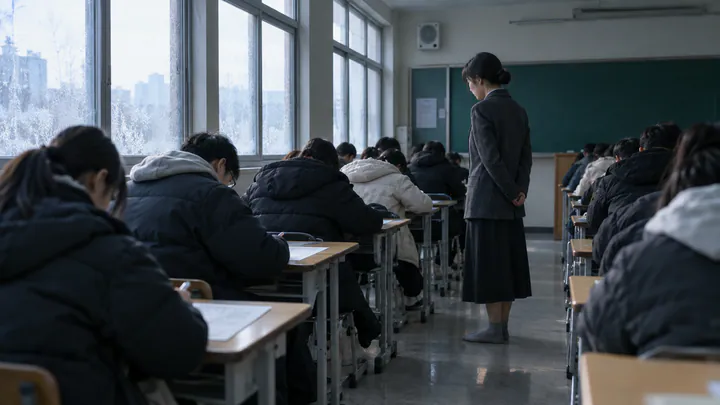
Khulan had been with me eleven days. On the first night her mother had telephoned from Dalanzadgad and said, Father, she won't go to school, she won't answer the teachers, she sits at her desk with her head down on her arms. Talk to her. She listens to you. I had not talked to her. I had let her water the camels and scrape the frozen dung from the corral and carry snow in the blue plastic basin to melt. She did all of it well and said almost nothing.
"There is a story about a salt camel," I said.
"Is it true?"
"It is older than true."
She pulled her deel over her knees. "That means no."
Before trucks, I told her, the families of this valley sent a caravan every autumn to the salt lakes in the south. Forty camels nose-roped in a string, nine days down and ten days back, because coming back they were heavy. The salt became flour, and the flour became boortsog and noodles through the winter, and that was how the valley ate.
One year a girl named Saruul walked in that caravan. She was twelve.
"Same as me."
"Younger. You are twelve and a half."
Her father had broken his leg in the summer, so she went in his place. The caravan master was a man named Dorj, who had a voice like a dropped kettle and a whip he wore through his belt like a second spine. He gave Saruul the oldest camel in the string, a gelding called Khongor, the colour of dry grass, whose front hump leaned left like a hat in the wind.
"Why the oldest?"
"Because she was the youngest. That is how men like Dorj think. Put the old with the young, and if you lose both, you have not lost much."
Khulan made a noise in her nose and said nothing.
Khongor walked well all the way south. At the salt flats the caravan dug for two days, cutting the grey crust with spades and breaking it into sacks. Saruul's mother had told her: bring home a full load, we need eight bags of flour, not six. So Saruul packed Khongor's two side sacks until the seams bulged, and when no one was looking she tied a third sack across the top of the saddle.
"That's cheating."
"That's what everyone's mother says to do."
On the morning they turned for home, at the very edge of the flats, where the white crust gives way to black gravel, Khongor stopped. He folded his front knees, then his back ones, and lay down with all that salt on him. Saruul pulled the nose rope. She pulled until the peg in his nose made him groan, and he groaned, and he did not get up.
"He was tired," Khulan said. "You said he was old."
"Maybe."
Dorj rode back along the string. He looked at the camel, and then he looked north, where the sky had gone the colour of the bottom of a ladle. "Snow by tomorrow night," he said. "I won't hold thirty-nine camels for one." He pulled the stick from his belt and held it out to her. "Beat him till he stands. Or leave him for the wolves. Your choice, girl, but make it before I reach the front."
And the other camels were full. There was no room on them. Leaving Khongor meant leaving the salt.
"Did she hit him?"
"She took the stick. She raised it."
"Grandfather."
"She raised it. Everyone raises it at least once. That is not the part of the story that matters."
What mattered, I told her, was that while Saruul stood there with her arm up, she saw that Khongor was not looking at her, and not looking north toward the pass the caravan always took. He was looking east, toward a dry riverbed that cut down between clay walls. His nostrils were opening and closing, opening and closing.
"Camels can't smell snow."
"Can't they? Go out and ask ours why they're lying with their backs to the north."
She did not go out. She pulled the deel higher.
The caravan moved off. Saruul heard the bells grow small. She put the stick down on the salt. She untied the third sack, the secret one, and let it drop. Khongor didn't move. She unbuckled one of the side sacks, and the salt slid out of it and spread over the crust, grey and glittering, half of everything she had dug. Her hands were shaking, and not from cold.
Khongor got up. Front legs, back legs, a long complaint from deep in his chest. Then he turned east and began to walk.
"So she followed a camel."
"She walked beside him. There's a difference. In front, you lead. Behind, you drive. Beside, you are going somewhere together."
The snow came that same night, a full day early. But by then they were deep in the riverbed, and the wind went over their heads like a herd running on a roof. Saruul slept against Khongor's side under a felt blanket, with the snow piling on the clay above them. For three days they walked a way no one in her family had walked, and on the second day they came to a well she had never heard of, with a cracked wooden trough, and the camel went straight to it as if he had been there yesterday.
She came home with half a load.
"And her family?"
"Her mother counted the sacks. Then she counted them again."
"Were they angry?"
"Very. There were six bags of flour that winter, maybe five. They ate more mutton and less boortsog. Her mother did not speak to her for a week."
"That's not fair."
"No."
"And Dorj?"
I poured her tea before I answered. "Dorj came home eight days later, by the pass, with fewer camels than he left with. He never said how many. He never gave anyone the oldest camel again."
And that, I told her, is why in this valley, when a herder sees one camel walk out of the string and stand apart, looking somewhere strange, she does not reach for the stick first. She looks where the camel is looking. And that is why the salt camel walks alone.
Khulan held the bowl in both hands and did not drink. The stove ticked. One of the camels outside groaned in its sleep, the same long complaint as in the story, and she glanced at the door.
"Mama called you," she said.
"She calls every Sunday."
"She told you to talk to me."
I said nothing, which in our family is the same as yes.
She turned the bowl a little. "I thought I was Saruul. Because she's twelve. But I'm not." She said it slowly, as if she were reading it off the felt wall. "I'm the camel. I'm the one who lay down."
"Are you?"
"And you're Saruul." She looked at me properly for the first time in eleven days. "You're the one holding the stick."
"I'm holding a ladle."
She didn't laugh. "Then what am I looking at? If I'm the camel. What did I smell?"
"You tell me."
She put the bowl down and counted on her fingers, the way children count sheep that aren't there. "The olympiad class. The English centre after school until seven. The dormitory, because the olympiad school is in the city and Mama can't drive me." Three fingers. "I only wanted the first one. I liked the numbers. Then they kept tying things on."
"A third sack across the top."
"When no one was looking," she said.
The wind tried the door again and the cord held. I banked the stove for the night and set the pot at the back where it would stay warm until morning.
Tomorrow I will walk up the hill behind the corral, where the telephone finds its one bar, and I will tell my daughter that the camel has lain down at the edge of the flats, and that I am taking off half the salt. I know what she will do. She will count the sacks. She will count them again.
Khulan was already asleep, turned toward the wall, her back to the north.