The Astronomer Who Missed the Bus
An overworked observatory clerk misses her last bus home and discovers the depot after midnight keeps its own quiet constellations.
Drafted with AI and published automatically. Our editors set the standards and fix reported errors — how we work.
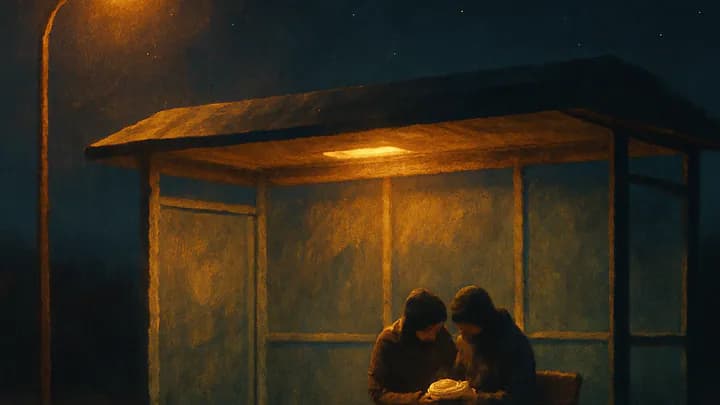
Priya ran for the bus and watched its red taillights round the corner without her. The exhaust hung in the cold like a snubbed sentence, and she stood on the empty curb holding a thermos, a canvas bag of star charts, and the particular shame of a grown woman who had timed her own life badly.
The depot clock read 12:07. The next bus out to Halden Junction, according to the peeling schedule taped inside the shelter, was at 5:42. She did the math twice because she wanted it to be wrong. It was not wrong. Five hours and thirty-five minutes, give or take a wind gust.
She sat down on the metal bench, which was cold enough to feel personal, and considered her options. A taxi would cost more than her weekly grocery budget. Her sister lived on the other side of the river and would answer the phone the way she always answered, which was to say, kindly, but with a small sigh that Priya had begun to hear even in her dreams. There was the observatory itself, forty minutes back the way she had come, where she could probably sleep on the break room couch if the security guard let her in, but the thought of walking all that way in these shoes, past the reservoir where the geese screamed at nothing, was worse than the bench.
She unscrewed the thermos. Lukewarm tea. She drank it anyway.
"You missed it too?"
The voice came from the far end of the shelter, from a bundle of coat and scarf Priya had assumed was a forgotten laundry bag. The bundle unfolded into a woman, small and round-faced, maybe seventy, with hair the color of an old nickel and a paper sack balanced on her knees.
"The 12:04," Priya said. "By about six seconds."
"Ah. I missed the 11:38. Been waiting for someone to keep me company." The woman patted the bench. "I'm Marisol. There's a pastry in here I can't eat by myself in good conscience."
Priya hesitated the way city people hesitate, then moved over. The pastry, when it appeared, was a wedge of something dense and cardamom-scented, still faintly warm through its wax paper, as if it had been baked in defiance of the hour.
"My daughter makes them," Marisol said. "She works nights at a bakery three streets over. I bring her a flask of soup, she sends me home with whatever hasn't sold. It's a fair exchange, mostly."
"It's very good."
"It should be. She's been practicing since she was nine." Marisol tilted her head at the canvas bag. "You're carrying charts."
"I work at the observatory. Not — I'm not the astronomer. I'm the person who files what the astronomers say. I write down what they see and put it in the right folder."
"That sounds like being an astronomer to me."
"It really isn't."
Marisol considered this with the seriousness of someone weighing produce. "What did they see tonight?"
Priya surprised herself by pulling out the top chart. Under the sodium light of the shelter, the paper looked jaundiced, but the marks were still clear: a smear of ink where a graduate student had noted a variable star's dip in brightness, a neat annotation in her own handwriting confirming the time.
"This one gets dimmer every three days and eight hours," she said. "Then bright again. Nobody knows why, exactly. Something orbiting it, probably. Something we can't see directly."
"So you know it's there because of what it hides."
"More or less."
Marisol nodded slowly, as if this confirmed a long-held suspicion about the universe. She wrapped the rest of the pastry and pressed it into Priya's hand. "For later. Five hours is a long time."
The depot at night, Priya discovered, was not empty so much as differently populated. A man in a reflective vest came through at 12:40 and swept cigarette butts into a long-handled pan. He nodded at Marisol like they had an arrangement. A cat with one folded ear picked its way along the top of the shelter and settled above them, radiating suspicion.
At 1:15, a young man in a delivery uniform arrived, breathless, and swore at the schedule in three languages. Marisol offered him coffee from a second thermos Priya hadn't noticed. He drank it standing up, apologized for the swearing, and told them about his newborn son, who had a full head of black hair and had already, in six days, developed opinions.
At 2:02, a woman in hospital scrubs sat down at the far end and cried without sound for eleven minutes. Nobody spoke to her. When she stood up to leave, Marisol handed her a napkin-wrapped pastry without comment, and the woman took it and walked into the dark toward the taxi stand.
"Do you do this often?" Priya asked.
"Miss the bus? Every Thursday."
"On purpose?"
Marisol smiled, and in the smile was something Priya recognized from the observatory: the private pleasure of someone who has learned to read a signal others dismiss as noise. "My husband used to drive the 11:38. Forty-one years. When he retired, he said the strangest thing he'd miss was the people who missed it — how they always seemed to find each other. He said the depot at night was the friendliest room in the city and nobody knew."
"Is he — "
"Six years ago, next month." Marisol said it without flinching. "So I come. I bring pastries. I keep the room friendly. It's not a large project, but it's mine."
Priya looked at her charts, at the marks that measured a star by what obscured it, at the careful handwriting that was, she saw now, a kind of witnessing. She thought about the graduate students who never remembered her name, and about her sister's small sigh, and about how she had been walking through her own life the way she walked through the observatory hallways, quietly, apologizing to the walls.
"I don't think I want to go home," she said. "I mean — I do. Eventually. But not on the 5:42. Not tonight."
"Then don't."
They stayed. At 3:30 an older man arrived with a violin case and a story about a wedding gig two towns over that had ended in a fistfight; he played them a slow tune anyway, not for money, just because his hands were still full of it. At 4:15 two teenagers appeared holding hands and a shared bag of chips, blinking as if they'd surfaced from underwater, and asked shyly if this was where the buses came. Marisol said yes, and offered them what was left in the sack.
By 5:30 the sky above the depot had gone the color of the inside of an oyster. Priya's feet hurt. Her back hurt. She felt, unaccountably, well.
The 5:42 pulled in on time. Marisol did not board it. She waved from the bench, small and unbothered, already scanning the far end of the shelter for whoever would arrive next.
Priya took her seat by the window. As the bus swung out of the depot, she opened her notebook, uncapped her pen, and wrote, in the neat handwriting of a professional witness: Thursday, 12:07 to 5:42. Observed: one variable kindness. Period unknown. Source, not yet catalogued.
Then she closed the book, and watched the city brighten, and let herself be carried home.