Eight Hundred Plates Before the Groom Arrives
A short story about a Samarkand plov master who finds his giant wedding cauldron cracked at dawn, with eight hundred guests due and a street full of neighbours offering loud advice.
Drafted with AI. This version has not been reviewed by an editor, so it carries no ads — how we work.
Story Time is original short fiction. The characters, places and events in this story are invented.
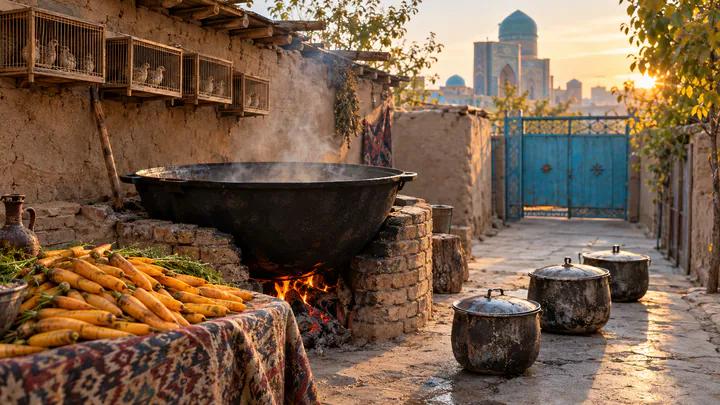
At ten past five, Bahodir laid his palm on the belly of the kazan to feel whether last night's warmth was still in the iron, and his palm came away black and slick. Oil on the outside of a cauldron is a cauldron trying to tell you something.
He crouched with the torch. The crack ran from just below the rim down into the curve of the belly, thin as a hair from Gulnora's comb, and along it the seasoning oil he had rubbed in at ten o'clock last night had crept out and gathered in a single patient drop.
"No," Bahodir said to it. "Not today."
The kazan had been his teacher's, and before that it had been a rumour of his teacher's teacher. It held enough plov for four hundred people at a time, and at a wedding of eight hundred he did two batches and nobody ever knew the difference, because he was Bahodir and there was no difference. Today's wedding was Nodira's. Nodira was Rustam's niece, raised in Rustam's house since she was six, his daughter in every way except paper, and Bahodir had been asked to cook it by Nodira's mother in front of Rustam, which was a kind of honour so sharp you could cut onions with it.
Behind him, in the wall cages, Mavluda's quails began their morning argument. Pit-pilik. Pit-pilik. Across the lane her radio came on, a man singing about a girl in Fergana at a volume intended for the girl to hear it.
"Ustoz?" Sherzod came through the gate with his sleeves already rolled and his phone already raised. He was nineteen and filmed everything. "I'll get the fire going for the light, it looks good on —"
"Put that away and bring a bucket."
Sherzod brought a bucket. Bahodir poured a ladle of water into the kazan and they both watched it bead along the crack and sweat through to the outside, slow and certain, like a guest who knows he is not invited and comes anyway.
"Oh," said Sherzod.
"Yes."
"Can I film that?"
By twenty to six the courtyard had what Gulnora called a committee. She had brought out tea in the good pot, which meant she had decided this was a public event, and the public had come.
Dilfuza-opa from number fourteen arrived first, carrying a kazan for forty against her hip like a grandchild. Komil, who had driven the number nine bus for thirty-one years and still spoke as if announcing stops, came behind her with a kazan for sixty. Mavluda turned her radio down one notch, which for her was a gesture of mourning, and contributed a pot that Bahodir privately thought was for soup.
"Three pots," Dilfuza-opa said, setting hers down beside the heaps of yellow carrots Sherzod had spent last evening cutting into matchsticks. "Split it. Problem finished."
"Three pots is three plovs," Bahodir said. "A wedding has one plov."
"Dough," said Komil. "My father sealed a samovar with bread dough. It held until Brezhnev."
"Your father's samovar did not have two hundred kilos of rice in it."
"Anvar can weld it," Mavluda said.
"Anvar is in Navoi at his sister's," said three people at once.
The bread seller came down the lane on his bicycle, calling, "Non! Issiq non!" and the committee bought six rounds without looking at him and tore them up over the tea. Sherzod, who believed in trying things, mixed flour and water in a bowl and pressed a grey rope of it along the crack. Bahodir poured another ladle. The water found its way around the dough with the ease of an old man finding the shortcut through a bazaar.
"Dough is for samovars," Komil admitted.
At six o'clock Bahodir stood over the three borrowed pots and did arithmetic aloud, which he never did, because a man who has cooked thirty years of weddings does not count; his hands count. Forty and sixty and the soup pot. Eight batches. Eight fires. Eight chances for the rice to come out different, and eight hundred guests who would each eat from a different pot and each go home with a different opinion, and every one of those opinions would arrive at Rustam's gate by evening.
Bahodir lost his touch, they would say. Bahodir cooked Nodira's plov in soup pots.
It was Mavluda who said it, in the end. She said it to her quails, but at a volume intended for the courtyard. "Of course, Rustam has a big one."
The radio singer paused between verses. The committee found things to look at: the carrots, the bread, the sky over the plane tree where the swifts were doing laps.
Everyone on the street knew about Rustam's kazan. Everyone also knew about the spring cook-off of 1996, when the judges gave the prize to Rustam's plov and Bahodir told anyone who would listen that the judges had colds. They knew about the raisin dispute, which was older than Sherzod. They knew that at every wedding where one of them cooked, the other stood near the back and ate one spoonful with the face of a man reading a bad newspaper.
"Rustam is the uncle," Bahodir said. "The uncle stands at the gate and greets people. He does not lend his kitchen to the cook."
"Nobody said kitchen," said Dilfuza-opa. "Mavluda said kazan."
"I said it to the quails," said Mavluda.
Bahodir drank his tea. It was too hot and he drank it anyway, which Gulnora noticed and said nothing about, which was worse than if she had said something.
At twenty-five past six he put the bowl down.
"Sherzod. Wash the carrots again."
"They're washed."
"Wash them so you are busy."
He went out through his own gate into the lane. The street was still blue at the edges, woodsmoke drifting low from the courtyards where other people's breakfasts were happening, and the bread seller was still at the far end ringing his bell. Bahodir crossed the lane slowly, because a man of fifty-eight does not hurry towards a rival's gate, and because behind him he could hear the committee following at a respectful distance while pretending to do other things. Komil was inspecting a drainpipe. Dilfuza-opa had discovered an urgent need to sweep a stretch of road that was not hers.
Rustam's gate was blue metal with a pattern of stars punched into it, repainted for the wedding. Bahodir raised his hand and the gate opened before he knocked.
Rustam stood there in his undershirt and an embroidered skullcap, holding a bowl of tea, looking as if he had been awake a very long time and had enjoyed none of it.
"Bahodir-aka."
"Rustam-aka."
They had used the respectful form with each other for thirty years. It was the only weapon either of them was allowed in public.
Bahodir looked past him into the courtyard so he would not have to look at his face, and said it properly, the way you are supposed to say a thing in front of witnesses. "My kazan has cracked. I have eight hundred guests for your niece by noon. I need to borrow yours."
Behind him, Dilfuza-opa stopped sweeping.
Rustam stepped aside.
Just inside the gate, on a flat handcart with new rope on the wheels, sat Rustam's kazan. It had been scrubbed until the iron showed grey, then oiled until it shone black again, and someone had draped a clean bedsheet over the top to keep the dust off. Two split logs leaned against the cart, ready to wedge it on the slope of the lane.
Bahodir looked at it for some time.
"When?"
"Midnight." Rustam sipped his tea. "Iron that old does not crack quietly. It went like a pistol. I said to Zulfiya, that is Bahodir's kazan. She said go over and tell him. I said he will come."
"You could have brought it."
"And you would have stood in your gate and told me you had a plan, and sent it back, and cooked my niece's wedding in Dilfuza's pot to prove it."
Bahodir opened his mouth and found there was nothing in it that was not true.
"Six and a half hours," he said instead.
"I slept in a chair." Rustam handed his tea bowl to someone in the courtyard, possibly Zulfiya, possibly a cousin, and took one handle of the cart. "Well? It is not going to walk."
Bahodir took the other handle. They eased it over the gate step together, and the committee abandoned all pretence and surged forward to help, Komil calling out directions as if the lane were a bus route. Sherzod came running with his phone up. Nobody told him to put it away.
Halfway across the lane, Rustam said, without turning his head, "The raisins."
"My raisins."
A long pause. The cart wheel squeaked.
"Your raisins," Rustam said. "Today."
They set the kazan into the brick hearth beside the cracked one at twenty to seven. Bahodir sent Dilfuza-opa's pot to boil the chickpeas, Komil's to keep water hot for the rice, and Mavluda's to make tea for the street, because every pot that comes through a gate on a wedding morning ought to go home having done something. Then he lit the fire under Rustam's kazan, poured in the first long ladle of cottonseed oil, and listened to it begin to warm.
"Stand there," he told Rustam, pointing with the skimmer to a spot by the hearth where a man could see everything. "If you are going to criticise, you should at least watch it done properly."
Rustam stood there. He did not go to the gate to greet anyone for nearly an hour.