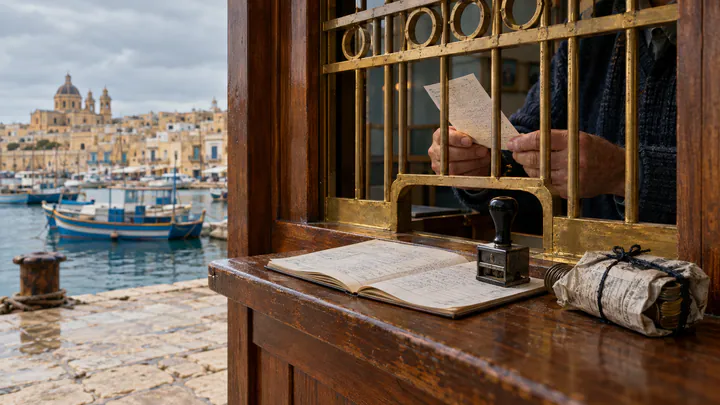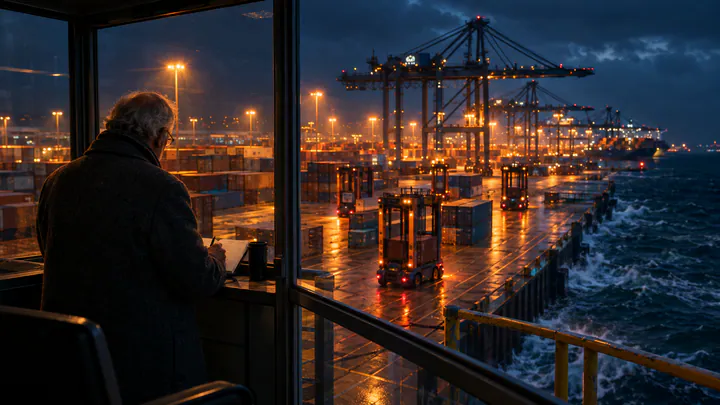
The Weighbridge Closes at Midnight in Flacq
A short story about a weighbridge clerk at a Mauritian sugar mill who must decide, minutes after the gate closes, whether an old planter's last load gets weighed.
Drafted with AI. This version has not been reviewed by an editor, so it carries no ads — how we work.
Story Time is original short fiction. The characters, places and events in this story are invented.
At 11:49 the printer ate another ticket. Josiane heard the change in its chatter, the print head stuttering against paper gone soft as a warm roti, and she had the cover up before the second line could smear.
Twenty years in the weighbridge cabin had taught her the machine's moods. She worked the crumpled strip out with the flat end of a pencil, blew into the feed slot, and threaded a fresh run from the box she kept on top of the transformer, where the heat kept the paper a little drier. November in Flacq did not believe in dry. The cabin window wept on the inside, and through it the last estate lorry of the queue sat on the platform with its chains still singing.
She pressed the key again. The head ran clean: gross, tare, net, ticket number 41,207, 23:51. She tore along the serration and passed it through the hatch.
"Last one, madam?" the driver asked.
"Last one for you. Go and tip before Sooprayen shouts."
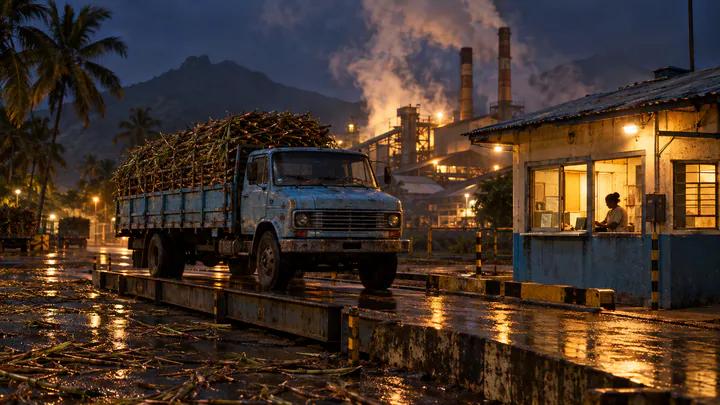
From the guardhouse by the gate came Clency's transistor, a séga with a ravanne beating under it and a singer complaining that his woman had left him for a man with a motorcycle. Clency turned it up every night after eleven, when the managers' cars were gone. Except tonight one car was not gone. Across the yard, behind the boiler house and its chimneys breathing white into the dark, the light in the general manager's office was still on.
Josiane looked, as she did every night, at the memo taped beside the scale indicator, exactly at the height of her eyes. With effect from this season, no weighbridge ticket shall be issued after the published closing time. Late tickets will be treated as a disciplinary matter. — A. Rivalland, General Manager. He had underlined disciplinary twice in blue felt pen.
In August, Jean-Noël on the day shift had printed a ticket at 6:07 for a lorry whose driver was his cousin. Rivalland had moved him to the bagasse store with a shovel, and everyone at the mill, down to the boys sweeping cane trash off the tarmac, had understood the lesson without anybody saying it twice.
Her application was on that same man's desk. Three pages, typed by her niece on the office machine after hours, twenty seasons without a discrepancy. Shift supervisor: day hours, a desk with a fan, a pension that would mean something. Rivalland had said he would decide before the inter-crop. The inter-crop began tomorrow.
At 11:58 she ruled off the tally sheet and wrote the season's total for the night shift in her small upright hand. At midnight the radio gave the pips, Clency dropped the gate bar and wrapped the chain around it twice, and she wrote CLOSED 00:00 and initialled it. The boilers would keep hissing until two or three, until Sooprayen's men had pushed the last of the yard stock onto the carriers. But the weighbridge was finished. She allowed herself to unpin her hair.
At 12:11 a horn sounded on the coast road, twice, the second note weaker than the first.
Headlights came up toward the gate, one bright, one yellow and dim. A flatbed lorry, the blue of its cab gone chalky, cane piled high and tied with rope instead of chains. Steam leaked from under its bonnet. Clency's torch swung over it, and she heard voices, Clency's flat and patient, another one old and quick.
Clency came to the hatch with the torch still on. "Boodhoo. From Camp de Masque."
"The gate is closed."
"I told him."
He did not move away, though, and behind him the old man was already coming across the tarmac, cap in his hand, walking the careful way of someone whose knees had been cutting cane for fifty years. Josiane knew him. Everyone at the mill knew him. Small planter, four arpents by the river, a lorry older than her marriage. Once, years ago, he had brought her a bag of litchis because she had caught a mistake on his tare card that would have cost him three hundred rupees.
"Madam Josiane." His hands were black to the wrist. "Hose split near Palmar. My grandson tied it with an inner tube and we came slowly, slowly, stopping to put water."
"Tonton, it is twelve past."
"I know what time it is." He said it without anger. "Six tonnes, maybe more. The last of the field. Cut Wednesday morning. You know how long cut cane waits."
She knew. Two days in the sun and the sugar started turning sour inside the stalk. By the time any mill opened again there would be nothing in that cane worth crushing. It would go to somebody's cows, and the cooperative loan for the fertiliser would still be there in January, waiting for him.
Clency leaned in close to the glass, lowering his voice under the séga. "The printer jams. Everybody knows it jams. You write a manual slip, eleven fifty-five, printer fault. I write the same in my gate book. Finished."
She looked at him. He was offering his own book, his own name, and he was not looking at her while he did it.
"And the ticket numbers?" she said. "Forty-one two-oh-seven was at eleven fifty-one. The manual slip goes in the jam log, and the jam log has the clock time from the indicator, and he reads the jam log. He reads everything, Clency. That is the kind he is."
"So he reads it."
"So it is a lie in three places instead of one."
Clency straightened. The old man stood with his cap, not pleading, which was worse. In the lorry cab a boy of about sixteen gripped the wheel with both hands as if the engine might die if he let go.
Josiane looked at the memo, at the underlining, at her own reflection in the wet glass over it. Then she reached for the switch that woke the indicator.
"Lift the bar," she said.
"Josiane."
"Lift it, and tell the boy to come on slowly. If he brakes hard on my platform I will charge him for it."
The lorry crept on. The platform took it with the low groan she felt through the cabin floor more than heard, and the red digits climbed, wavered, settled. Gross 12,380. She pulled the old man's card from the planters' file, the cardboard furred at the corners from thirty seasons of handling. Tare 5,640. Net 6,740 kilos.
She pressed print. The head moved two characters and hesitated, the paper buckling. She cupped her palm over the feed, breathed warm air into it, and the machine coughed and ran.
Ticket 41,208. Gross, tare, net. 00:19.
She did not look at it for long. She handed the planter's copy through the hatch.
"Go to the yard. Sooprayen's carriers are still running. Tell him I said put it straight on, don't let it sit."
Boodhoo read the slip, and his thumb went over the time as if he could rub it off. "This will make trouble for you."
"Tonton. Go before your hose splits again."
When the tail lights had turned toward the cane yard, she tore the office copy off, folded it once along a clean line, and locked the cabin behind her.
The tarmac was slick with cane trash and dew. The smell of burnt sugar from the bagasse furnaces sat in the back of her throat the way it had for twenty Novembers. She walked past the boiler house, where the hiss was loud enough to make her own footsteps silent, and up the outside stairs to the office with the light.
Rivalland was in his shirtsleeves, the season's crushing figures spread over the desk under a stapler. He was younger than her by perhaps five years and had a habit of taking his glasses off before he spoke, as if to give the other person a fair chance.
"Madame Moutou. The weighbridge is closed."
"It was." She put the ticket on top of his figures and unfolded it. "Now there is one more."
He took his glasses off. "Nineteen minutes past."
"Boodhoo, Camp de Masque. Broke down on the coast road. Six tonnes seven hundred and forty. Cut Wednesday."
"You have read my memo."
"Every night. You put it at the height of my eyes."
Something moved at the corner of his mouth and was put away. "Then you know what I did with Jean-Noël."
"I know. That is why I brought it myself. Someone could have written you a different time. You would have found it, because you look. I prefer you find it from me."
She took the pen from her blouse pocket, bent over his desk, and wrote beside the time, small and upright: Weighed by J. Moutou, clerk. Late arrival, vehicle breakdown. She dated it and signed it.
In the tray by his elbow she could see a folder with her niece's careful typing on the label. Rivalland saw her see it. Neither of them touched it.
"You understand I cannot simply put this in a drawer," he said.
"I didn't bring it to go in a drawer."
He stood and went to the window. Below, under the yard lights, Sooprayen's men were forking the old man's cane onto the carrier, and the carrier took it up its slope toward the knives with the steady clank it had made all season. Rivalland watched until the last bundles went over the top. He did not say anything else, and she did not wait for him to.
Back in the cabin it was 12:31. The radio had moved on to a slower séga. Josiane opened the tally sheet, drew one neat line through her midnight total, wrote the new figure beneath it, and initialled both.