The Same Six Numbers from Strada Mezzodì
A short story about a meticulous Valletta lotto clerk in 1964 who sees a dead fisherman's numbers still arriving every Saturday in his handwriting, and has three weeks to learn who sends them.
Drafted with AI. This version has not been reviewed by an editor, so it carries no ads — how we work.
Story Time is original short fiction. The characters, places and events in this story are invented.
Saturday, 3 October 1964
At twenty past eleven a boy of perhaps nine pushed a folded slip and one shilling and sixpence under my grille and ran before I could give him his counterfoil. The numbers were 7, 14, 23, 41, 66, 90. The hand was Salvu Mifsud's.
Salvu Mifsud was buried at the Addolorata on the eleventh of August. I sent carnations from the booth fund.
I know his hand the way I know the bell at St Paul's. His sevens are crossed in the middle, as some schoolmaster must have taught him; his fours stay open at the top like a gate he never troubled to shut. This is the third Saturday running. Twice I told myself I was mistaken. I am not often mistaken; that is what the Department pays me for.
I entered it in the official ledger as I enter everything: slip number, stake, player's registration, 2214. I did not write in the official ledger what I write here, which is that my hand was not steady on the stamp.
Monday, 5 October
Is-Sur Cassar came down from the Department with the new forms, which no longer have a crown on them, and with a circular. Quarterly audit of irregular tickets. Any slip bearing the registration of a deceased player is to be voided and reported to the Police at Floriana.
He read it to me aloud, though I can read. Then he ran his finger down my ledger.
"Twenty-two fourteen. Mifsud. Didn't he drown?"
"A stroke, sir. On the wharf. In August."
"Then he is very keen." He tapped the page twice. "Audit closes on the twenty-sixth. A dead man's number is either a ghost or a thief, Sinjura Carmena, and the Department does not insure against ghosts."
Three Saturdays. In twenty years I have not made one correction in red ink. I do not intend to begin by sending Salvu Mifsud's name to the police.
Wednesday, 7 October
Went after closing to Strada Mezzodì, to the bottom end where the street runs out against the bastion, to see the widow, Rożina.
She gave me coffee and nothing else. Three neighbours arrived in the time it took the water to boil, and they did not sit. I asked, as lightly as I could, whether anyone in the family still played Salvu's numbers.
"Who would?" said Rożina.
"Numbers aren't property," said the one called Ġanna, who has a mole by her lip and a voice like a ladle on a pot.
"The Government took enough off him while he was alive," said another.
I did not say the word police. On the dresser stood a biscuit tin with a faded coronation picture on the lid. "He kept every counterfoil," Rożina said, when she saw me looking. Then she got up and put the tin in a drawer, and Ġanna showed me to the door as if it were her own.
Saturday, 10 October
A different boy. The same slip. Eleven-twenty, one and six.
This time I held it up to the window of the booth. The figures are right, but they are not Salvu's. Salvu pressed hard on the downstroke and lifted between, quick, a man with a boat to get to. These lines carry the same pressure the whole way, slow, the way a child copies a capital letter off the blackboard.
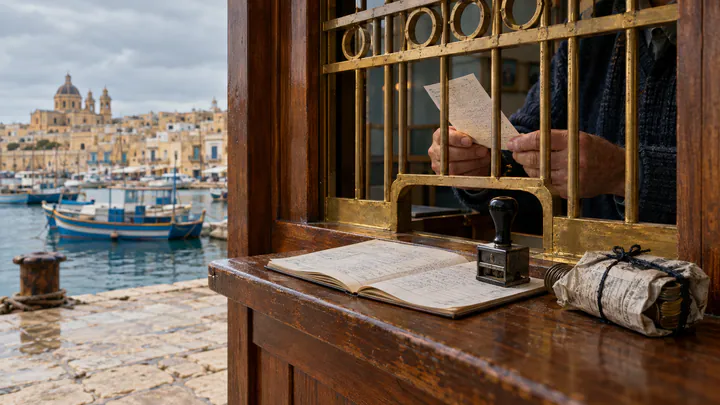
And in the bottom corner, pressed up into the paper from underneath, a ring of letters reading backwards. My own date stamp. LOTTO VALLETTA, 4 MAR 1961. Someone had laid a new form over one of Salvu's old counterfoils and gone over every line so hard that my stamp from three years ago came through, like a shell in limestone.
The coins were wrapped in newspaper and tied with black twine, stiff with tar. When I asked the boy who had sent him, he said, "A man." In Valletta that is the same as saying "the sea."
Tuesday, 13 October
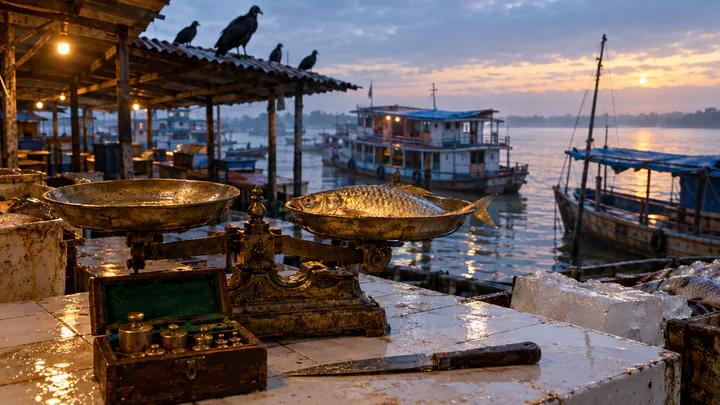
Took the twine down to the fish market at half past six, before opening. It is lampuki season and the slabs were silver and gold to the far wall. Every man there uses tarred twine. It was like asking which hen laid an egg.
But the man gutting lampuki at the third slab had fished beside Salvu for thirty years, and grief makes people talk before they remember not to. "The brother still mends the nets for the kannizzati," he said. "Wenzu. Doesn't go out any more. His chest." Then he remembered who I was, and found something urgent at the other end of the slab.
Saturday, 17 October
I cannot leave the booth, so I paid Pawlu, who shines shoes at the corner by the steps, threepence to follow whatever boy came at eleven-twenty.
Pawlu came back at noon with his box under his arm. The runner went down to the wharf, to a big grey man on an upturned crate with a net across his knees, and the man gave him a penny. "His breathing whistles," Pawlu said. "Like a kettle with a cloth on it."
Two Saturdays gone.
Thursday, 22 October
Gregale since Tuesday. Nothing has gone out of Marsamxett all week, and the wharf is empty of nets.
So I went back to Strada Mezzodì, not to Rożina's door but to the one two up from it. The ground-floor window faces the grey light off the water. Through it I saw a big man standing with two papers pressed flat against the glass, a carpenter's pencil in his fist, the tip of his tongue between his teeth. On the sill beside him, the coronation tin.
I knocked. He opened the door with the pencil still in his hand, saw who I was, and put the pencil behind his back like a schoolboy.
"Is-Sur Wenzu. I'm from the lotto booth."
"I know where you're from." He did not ask me in, but he did not close the door either. "I can't write, Sinjura. Salvu wrote mine. Forty years. His slip, my slip, and when we won, twice, we split it down the middle like bread."
"Clerks write slips for players who can't. You only had to ask me."
"Then it would be your hand." He said it gently, as if I were the one who did not understand something simple. "His hand had the luck in it. You keep the hand, the luck stays in the house. Rożina has the pension and four chairs. If they ever come up, she takes the ticket in. Nobody questions a widow."
"They will now," I said, and I told him about the circular, and Floriana, and the twenty-sixth. The colour went out of him like water out of a cracked jar.
"It isn't stealing."
"No. On paper it's a dead man's registration. On paper that is worse."
He looked at the slip still flat against the window. "Seven is the boat's number in the register. Fourteen, our mother's birthday. Twenty-three, this house. Forty-one, the year the boat went down in the bombing and we built the new one. Sixty-six, he said, looked like two lampuki chasing each other. Ninety, because the biggest number comes when you've stopped watching for it."
I asked him then whether it was the numbers he wanted or his brother's hand. He thought about it for so long that the wind rattled the shutter twice.
"The numbers," he said. "The hand's in the tin."
Saturday, 24 October
Eleven-twenty. No boy. Wenzu himself, in a clean shirt, holding the newspaper twist of coins in both hands as if it might blow away.
I took a new form, the one without the crown, and wrote the six numbers in my own hand. I read each one back to him and he nodded at each, and at ninety he closed his eyes. I issued him a registration of his own, 2391, and stamped it.
When he had gone, I opened the official ledger. Six Saturdays stood there under 2214: the nineteenth and twenty-sixth of September, the third, tenth and seventeenth of October, and the slip from today's first post, which he had sent before he lost his nerve to come. Through each 2214 I ruled one line, with the edge of the stamp-pad tin, so that the old figures can still be read, as the regulations require. Beside each I wrote 2391, and in the margin: Player unable to write; slip prepared by player from his own copy. Amended by clerk. Then my initials, six times.
Black ink. Not red. That much of my record I have kept.
Monday, 26 October
Is-Sur Cassar ran his finger down the ledger and stopped at the first amendment. He stayed there a long while. He knows I have never initialled a correction in twenty years.
"Mifsud," he said. "I had him dead."
"The other one, sir. The brother."
He looked at the six sets of initials, and at me, and then at the initials again. "Neat," he said, and turned the page.
Saturday's draw was 3, 19, 41, 52, 88. Wenzu came by at closing to ask what one number pays. Nothing, I told him. He nodded, tucked the counterfoil into his shirt pocket, and said that was all right; the luck was only finding out where he lived now.