The Felt Remembers Every Winter It Kept
A short story about an old felt-maker in Ulaanbaatar's ger district who hears past families in the walls she mends, and must decide whether to sell her own ger.
Drafted with AI. This version has not been reviewed by an editor, so it carries no ads — how we work.
Story Time is original short fiction. The characters, places and events in this story are invented.
Drink it before it skins over. You have measured my fence twice, and the ground will not get any bigger for being measured a third time. The salt is already in. Don't add more. You city boys always add more.
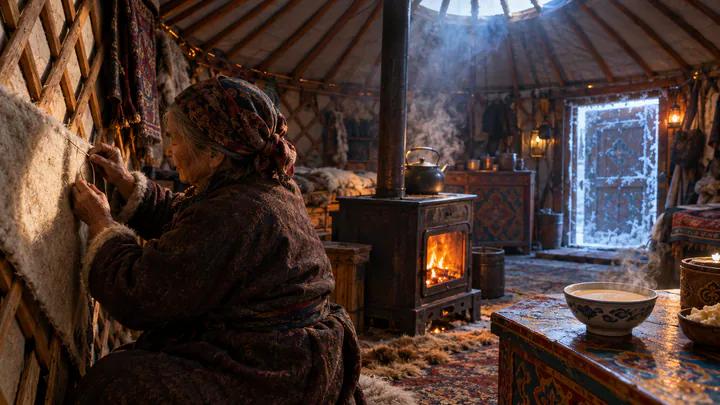
Put your tape measure by the stove; the spring has frozen, I heard it stick. And put the paper down, Tsogoo. I know what it says. The offer is good until the first day of Tsagaan Sar, and after that the company with the blue sign will build its towers around me and I will be an old woman in a felt tent at the bottom of a well. My son has explained it. He explains it every Sunday, and twice on the telephone.
You want to know why I haven't signed. Sit nearer. No, the other side, that's the guests' side. There. You can see the north wall from there.
My husband raised this ger in 1974, on the grass outside Tsetserleg, the autumn we married. The lattice came from his uncle. The felt I made myself, with my two sisters and a borrowed grey horse that kept stopping to eat. You lay the wool out on an old hide, you beat it with sticks until your shoulders scream, you sprinkle it with water, you roll the whole thing up and tie it behind the horse, and the horse drags it across the steppe until the wool forgets it was ever separate hairs. That's felt. It's wool that has been made to agree with itself.
Ganbold put the ger up in four hours. He was proud of that; he timed it with his father's watch. Then he sat down where you're sitting and turned on the radio, and the first thing he ever said inside these walls was that the announcer was a liar about the milk quotas.
We came to the city in 1996, when the state farm stopped paying. Everybody came then. You'd have been a baby. We found this plot on the hill, built the fence from old pallets, and Ganbold put the ger up again. Five hours this time. He blamed the slope.
I started mending walls for the neighbours because I was the only one on the hill who knew how. Felt wears through where the lattice rubs, at the elbows, you could say. Coal soot gets into it and makes it brittle. A good patch is cut a hand wider than the hole and stitched with doubled thread, tight, so the wind can't find the edge.
The first time I heard them, I was patching the Dulmaa family's west wall. Winter of 2000, the bad dzud, when the animals died standing up all over the countryside. I had my cheek against the felt to see the stitch from the inside, and I heard a woman counting. Forty-one. Forty-two. Her voice was flat as a plate. Dulmaa told me later that her mother had counted the dead sheep every morning that spring, out loud, until there was nothing left to count, and then they packed the felt on a truck and came here.
Don't look at me like that. Drink your tea.
After that I heard them every time. A boy practising long-song in a wall from Khövsgöl, cracking on the high note, again and again. A man and wife arguing about whether to sell a motorbike. A baby being named. Felt keeps the winters it held, Tsogoo. Summers go straight through it; summer is all open doors. But winter, when the stove runs all night and everyone is close together inside, it soaks in. I never told the families. I stitched, I took my payment in flour or coal or nothing, and I went home.
Ganbold died four winters ago. A clot, the doctor said. He was carrying a sack of coal up from the gate.
And every evening since, at seven, when the news starts, he argues with the radio. Not loudly. Like a man in the next room. He tells the announcer that the price of flour is a scandal, that parliament is a herd of goats, that the weather girl is guessing. I turn the radio on so he has something to argue with. My son thinks I'm lonely for the noise.
Erdene drives for a mining company. He is a good son; you have met him, he is the one who rang your office. He has paid the deposit on a flat in the thirteenth district. Third floor, radiators, a bath with a door that closes. He has a daughter, Saruul, who is six, and every winter she coughs. You've seen the hill in the morning, the smoke lying in the gully like wet wool, every chimney feeding it. Last January she stayed here with me for two weeks while her mother was in hospital, and she coughed every night, and I sat up feeding the stove and listening to her.
Erdene says, Eej, you can't haul coal at seventy. He says, The flat has a room for you. He doesn't say, Saruul will not come up the hill again in winter, but that's in it too. I can hear what's inside a sentence. That's not magic. That's having a son.
In December I mended Dulmaa's wall again, the same west wall, a new tear beside my old patch. I put my cheek against it.
Nothing. Wool. Soot. The cold coming through.
I went home and sat by this stove and waited for seven o'clock. Ganbold was there, but further off. Like he had walked to the gate and was arguing from the gate. Every night since, a little further.
I don't know which of us is leaving, Tsogoo. That's the truth. Either the felt is letting go of what it kept, or my ears are, or something in me that used to reach into the wool has gone stiff, like your tape measure. I have sat up nights trying to decide. If it's the felt, then staying here is keeping a house for no one. If it's me, then staying is keeping a house for someone who can't hear it anyway.
Three nights ago I couldn't sleep. The stove was low and I didn't get up to feed it, which I never do. I lay on that bed with my ear against the north wall, the old wall, the first one I made with my sisters and the grey horse.
I didn't hear Ganbold.
I heard Saruul. Coughing, the way she did last winter, small and dry, and then my own voice, very quiet, singing her the song about the camel who lost its calf. I don't remember singing that. I must have been half asleep.
So it still works. It's still keeping. It kept her.
And I lay there and thought: it will keep this winter too, whatever happens in it. It isn't the hill that holds them. It's the wool.
Give me the paper.
No, wait. Before the pen. You draw the flats, yes? Not only measure, you draw them. Then you can do this. In my son's flat, the room for me: I want one wall lined with my felt. The north wall from here, the old one. Not hung like a carpet. Lined, properly, from floor to ceiling, fixed so it touches all along. Wood strips behind, whatever you need. I'll cut it to fit myself; my hands still work.
You're going to tell me about fire rules. Concrete. Damp. I know about damp better than any engineer. Felt breathes. It will be fine.
Look at you, frowning at the wall like it's going to tell you something.
So?
Yes?
Good. You said yes before you knew why. Ganbold raised this ger that way the first time, before he'd even seen the grass he was putting it on. Pass me the pen. And finish your tea. It's nearly seven, and I want the radio on.