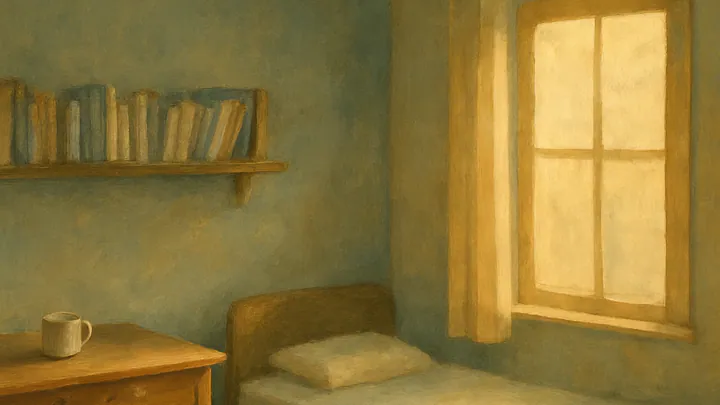
Eleven Minutes Between Earth and Mars
A piano tuner on Earth trades recorded messages with her brother on a Martian survey outpost. With a signal delay neither can shorten, they finally learn how to say the things the airport swallowed.

My brother's voice arrived eleven minutes after he made it, so every time he laughed I was hearing something that had already finished happening.
The first message came while I was kneeling inside a client's upright with a felt needle between my fingers, softening a hammer that had gone bright and glassy. The earpiece chimed. I nearly deleted it unheard. Theo had been off the planet four months by then, and we hadn't spoken since the airport, where I said the worst true thing I have ever said to anyone.
“Iris,” his recording said. “It's dusty here. Obviously. Everything is dust. I keep finding it in my teeth.” A pause — the strange, roomy pause of someone who knows nobody can cut in. “I'm not asking you to write back.”
I sat on that client's carpet with the needle in my hand until the light through the bay window went the color of weak tea.
Eleven Minutes
Nobody tells you that talking across that much distance isn't conversation. It's correspondence with a pulse. Theo was a dust-mitigation technician on a survey outpost — filters, seals, panels swept twice a shift — and the signal between us took anywhere from four minutes to twenty-two, depending on where the two planets happened to be standing in relation to one another. There was no interrupting. No talking over. No stopping a person mid-sentence to say that is not how it happened.
Which is, I suspect, the only reason we managed it at all.
I started small. I recorded the A above middle C on the 1912 grand in the back of the shop, the one nobody buys because the case is scarred, and I said, “This is the only honest note left in this building. It's yours.” Eleven minutes out. Eleven minutes back. Twenty-two minutes later he sent me the sound of grit hitting the hab window, which is exactly like sleet, except drier and somehow politer, as though the weather were knocking.
We traded sounds for weeks before we traded anything else. He sent the hum of the scrubbers, a three-note warning chime he said he heard in his sleep, the click of his boots on a floor grate. I sent him the shop cat complaining, the tenor of a bench that squeaks in G-sharp, a chord I built one note at a time so he could hear the beats slow down and disappear as I brought a unison home.
“That's the sound of something stopping being wrong,” he said, eleven minutes later. “Do that again.”
So I did.
Our mother had moved into the Larches three weeks before Theo took the posting. That was the shape of the injury. June Mardell, who taught music at the secondary school for thirty-one years, who could sight-read anything you put in front of her, was losing her nouns first and her people second. She still had her hands. She still had a waltz she'd hummed my whole life, something in three with a stumble in the middle where she always lost the words and laughed and started again.
At the airport I had said: “Go on, then. She won't notice you're gone. That's the part you're counting on.”
He didn't answer. He put his bag on the belt and went through the gate and I stood there for a long time in the noise, waiting for a reply that had eleven minutes and then eleven months to find me.
I never mentioned it in the messages. Neither did he. We just kept sending each other sounds, the way you leave food outside a door for something wild that hasn't decided about you yet.
Twelve Days of Nothing
In November the lag stretched to twenty-two minutes, and then the sun moved between us.
Conjunction, they call it. For twelve days the star stood in the middle of the conversation and shredded anything we tried to send through it. The system said: messages will queue for delivery. The system said: expected resumption, 4 December.
It was the worst fortnight my mother had all year. She stopped eating unless someone sat with her. She asked for her own mother twice. On the Thursday she looked at me with complete clarity and asked where Theo had gone, and I said he'd taken a job very far away, and she said, “Well, that's not like him,” and then she was gone again, out on the water somewhere I couldn't row to.
I recorded twenty-three messages into the blackout. I knew they were going nowhere. That, I think, is exactly why I could make them.
I told him about the airport. I told him I'd rehearsed that sentence in the car park because I wanted it to leave a mark. I told him that on the days I drove to the Larches after work with the tuning kit still in the boot, I sometimes sat in the car for ten minutes fantasizing about driving straight past, all the way to the coast, and that I hated him for doing the thing I was too much of a coward to do, and that I'd dressed the hatred up as loyalty because loyalty is easier to carry into a room.
I told him about the waltz. I played it badly into the microphone and said, “She stumbles in the same bar every time. I've started stumbling there too. I don't know if that's grief or manners.”
Then I sent the whole pile into the sun.
On the fourth of December my earpiece chimed at ten past six in the morning, and it kept chiming for an hour and a half.
He had queued his own twelve days. He'd been talking into the dark too.
“I thought distance was a kind of courage,” he said. “I genuinely did, Iris. I thought if I went somewhere hard enough, it would count as facing something. I was two months in before I understood I'd just gone where nobody could watch me not cope.” A long breath. The scrubbers, underneath, like surf. “You were right at the airport. You were right and you were cruel, and I've decided I'm allowed to hold both.”
Then, forty minutes of messages later: “Play the stumble again. I want to hear where she loses it.”
I did. Eleven minutes out, eleven minutes back, and in between I made tea and watched the sky go pale over the shop roof, and it occurred to me that I had never in my life given anyone twenty-two uninterrupted minutes to consider what I'd said.
He came home in February, rotation complete, slow on his feet the way they all are for the first fortnight, as though gravity were a debt being collected.
We went to the Larches on his second day. Mum looked at him a long while and called him by our father's name, and Theo said, “That's right,” because arguing costs her more than being wrong does. Then I lifted the lid of the day room's terrible spinet and played four bars, and she came in on the fifth, humming, and stumbled in exactly the place she always stumbles, and laughed, and started again. Theo stood by the window with his hand over his mouth.
In the car afterwards he was quiet until the lights at the ring road.
“Are we all right?” he said. “You and me.”
The indicator ticked. A cyclist went past. I didn't say anything.
“You can answer,” he said. “I'm right here. It's instant now.”
“I know,” I said. “Give me a minute.”
And he did — he gave me the whole minute, and part of another, and I let the silence run itself out the way you let a note ring until it has finished being a note. Then I answered him.
Frequently asked questions
Why does the delay make honesty easier for Iris and Theo?
Without the possibility of interruption, neither sibling can be argued out of a sentence halfway through. The lag turns speech into something closer to letter-writing, where a person has to finish their own thought before anyone can dispute it.
What does the piano work add to the story?
Tuning is an art of listening to decay — waiting for a note to stop being a note. Iris's trade quietly teaches her the same patience the eleven-minute delay demands of her, so the ending lands as craft rather than moral.
Is Theo's leaving presented as a betrayal?
The story resists that verdict. Theo mistook distance for courage, and Iris resented him partly because she wanted the same escape; the reconciliation depends on both admitting a shared, unspoken wish.
What is the significance of the conjunction blackout?
Twelve days of enforced silence force Iris to keep speaking into nothing, which is exactly what caring for her mother has become. When the queue finally delivers, she discovers that unanswered words were never wasted words.