The Weather Reader of Junction Nine
At a lonely rail junction on the high plains, a signal keeper has a strange talent for reading storms — until one arrives that seems to be reading her back.
Drafted with AI and published automatically. Our editors set the standards and fix reported errors — how we work.
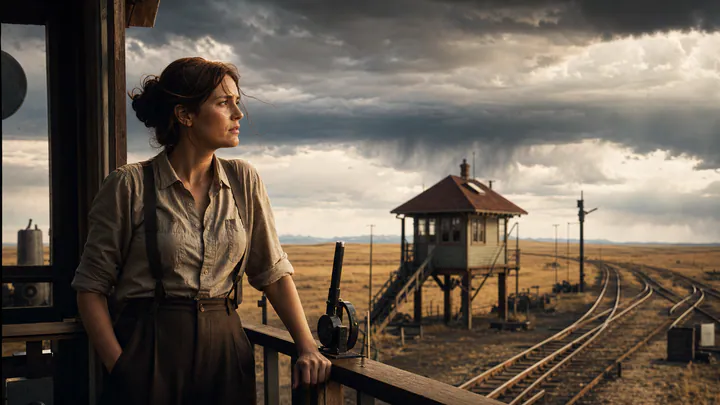
The barometer in the signal shack had been broken for six years, and Ines Corva had never once needed to fix it. She could feel the pressure drop in her back teeth, the way other people felt a song they half-remembered.
Junction Nine was three tracks, one water tower, and a tin-roofed shack the color of a pigeon's wing. It sat in the middle of a plain so wide the horizon curved. Freight trains passed twice a day. Passenger trains, once a week on Thursdays, if the schedule was kind. Ines threw the switches, logged the times, and watched the sky, which was the real job, though no one had ever written it into her contract.
On the morning the storm came, she was drinking coffee that had gone lukewarm because she'd been staring west for twenty minutes without lifting the cup. The clouds out there were the wrong color. Not the bruised green of hail weather. Not the flat gray of a soaker. Something else — a pale, brassy shade she had seen exactly twice in her life, and both times something had happened she did not like to remember.
She set the cup down and went out onto the platform.
The air smelled like a struck match. The prairie grass leaned east though there was no wind she could feel. A meadowlark started a song and stopped in the middle, as if it had thought better of it.
“All right,” Ines said to the sky. “What are you.”
The sky did not answer, but the wire above the tracks hummed a note it did not usually hum.
The Timetable
She had inherited Junction Nine from her father, who had inherited it from his aunt, who had, according to family legend, been sent out here as punishment for a love affair that scandalized a town whose name no one bothered to remember anymore. The Corvas were weather people. It ran in them the way red hair ran in others. Her father had known three days in advance when the blizzard of ‘78 would swallow the northern line. Her great-aunt was said to have felt the drought of 1934 begin in her left ankle in the winter of 1932.
Ines had felt her husband's heart attack four hundred miles away, though she had told no one this and did not intend to. She had been mending a shirt cuff. The needle had gone still in her hand, and she had looked up at a cloudless afternoon and known that something enormous had come loose in the air. The phone call arrived nineteen minutes later.
That had been eleven years ago. She had asked to be transferred to Junction Nine the following spring. Her supervisor, a kind man named Halberd, had asked her if she was sure. “It's lonely out there, Ines.”
“I know,” she'd said. “That's the point.”
Loneliness was a weather she could read.
The Storm That Knew Her Name
By noon the brassy color had spread across the whole western sky. The 12:14 freight came through on time, and the engineer waved at her from the cab with the particular tight face of a man who was watching his mirrors. She threw the switch, watched the cars pass — grain, grain, grain, tanker, grain — and when the last car cleared the points she went back inside and picked up the handset.
“Halberd,” she said, when he answered. “I need you to hold the 3:40 at Sable Creek.”
“Weather?”
“Weather.”
He didn't ask her what kind. He never did. He had been her father's dispatcher too. “Held,” he said, and hung up.
She stood in the doorway of the shack and watched the storm arrive.
It came slowly, which was the first strange thing. Prairie storms usually galloped. This one walked. She could see the curtain of it advancing across the grass, a slow tilt of light and shadow, and the grass bending under it in orderly rows, as if being read.
The second strange thing was that when it reached the outer fence line, it stopped.
Ines stood very still.
Rain fell inside the storm's boundary. She could see it, silver and heavy, hammering the far pasture into mud. On her side of the fence, the sun still shone. A fly landed on her wrist and walked in a small confused circle.
“What,” she said, quietly, “do you want.”
The wind on the far side of the fence shifted. A word rolled out of it — not spoken, exactly, but arranged. She felt it settle in her teeth the way pressure did.
Ines.
She sat down on the platform steps because her knees had decided to.
She was not a fanciful woman. She had spent eleven years being extremely deliberately unfanciful. But she had also spent forty-eight years in a body that told her the truth about air, and the air was telling her, now, that something out there in the brassy light knew her, and had come a long way to find her.
“All right,” she said again. Her voice was steadier than she expected. “I'm here.”
The storm considered her.
Then, very gently, it began to rain on her side of the fence.
It was warm rain. That was the third strange thing. Warm as bathwater, and it smelled, faintly, of the pipe tobacco her husband had smoked on Sunday evenings on the back porch of the little house they had shared, before Junction Nine, before the shirt cuff, before eleven years of eating dinner alone with the radio on.
Ines put her face up into it.
She did not cry, because Corvas did not cry at weather; they read it. But she sat on the platform steps of Junction Nine with warm rain running down her collar, and she let herself understand, for the first time in over a decade, that grief was also a pressure system. That it had come from somewhere. That it had, apparently, been trying to find her.
The rain lasted four minutes. She timed it, out of habit. When it stopped, the brassy light had gone out of the sky, and the storm on the far side of the fence had thinned into ordinary gray cloud, the harmless kind, the kind that would blow east and be gone by supper.
She stood up. Her uniform was soaked. The meadowlark, somewhere in the grass, started its song again and this time finished it.
Inside the shack, the phone was ringing. Halberd, probably, wanting to know if he could release the 3:40.
“Yes,” she said, when she picked up. “Send it through. It's clear here.”
“You sure, Ines?”
She looked out the window at the plain, wide and drying in the sun, and at the fence line where the grass was still faintly bent, as if something had leaned against it for a long time and then, at last, stood up and walked away.
“I'm sure,” she said. “The weather's turned.”