The Flag Room at the Helsinki Games
A short story about a widowed seamstress at the 1952 Helsinki Olympics who has two days and one length of blue wool to sew a flag she has only read about in a telegram.
Drafted with AI and published automatically. Our editors set the standards and fix reported errors — how we work.
Story Time is original short fiction. The characters, places and events in this story are invented.
21 July 1952, ten past eleven at night
Herra Kivimäki came into the gym at nine holding a telegram out in front of him like a hot pan. "Order seventy-one," he said. "They've arrived, they need a flag for the village raising on the twenty-third, and nobody has sent us a pattern."
I write orders by number in this part of the ledger, as I have since 1938. Names and measurements live at the front. What lives back here is what I think.
The telegram, copied exactly: WHITE FIELD STOP ONE BLUE STRIPE AT FOOT STOP STAR EIGHT POINTS BLUE CENTRE STOP BLUE DEEP STOP.
Deep. Centre. Two words doing the work of a drawing, and neither will sit still. Centre of what? And deep as what? I have heard men call a navy coat deep and a cornflower deep in the same breath.
Kivimäki had already solved it. He had brought the committee's Swedish flag atlas, the 1934 one with the cracked spine, and opened it on the vaulting horse we use for a cutting table. There it was, near enough: white, a blue stripe along the bottom, a star. The blue a soft washed sky. The star up in the hoist corner, centred neatly inside a small square of somebody else's stripes.
"Centre," he said, tapping the little square. "Centre of its corner. Leave out the striped part if you must. It's printed. It's authoritative."
"It's eighteen years old," I said.
"So is this gymnasium." He pressed his cap down. "Rouva Aino, there are sixty-nine nations and four more days of ceremonies, and I have not slept since the rain on Saturday. Copy the book."
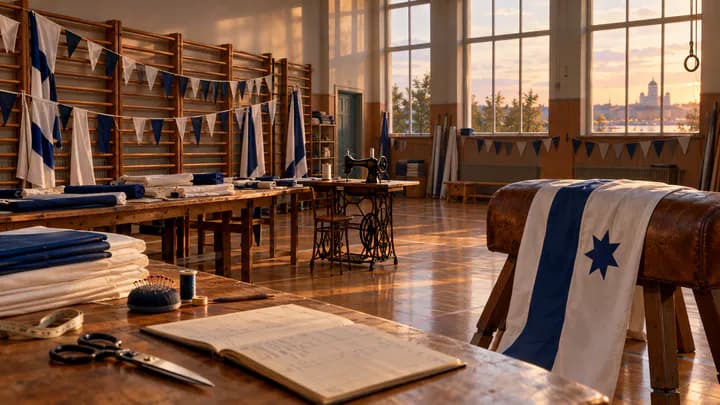
Stock, counted twice by me and once by Sirkka, who counts faster and wrong: white bunting, plenty. Mid-blue wool, one strip left from the bolt we used for orders 12 and 30, enough for a stripe and a star if I nest the pieces and nobody sneezes. The navy has all gone into the stadium. New coupons will not clear before September.
So: one attempt.
It is still light enough outside to read by. The machines have stopped. Martta has gone home carrying her feet in her hands, she says.
22 July, quarter past six in the morning
Couldn't sleep, came in early. Laid the mid-blue against the atlas plate by the window. It matches. Kivimäki will be pleased.
When the clerk at the resettlement office wrote out my papers in 1944, he put my place of birth as USSR, because that was what the map on his wall said now. I made him tear it up and write Viipuri. He told me it made no difference to anybody. He was a young man with soft hands and he was wrong. It makes a difference to the person standing in the queue holding the paper.
22 July, half past two
The interpreter came. Kivimäki had not sent him; he took the tram alone, asked at the door for the flag woman, and stood among the bunting tables with his hat in both hands. Thin, perhaps twenty-five, a good grey suit that had been someone else's first. We found we both had German, his better than mine.
"Call me Hans," he said. "It's easier."
I said I had not asked for easier, and asked his name. He told me. It has a sound in the middle that my mouth does not own. I tried it four times while Sirkka pretended to thread a bobbin. He corrected me twice, then let the fourth one pass, which I took as kindness and not success. I will not write it here. I would spell it wrong, and I think he has had enough of that.
I showed him the plate. He looked a long while without touching the page.
"That is the one they gave us," he said. "The square in the corner was theirs. Our star sat under it like—" He hunted for the German, did not find it, and made a small gesture of a dog lying beneath a table.
"And the blue?"
"Too pale. That was their idea of our sea." He looked around the gym, at the wall bars hung with drying bunting, and stopped at the big flag of ours we nailed over the scoreboard for luck. "Like that. Dark. The lake at evening, not the afternoon."
"And the star. Centre of everything, or centre of the white?"
"Of the white." He drew it with one finger in the empty margin of the atlas, careful not to touch the old flag. "In the middle of everything it is standing in the doorway. It should be inside the house."
Then he said what he had come to say, quietly, though Kivimäki was nowhere near. "If we walk under the book's flag, the boys will walk. They are polite. But there will be a photograph in the newspaper at home, and the people who print the newspaper know what that corner meant. They will not be polite."
I asked if he had told Herra Kivimäki. Yes, on Sunday. Herra Kivimäki said the telegram did not say pale or dark, it said deep, and a book is a book.
After he left I held a strip of the mid-blue against the scoreboard flag. Sirkka said, "Oh," which is all anyone needed to say.
22 July, twenty to eleven at night
There is no dark blue in this building that is not already sewn into something with a number.
I went through every bin. Martta found a bag of navy offcuts from order 44 and I nearly kissed her, but the largest piece is the size of a hand towel. A pieced stripe would look like a quilt from the far end of a parade ground, and someone would photograph that too.
Kivimäki telephoned at eight to ask was it cut. I said in the morning. He said, "From the book." I said, "From the telegram." He said those were the same thing, and I let him hang up believing it.
The scoreboard flag belongs to the committee. I will not touch the committee's.
There is the one at home.
I sewed it in May 1945 from wool bought with my own coupons and the last of Lauri's, which the office never thought to cancel. I had left our old flag on the pole on Torkkelinkatu when we went out on the train, and I could not stand a bare window in a strange city. I dyed the blue twice in the copper until it was right. It has hung in Kallio on every flag day for seven years. I made it properly, four white panels set into the cross, and the cross is thirty-six centimetres wide and over two metres long the one way.
A stripe of twenty centimetres. A star of thirty-four. I have done the sum three times.
23 July, ten past one in the morning
Took the last tram home. Took it down. Rouva Heikkilä across the yard put her head out and asked was it washing day. I said yes.
Back at the gym by midnight with it folded in my string bag. My own stitches are small and tight and I cursed every one. The white panels came away one by one, and then the blue lay on the vaulting horse by itself, a cross with nothing to hold.
I cut the stripe from the long arm in a single run of the shears. The star I drew from the short arm with chalk and a tin plate for the circle, eight points, and checked it against the scoreboard flag under the windows. At midnight the windows are the colour of milk with a little ink stirred in. The blue looked like the lake at evening, because it was evening, more or less, and has been for a week.
The star sits in the middle of the white, above the stripe. Inside the house. I ran the treadle until my calf cramped and finished the hem by hand.
The mid-blue is folded back on the shelf, uncut. It will do for order 74.
23 July, half past seven in the evening
Kivimäki came at nine. The interpreter was with him, hat in both hands again. Kivimäki unrolled the flag across the horse, then opened the atlas beside it, and looked from one to the other like a man reading two timetables.
"The star has moved."
"The telegram says centre."
"The blue—"
"The telegram says deep."
"Your count said mid-blue only. Where did this come from?"
"Herra Kivimäki," I said, "do you want me to count it all again now, or do you want it in Käpylä by eleven?"
He looked at his watch. He rolled it up himself, badly, and I took it off him and rolled it again.
The interpreter put two fingers on the stripe before I closed the roll. He looked at the scoreboard, then at me, and did not ask. I said his name, the fifth time. He did not correct me.
I did not go to the raising. Orders 72 and 73 are due Friday, and Martta's feet are worse. Sirkka went on her dinner hour and came back to say it went up straight, and that the blue looked nearly black against the pines, and that one of the athletes cried and pretended it was the wind.
Own stock, for the record: white wool, four panels, each hemmed on two sides. Laid together on the table they make the shape of a cross that is not there. Kept.
Window in Kallio: bare. Coupons clear in September. The dye times are written on the inside cover.