Everything Left Between the Pages
A rural mobile library driver keeps finding odd things tucked into returned books — a feather, a cowslip, a pencil line in a margin. Then she works out who is writing back, and why they never speak.

The first thing I ever took out of a library book was a jay's feather, and I put it back within the hour. After that I could not stop noticing what people leave behind.
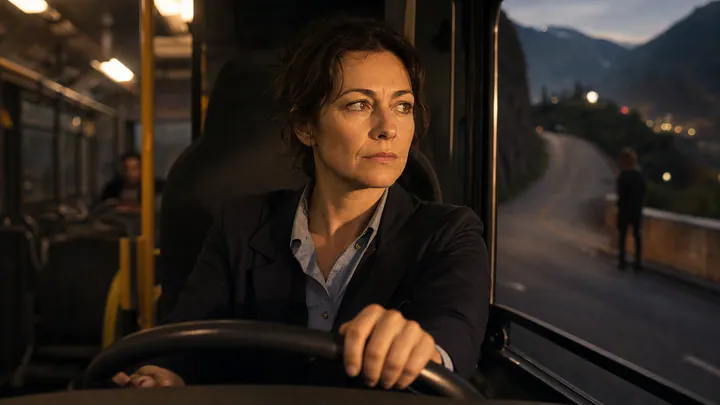
I drive Van Two for the county mobile library service, which is a grand way of saying I am a bookshop with a diesel engine and a leak above the biography shelf. Tuesdays I do the Cranmoor estate. Wednesdays, the schools, which smell of wet anoraks and are wonderful. Thursdays I run the long westerly loop: Coldharrow Lane at quarter past eleven, Beale's Farm at half past two, and eleven miles of hedgerow in between that in April smells of rain and crushed wild garlic.
People leave things in books. Boarding passes, bank receipts, a betting slip, a strip of uncooked bacon once, at page sixty of a submarine thriller. I bin most of it. The feather was different. It was laid into the gutter of page 141 of Birds of the Western Shires, flat and deliberate, blue barred with black. And in the margin beside it somebody had written in soft pencil: Still not convinced this is a jay.
Underneath, in a second hand — smaller, harder, pressing through to the next page — somebody else had written: It is a jay. You never could tell blue from anything.
I began paying attention the way you do when the radio is bad and the lanes are long.
Three books went round and round. The bird guide. A water-stained paperback on the coastal path, with its spine mended in fabric tape. And an anthology of border ballads that nobody in the county had touched since 1994 except these two, whoever they were.
The pattern took me a month to see, because it was hidden inside my own timetable. The books came back to me at Coldharrow Lane on a Thursday morning, and they went out again at Beale's Farm that same Thursday afternoon. Every time. Reserved, collected, returned, reserved. Eleven miles, one direction, once a fortnight, carried by me.
At Coldharrow the borrower was Aubrey Finch, seventy-nine, of the sheltered terrace behind the chapel. Tweed cap gone shiny at the brim. He always offered me twenty pence for a fine, in coin, warm from his pocket, and I always told him we stopped charging fines in 2019, and he always said, "Then put it towards the leak," and we did this like a hymn.
At Beale's Farm the borrower was Delia Rowe, seventy-six, who came down the yard in boots the colour of the yard, with her hair tied back with a length of baler twine, and who read faster than anyone on my route.
One Thursday I held the bird guide a second too long before handing it over.
"Page a hundred and forty-one," I said.
Delia did not blush. Women who have lambed in February do not blush. She took the book, tucked it under her arm, and looked at the hedge over my shoulder.
"Is it against the rules," she said, "writing in them?"
"Technically."
"Then don't look."
"It's pencil," I said. "I have rubbed out worse."
She laughed, one syllable, and her whole face changed shape, and I saw what she must have looked like at nineteen.
The Rules of the Margin
Over the following weeks she gave it to me in pieces, the way you give a stranger anything, a bit at a time while your hands are busy with something else.
They had grown up two farms apart. He had gone to work on the boats at Marran Head; she had married a man called Rowe and stayed. Aubrey had married Marion, who was, Delia said firmly, a lovely woman and a better cook than either of them deserved. Fifty years passed the way fifty years do, in one long Tuesday.
Marion died six winters ago. Delia sent a card. Aubrey did not answer it.
"He couldn't," she said. "He's never been able to say anything straight out in his life. Then about three months after, I take out that walking book, and there's a line under a sentence about the cliff path at Marran, and a bit of pencil in the margin that says we sat here once." She shook her head. "Sixty years I'd waited for that man to say something, and he said it to a book."
"So you wrote back."
"I wrote I know." She shifted the sack of feed on her hip. "And that's how it's gone on. He puts it in, I take it out, you drive it up and down the lane and get paid for it."
"Why not the telephone?"
Delia looked at me with great patience, the way you look at someone who has asked why sheep don't simply open the gate.
"Because on the telephone you have to be quick," she said, "and because in a book you can rub it out."
In September the county did a route review.
The letter used the word rationalisation four times. Coldharrow Lane was going fortnightly and moving to the eastern loop. Beale's Farm was staying on Thursdays with me. Same service, said the letter, same books, same lovely people. Just no longer on the same day, or the same van, or the same fortnight.
Eleven miles became, administratively, about six weeks.
I told Aubrey on a morning with a low white sky. He read the letter twice and folded it into quarters, which took him some time because his hands are not what they were.
"Well," he said. "There it is."
"There's the post," I said. "There's a phone in the chapel hall."
"There is." He handed the letter back, as though it were mine. "Marion used to say I was the only man alive who could be brave in a gale and a coward in a kitchen." He set his twenty pence on the counter. "For the leak."
The last Thursday of the old timetable, he came out with the bird guide in a carrier bag against the drizzle, and I did not take it from him.
"Mr Finch," I said. "There's a seat in the cab."
He stood in the rain a long moment. Behind him the chapel guttering ran like a tap.
"That's not regulation," he said.
"Neither is pencil."
He climbed up holding the grab handle with both hands and sat very upright with the bag on his knees, and for four miles he said nothing at all. Then he began to narrate the lane, because men of that generation narrate rather than speak: that gate was hung wrong in 1968; that field floods; a hare went along that headland once with a dog behind it and the dog never had a prayer.
At the top of Beale's he stopped talking. The yard came up grey and puddled, the dog barking, the smell of silage and wet stone coming in through the vents.
Delia came out drying her hands on a towel, saw the van, saw the passenger door open, and stopped where she was, halfway across her own yard, in the rain, holding the towel.
Aubrey got down carefully, one hand on the step.
"I've brought your book back," he said.
"You're early," said Delia.
"Six years early," he said, and went up the yard to her.
I stayed in the cab with the wipers going and looked hard at my timetable until I heard the kitchen door shut. Then I turned the van around in the gateway, the way I have four hundred times, and drove down the lane with all my shelves rattling behind me.
That evening I filled in the log the way I always do. Issues: nineteen. Returns: twenty-two. Mileage: forty-one. And at the bottom, in the box marked items recovered from stock, I wrote: one jay's feather, one bird guide, one man — delivered by hand to the correct borrower.
Frequently asked questions
Why do Aubrey and Delia use book margins instead of simply phoning each other?
Because the margin gives them a place to be brave without being seen being brave. A pencil line can be rubbed out; a voice on a telephone cannot, and at their age both of them have learned exactly how much a spoken sentence costs.
What does the narrator's habit of noticing 'what people leave behind' say about her?
Greta collects other people's small evidence because she is more comfortable holding a life than living inside one. Her decision at the end is the first time she stops archiving and starts delivering.
Is the closing of the route a tragedy or a gift in this story?
Both, which is the point. The cut ends a ritual that had become a hiding place, and forces two people to arrive at each other in person rather than in pencil.
Why does the story withhold the actual words written in the margins for so long?
Because restraint is the language these characters speak. By the time we read a full sentence of theirs, we have already learned to hear the enormous things they are not saying.