Best High-Protein Foods for Daily Energy: A 2026 Guide
Protein does not work like caffeine — it works by flattening the blood-sugar swings that cause afternoon crashes. Here is how much you need, which foods deliver it per serving, what it costs, and the distribution mistake most people make.
Rewritten with AI and republished automatically. Our editors set the standards and fix reported errors — how we work.
TL;DR: Protein does not fuel you like caffeine. It steadies energy by blunting blood-sugar swings and keeping you full. Aim for 1.2–2.0 g per kg of body weight, split into three or four meals of roughly 25–35 g. Eggs, Greek yogurt, chicken, fish, lentils, tofu, and cottage cheese do most of the work.
Does protein actually give you energy, or does it just keep you full?
Mostly the second — and that matters more than it sounds. A high-protein food is any food that delivers a substantial share of its calories as protein, the macronutrient your body uses to build and repair tissue, enzymes, and hormones. Protein does contain about four calories per gram, but the body is reluctant to burn it for quick fuel; it would rather use carbohydrate and fat and save amino acids for structural work.
The energy benefit is indirect. Protein slows gastric emptying and the rate at which glucose enters your bloodstream, which softens the spike-and-crash pattern that a toast-and-coffee breakfast produces by 11 a.m. It also has the highest thermic effect of the three macronutrients — a meaningful fraction of its calories is spent on digestion itself — and it is the most satiating gram-for-gram, which is why protein-forward meals quietly reduce grazing.
If your afternoons still collapse after you fix your protein intake, the cause is usually somewhere else: dehydration, an eight-hour caffeine tail, or accumulated sleep debt that no amount of food will patch over. Food is one lever, not the whole machine.
How much protein do I need per day?
The Recommended Dietary Allowance is 0.8 grams per kilogram of body weight per day. That number is widely misread: it is the intake that prevents deficiency in most healthy adults, not the intake that optimizes strength, recovery, or appetite control. Sports and clinical nutrition guidance generally places active people, dieters, and older adults in the 1.2–2.0 g/kg range.
For a 70 kg (154 lb) adult, that spans roughly 84 to 140 grams a day. Pick your number with this decision rule:
- Sedentary, weight stable: 1.0–1.2 g/kg is plenty.
- Training three or more times a week, or in a calorie deficit: 1.4–1.8 g/kg protects lean mass.
- Over 60: lean toward 1.2–1.6 g/kg. Older muscle responds less readily to a given dose of amino acids, so both total intake and per-meal size matter more.
- Pregnant, nursing, or managing a medical condition: targets should come from a qualified professional, not an article.
Use body weight in kilograms, not pounds, and if you carry significant excess weight, calculate against a reasonable goal weight rather than current weight to avoid an absurd target.
Which high-protein foods deliver the most per serving?
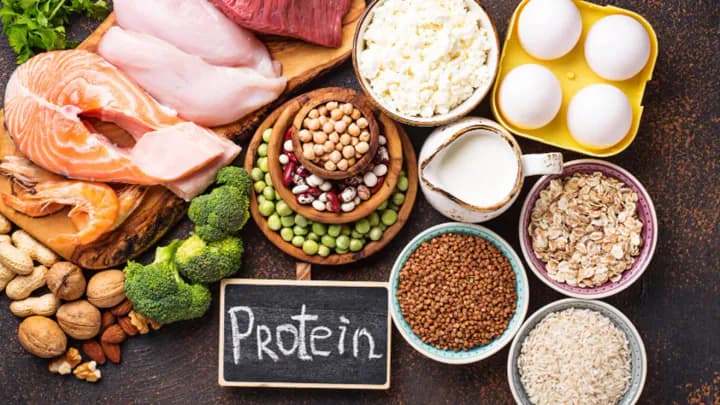
The short answer: cooked poultry, lean beef, fish, Greek yogurt, and cottage cheese lead on density; lentils, tofu, and eggs lead on versatility and value. Figures below are approximate and vary by brand, cut, and cooking loss.
| Food | Typical serving | Protein (approx.) | Best used for |
|---|---|---|---|
| Chicken breast, cooked | 100 g (3.5 oz) | ~31 g | Batch cooking, salads, grain bowls |
| Lean beef, cooked | 100 g | ~26 g | Iron and zinc alongside protein |
| Salmon, cooked | 100 g | ~22–25 g | Omega-3s; fast oven cooking |
| Canned tuna or sardines | 1 can, drained | ~20–25 g | Zero-cook lunches, pantry backup |
| Greek yogurt, plain | 170 g (¾ cup) | ~15–18 g | Breakfast base, sauces, marinades |
| Cottage cheese | ½ cup | ~12–14 g | Snacks, blended into pasta sauce |
| Lentils, cooked | 1 cup | ~18 g | Soups, salads, meat extenders |
| Firm tofu | ½ cup / ~120 g | ~10–17 g | Stir-fries, roasting, scrambles |
| Eggs | 2 large | ~12 g | Anchoring breakfast; cheap complete protein |
| Almonds | 1 oz (~23 nuts) | ~6 g | Topping up, not a protein source on its own |
| Protein powder | 1 scoop | ~20–25 g | Convenience when cooking is impossible |
Two honest notes. Almonds and nut butters are fat sources with protein attached — treat them as flavor and satiety, not as a way to hit a target. And cooked weights are what count: 150 g of raw chicken is not 150 g on the plate, so weighing raw and assuming it holds is one of the quietest ways people overestimate their intake by 20 percent.
Why does protein distribution matter more than the daily total?
Because most people eat 10 grams at breakfast, 20 at lunch, and 60 at dinner — and that back-loaded pattern wastes the day. Muscle protein synthesis responds to a dose of amino acids, particularly leucine, and a meal of roughly 25–35 grams of mixed protein reliably clears that threshold for most adults. A 10-gram breakfast does not.
The fix costs no extra food, only rearrangement: move 15–20 grams from your dinner to your morning. That usually means adding eggs, Greek yogurt, or cottage cheese to whatever you already eat. Our guide to high-protein breakfasts for busy mornings covers the assemble-in-four-minutes versions, which is the only kind that survives a real weekday.
Evening balance is easier than people expect too. A tray of chicken thighs, chickpeas, and vegetables in one pan is a 40-gram dinner with one dish to wash — the approach we walk through in our sheet-pan dinner guide. Even a carb-forward night works if you build in a protein anchor; a one-pot pasta takes well to white beans, tuna, or ricotta stirred in at the end.
Are plant-based proteins as effective as animal proteins?
Yes, with two adjustments. Most plant proteins are lower in at least one essential amino acid — legumes run short on methionine, grains on lysine — and their protein is digested slightly less efficiently because of fiber and antinutrients. Neither is a dealbreaker.
Practical rules for a plant-forward diet:
- Eat about 20–30 percent more grams than an omnivore aiming for the same result.
- Vary families across the day, not within a single meal. Combining does not need to happen on the same plate; your amino acid pool works over roughly 24 hours.
- Lean on the strongest performers: soy (tofu, tempeh, edamame, soy milk), seitan, lentils, chickpeas, and — among grains — quinoa.
- Watch vitamin B12, iron, and omega-3s, the nutrients that usually travel with animal protein. Supplementation is often appropriate; discuss it with a clinician.
Tempeh and seitan are the two most underused items on that list. Seitan in particular rivals chicken for protein density — though it is pure wheat gluten and off the table for anyone with celiac disease or gluten sensitivity.
What is the cheapest way to eat high protein every day?
Dried legumes, eggs, canned fish, large tubs of plain yogurt, cottage cheese, whole chicken, and firm tofu. These consistently deliver the most protein per dollar, and none of them require a specialty store. The most expensive protein per gram, almost without exception, is anything marketed as a protein product: bars, ready-to-drink shakes, chips, and flavored deli meats.
Three habits that cut the bill further:
- Buy whole chicken and break it down. The price gap between whole birds and trimmed breast is large, and the carcass makes stock.
- Use legumes as meat extenders. Half beef, half lentils in a bolognese or chili is indistinguishable to most palates and shifts both cost and fiber in your favor.
- Buy plain, flavor yourself. Plain yogurt plus fruit costs a fraction of single-serve flavored cups and contains far less added sugar.
If your grocery spending is the actual problem rather than your macros, treating food as a planned category instead of a monthly surprise helps. (General information, not financial advice.)
What are the most common high-protein mistakes?
The costly ones are rarely about food choice. They are about accounting and expectations.
- Counting the food, not the protein. A cup of quinoa is not "a protein." It supplies around 8 grams alongside roughly 39 grams of carbohydrate. Useful, but it is a grain.
- Treating protein bars as food. Many deliver 10–15 grams of protein wrapped in sugar alcohols and syrups at a premium price. Check grams of protein per 100 calories before you buy anything twice.
- Adding protein without subtracting anything. Protein is not calorie-free. Bolting three shakes onto an unchanged diet adds several hundred calories a day.
- Ignoring fiber. Sudden high-protein, low-fiber eating is the most common cause of the digestive complaints people blame on "too much protein." Legumes, vegetables, and whole grains solve it.
- Expecting a stimulant effect. Protein steadies energy; it does not create it. If you wanted an actual circadian lever, ten minutes of morning daylight does more for daytime alertness than any macro shuffle.
Who should not push their protein intake higher?
Anyone with chronic kidney disease, significant liver disease, a history of certain kidney stones, or a rare inherited amino acid disorder should have protein targets set by a physician or registered dietitian. For people with healthy kidneys, higher intakes within the normal dietary range have not been shown to cause damage — but "healthy kidneys" is an assumption worth confirming rather than guessing, particularly if you have high blood pressure or diabetes.
Gout is a separate case: the trigger is purine load, not protein itself, so organ meats, some shellfish, and certain fish matter more than total grams. And if you are on medication for any chronic condition, changing your diet substantially is a conversation to have with the person who prescribed it.
What does a realistic 120-gram protein day look like?
Here is a worked example for a 70 kg adult training four times a week, targeting around 1.7 g/kg. Nothing here takes more than 15 minutes of active work.
- Breakfast (~32 g): Three scrambled eggs (18 g) with 170 g plain Greek yogurt and berries (16 g).
- Lunch (~35 g): Grain bowl with 120 g leftover roast chicken (~36 g), a cup of lentils folded through the grains, olive oil, lemon.
- Snack (~15 g): Half a cup of cottage cheese with cracked pepper and a slice of rye.
- Dinner (~38 g): Sheet-pan salmon (~25 g per fillet) with roasted chickpeas and broccoli (~10 g).
That lands near 120 grams without a single scoop of powder, and each eating occasion clears the 25-gram threshold. Notice that the lunch protein is dinner's leftovers — cooking a little extra at night is the single highest-leverage habit in high-protein eating.
Key takeaways
- Protein steadies energy indirectly, through blood-sugar control and satiety — it is not a stimulant, and it will not fix poor sleep.
- The 0.8 g/kg RDA is a floor. Most active adults and people over 60 do better between 1.2 and 2.0 g/kg.
- Distribution beats totals: three or four meals of 25–35 grams outperforms a protein-heavy dinner and costs nothing extra.
- Eggs, Greek yogurt, cottage cheese, canned fish, lentils, tofu, and whole chicken give the best protein per dollar; bars and ready-made shakes give the worst.
- Plant-based diets work — eat roughly 20–30 percent more grams, vary the sources, and keep an eye on B12, iron, and omega-3s.
- Anyone with kidney, liver, or metabolic conditions should set protein targets with a qualified health professional rather than a general guideline.
Frequently asked questions
Does protein actually give you energy?
Not directly in the way caffeine or sugar does — protein supplies about four calories per gram but is a poor fast fuel. It improves perceived energy indirectly by slowing glucose absorption, flattening the blood-sugar spike-and-crash cycle, and increasing satiety so you snack less between meals.
How many grams of protein do I need per day?
The Recommended Dietary Allowance is 0.8 grams per kilogram of body weight, which is a minimum to prevent deficiency, not an optimum. Most active adults, people in a calorie deficit, and adults over 60 do better in the 1.2–2.0 g/kg range — roughly 84 to 140 grams a day for a 70 kg person.
Is 30 grams of protein per meal a real rule?
It is a practical target rather than a hard biological limit. Roughly 25–35 grams of a mixed protein source reliably supplies the 2–3 grams of leucine that triggers muscle protein synthesis in most adults, and spreading intake across three or four such meals is easier to hit than one enormous dinner.
Are plant proteins as good as animal proteins?
Yes, if you eat enough of them and vary the sources. Most plant proteins are lower in one or more essential amino acids and are digested slightly less efficiently, so a practical fix is eating roughly 20–30 percent more grams and combining families — legumes with grains, or soy with nuts — across the day.
What is the cheapest high-protein food?
Dried lentils and beans, eggs, canned fish, cottage cheese, plain Greek yogurt in large tubs, whole chicken, and firm tofu consistently deliver the most protein per dollar. Protein bars, ready-made shakes, and deli meats are usually the worst value per gram.
Can eating too much protein damage your kidneys?
In people with healthy kidneys, higher protein intakes in the normal dietary range have not been shown to cause kidney damage. People with existing chronic kidney disease, liver disease, or a history of kidney stones should have protein targets set by their physician or a registered dietitian.
Do I need a protein shake?
No — shakes are a convenience product, not a requirement. They earn their place when you genuinely cannot cook, such as a rushed morning or a post-training commute, and a plain whey, casein, or pea isolate with a short ingredient list does the job as well as anything expensive.