Easy 30-Minute Meals: How to Cook Fast Without Takeout
A 30-minute meal is a formula, not a recipe: one protein, one vegetable, one carbohydrate, one sauce. Here are seven formulas, a real timeline, the pantry list that makes it work, and the mistakes that quietly turn 30 minutes into 55.
Rewritten with AI and republished automatically. Our editors set the standards and fix reported errors — how we work.
TL;DR: A 30-minute meal is a formula, not a recipe: one protein, one vegetable, one starch, one sauce, cooked in one or two pans. Start the heat before you start chopping, keep a short pantry list stocked, and avoid the five mistakes below. Seven working formulas and a real timeline follow.
What actually counts as a 30-minute meal?
A 30-minute meal is a dinner that goes from cold pan to plated food in 30 minutes or less, including chopping, the water coming to a boil, and the oven preheating. That definition matters, because most published "30-minute" recipes quietly start the clock after prep.
Our test is simple. Read the ingredient list and look for the words chopped, cooked, shredded, or marinated. Each one is time someone else already spent. If a recipe calls for two cups of cooked rice and a pound of chopped butternut squash, you are looking at a 50-minute meal wearing a 30-minute label.
The honest version of fast cooking is built on a formula: one protein that cooks in under 12 minutes, one vegetable, one starch that cooks in under 15 minutes, and one sauce. Everything in this article is a variation on that.
Which pantry items make 30-minute cooking possible?
Speed on a Tuesday is decided on Saturday. You cannot cook fast from an empty shelf, and no technique compensates for a missing acid or fat. Keep this short list stocked and roughly 80 percent of weeknight dinners become assembly rather than cooking.
- Fast starches: chickpea or whole grain pasta, quick-cooking couscous, microwaveable brown rice pouches, corn tortillas.
- Fast proteins: eggs, canned white beans and black beans, canned tuna or sardines, frozen shrimp, a rotisserie chicken when you pass one.
- Flavor engines: garlic, fresh ginger, lemons and limes, soy sauce or tamari, Dijon mustard, chili flakes, smoked paprika, a jar of good olives or capers.
- Freezer vegetables: peas, spinach, edamame, corn, pepper strips. No washing, no chopping, no spoilage guilt.
- Finishers: Parmesan, feta, Greek yogurt, toasted nuts or seeds, fresh herbs. These do the work that a long simmer would otherwise do.
One rule: every fast meal needs an acid and a fat at the end. A squeeze of lemon and a drizzle of olive oil make a 20-minute dinner taste deliberate instead of rushed.
What are the seven fastest weeknight dinner formulas?
These seven cover nearly every craving, dietary pattern, and level of energy. Pick by how much cleanup you can tolerate tonight, not by what sounds most ambitious.
| Formula | Typical total time | Pans used | Best for |
|---|---|---|---|
| Stir-fry | 20 min | 1 skillet + rice pouch | Using up odd vegetables |
| Protein-packed pasta | 20 min | 1 pot + 1 skillet | Feeding a crowd cheaply |
| Tacos from cooked protein | 15 min | 1 skillet | Zero-energy nights |
| One-pot grain skillet | 30 min | 1 deep skillet | Meatless, minimal cleanup |
| Loaded sandwich or grain bowl | 12 min | 0-1 | Hot weather, no stove |
| Pantry soup | 25 min | 1 pot | Leftovers for tomorrow's lunch |
| Breakfast for dinner | 12 min | 1 nonstick skillet | Late nights, picky kids |
1. The stir-fry that beats takeout
Sliced chicken breast, broccoli, bell pepper, and snap peas in sesame oil with minced garlic and ginger, finished with low-sodium soy sauce over a microwaveable brown rice pouch. Slice the chicken thin against the grain so it cooks in four minutes and reaches a safe internal temperature of 165°F. Hard vegetables go in first, leafy ones last.
2. Pasta, but protein-packed
Chickpea or whole grain pasta tossed with sautéed spinach, cherry tomatoes, garlic, and shrimp, finished with lemon and Parmesan. Save a half cup of starchy pasta water before draining — it is what turns oil and cheese into an actual sauce. If you want the single-vessel version, our guide to one-pot pasta for weeknights walks through the liquid ratios, and the silky one-pan pasta method covers emulsification.
3. Tacos that work any night
Warm corn tortillas directly over a gas flame or in a dry skillet for 20 seconds a side. Fill with rotisserie chicken, black beans, avocado, lime, a spoonful of Greek yogurt in place of sour cream, and cilantro. This is the fifteen-minute floor of weeknight cooking.
4. The one-pot grain skillet
Quinoa, diced tomatoes, kidney beans, corn, and taco seasoning simmered in a deep skillet until the grain is fluffy, then topped with cheese and jalapeños. Quinoa needs a full 15 minutes plus 5 to rest, so this is the formula that genuinely uses all 30 minutes.
5. Sandwiches built like a real meal
Whole grain bread, hummus, grilled zucchini, roasted red peppers from a jar, feta, and arugula. Add a boiled egg or a side of yogurt so it holds you past nine o'clock. Layering a spread on both slices is what separates a good sandwich from a dry one.
6. Pantry soup in 25 minutes
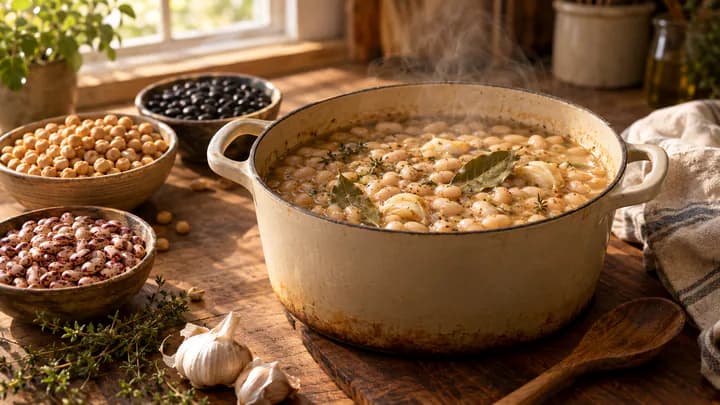
Sauté onion, carrot, and celery, then add canned white beans, spinach, and broth. Simmer 15 minutes with thyme and chili flakes. Mash a ladle of the beans against the side of the pot to thicken it without cream.
7. Breakfast for dinner
Eggs scrambled low and slow with smoked salmon, spinach, and goat cheese, plus sourdough toast and a handful of salad. It is the fastest complete-protein dinner in the repertoire — and many of the same ideas scale to mornings in our roundup of high-protein breakfast ideas for busy mornings.
How do I actually sequence a 30-minute meal?
Start the slowest thing first, and start it before you chop anything. That single habit saves eight to ten minutes per meal, because water heating and ovens preheating are dead time you can spend productively. Here is a real timeline for the shrimp pasta above.
- 0:00 — Fill the pot, salt it, lid on, high heat. Thaw frozen shrimp in a bowl under cold running water.
- 0:02 — Halve the tomatoes, smash the garlic, wash the spinach. Board work only.
- 0:07 — Water boils. Pasta in. Timer set two minutes under the box time.
- 0:08 — Skillet on medium-high with olive oil. Garlic 30 seconds, tomatoes 3 minutes.
- 0:12 — Pat the shrimp dry, add to skillet. Two minutes per side, no more.
- 0:16 — Spinach in, wilts in 60 seconds. Reserve pasta water, drain.
- 0:18 — Pasta into skillet with a splash of the water, Parmesan, lemon. Toss hard.
- 0:20 — Plated. The cutting board and the pot are the only dishes.
Notice that full mise en place never happens. Prepping every ingredient into separate bowls before turning on a burner is restaurant practice designed for repeatability, not for one dinner at 7 p.m. At home, chop while things cook.
Which mistakes quietly turn 30 minutes into 55?
Five failures account for almost every blown weeknight timeline. Each has a fix that costs nothing.
- Crowding the pan. Too much food drops the surface temperature, so ingredients release water and steam instead of browning. You wait, it stays gray, and you have lost ten minutes. Use a bigger pan or cook in two batches — both are faster.
- Wet protein. Shrimp, chicken, and tofu straight from the package are covered in moisture that must boil off before browning starts. Thirty seconds with a paper towel buys you three minutes.
- Chickpea pasta on high heat. Legume pastas foam aggressively and boil over. Use a larger pot, more water than you think, and medium-high heat. They also go from firm to mush in about 90 seconds, so test early.
- Frozen protein with no plan. Shrimp and thin fish thaw under cold water in ten minutes. Chicken breasts and ground meat do not. If it is not in the refrigerator by morning, it is not tonight's dinner.
- Seasoning only at the end. Salt added at the finish sits on the surface. A pinch when the vegetables hit the pan and a pinch in the pasta water does more than a heavy hand at the table.
When does the 30-minute promise not apply?
It does not apply to tough cuts, dried beans, whole grains like farro or wild rice, bone-in chicken thighs, or anything braised. No technique makes collagen dissolve in half an hour. If a recipe involves those, plan it for a weekend or a slow cooker and stop feeling behind.
It also strains when you are cooking for more than about six people on a standard four-burner stove, or for two or three different dietary needs at once. In those cases, switch format rather than fighting the clock: a sheet-pan dinner scales to a crowd with one pan and lets each person's components stay separate on the tray.
A clear decision rule: if any single component needs more than 20 minutes of unattended cooking, or the protein is thicker than about one inch, substitute or reschedule. Thin-sliced, small-cut, and canned are the three levers of fast cooking.
How do I keep fast meals genuinely balanced?
Aim for roughly 25 to 30 grams of protein per adult, a fist of vegetables, a whole grain or starchy vegetable, and a real fat source. That is one chicken breast, half a can of beans, or four to five ounces of fish, plus olive oil, avocado, nuts, or cheese. Meals built mostly on refined carbohydrates tend to leave people hungry again within a couple of hours.
Convenience ingredients are not a compromise worth agonizing over. Frozen vegetables are typically picked and frozen quickly, and canned beans keep their fiber; rinsing cuts a meaningful share of the added sodium. If you are managing a medical condition, food allergies, or a specific therapeutic diet, work with a registered dietitian or your physician rather than a recipe roundup.
One more piece of realism: the meal is not finished until the kitchen is. Washing the cutting board during the five minutes the quinoa rests is the difference between a routine you keep and one you abandon by February.
Key takeaways
- A true 30-minute meal counts prep, preheating, and boiling time — check ingredient lists for hidden work like "cooked" or "chopped."
- Cook from a formula, not a recipe: fast protein + vegetable + quick starch + sauce, finished with an acid and a fat.
- Start the heat before you chop; skipping full mise en place at home saves eight to ten minutes a night.
- Crowded pans and wet protein are the two most expensive mistakes in fast cooking, and both are free to fix.
- Tough cuts, dried beans, and long grains are out of scope — switch formats instead of fighting the clock.
- Stock roughly a dozen pantry staples and most weeknights become assembly rather than cooking.
Frequently asked questions
What actually counts as a 30-minute meal?
A 30-minute meal is one where total time from cold pan to plated food is 30 minutes or less, including chopping and the water coming to a boil. Recipes that quote 30 minutes but start after prep are usually 45-minute meals in disguise. Read the ingredient list for the words "chopped," "cooked," or "marinated" — each one hides time.
Is it cheaper to cook a 30-minute meal than order delivery?
Almost always, yes. Even with convenience shortcuts like pre-chopped vegetables, rotisserie chicken, and canned beans, a home-cooked dinner for two typically costs a fraction of the same meal delivered once you add service fees, delivery charges, and a tip. The gap widens further if you cook enough for leftovers.
Are pre-chopped vegetables and canned beans as healthy as fresh?
They are close enough that the convenience is worth it. Canned beans and frozen vegetables retain most of their fiber and micronutrients, and frozen produce is often picked and frozen at peak ripeness. Rinse canned beans to cut sodium, and buy frozen vegetables without added sauce. For individualized dietary needs, consult a registered dietitian or your physician.
What's the single biggest mistake that blows the 30-minute clock?
Crowding the pan. Too much food in one skillet drops the surface temperature, so the food releases water and steams instead of browning, which can add ten or more minutes and still produce gray, bland results. Cook in two batches or use a bigger pan; both are faster than waiting out a crowded one.
Can I make 30-minute meals without a dishwasher?
Yes, but bias toward one-pan and sheet-pan formats rather than stir-fries with separate rice pots. A sheet-pan dinner uses one lined pan and a cutting board. Wipe the board and wash as you go during the oven time so cleanup is already half done when you sit down.
How do I make a 30-minute meal filling enough that I'm not snacking at nine?
Aim for roughly 25 to 30 grams of protein per adult plus real fat and fiber. That usually means a full chicken breast, a can of beans split between two people, or four to five ounces of fish, alongside a whole grain and a fat source such as olive oil, avocado, or cheese. Meals built on refined carbohydrates alone tend to leave people hungry within two hours.
Does frozen protein work for a 30-minute meal?
Only shrimp and thin fish fillets reliably work from frozen; both thaw in about ten minutes under cold running water. Frozen chicken breasts and ground meat do not belong in a 30-minute plan unless you moved them to the refrigerator that morning. Set a recurring phone reminder for the night before — it is the highest-leverage habit in fast cooking.