Flat Iron and Curling Wand Temperatures for Your Hair Type
Most people style on the hottest setting by default. Choose a starting temperature from your hair's thickness and condition, then test down to the lowest heat that still holds.
Drafted with AI. This version has not been reviewed by an editor, so it carries no ads — how we work.
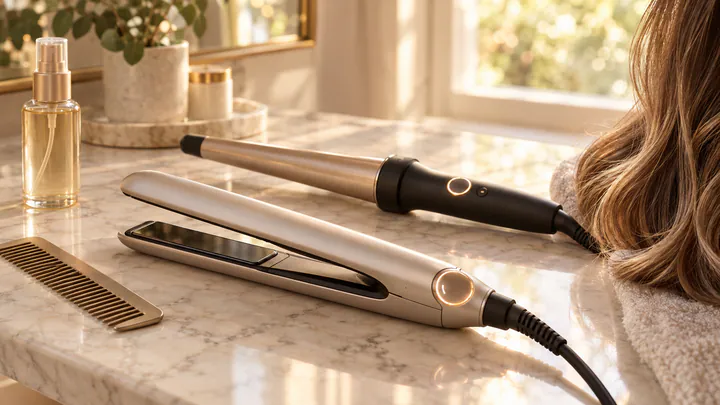
The right flat iron or curling wand temperature is the lowest setting that holds your style, and for most people that is well below the top of the dial. Fine or color-treated hair usually holds at roughly 250–300°F (120–150°C), medium hair at 300–350°F (150–180°C), and only coarse hair needs to go up toward about 390°F (200°C). This guide is for anyone who straightens or curls at home several times a week and is starting to see split ends, frizz or a whiff of burning: it gives you a starting range for your hair and a simple test to find your own minimum.
It is not for everyone. If your hair is chemically relaxed or already badly damaged (breaking, gummy when wet, or snapping when you brush it), talk to a stylist before using any heat at all. If you only air-dry, you can skip this one.
Why hotter isn't faster
Heat styling works by temporarily breaking the weak hydrogen bonds inside each strand. While the hair is hot, those bonds let go; as it cools, they re-form in whatever shape you've pressed or wrapped it into. Once the strand is hot enough for that to happen, extra heat doesn't make the style straighter, smoother or longer-lasting. It only adds damage.
That damage is real and it adds up. High heat lifts and chips the cuticle, the overlapping outer layer that makes hair look shiny and feel smooth. It dries out the strand and, with repeated exposure, weakens the keratin protein that gives hair its strength. On colored hair, heat can also fade or shift the shade, turning toned blonde brassy and dulling reds faster. None of this repairs itself: once a section is heat-damaged, the only fix is to cut it off.
Fine hair suffers most from a maxed-out dial because each strand has less mass and heats through almost instantly. A setting that a coarse strand needs just to soften can scorch a fine one in the same second.
Sorting your hair before you pick a number
Two things decide your starting point: how thick each strand is, and what condition it's in. Curl pattern and how much hair you have matter less than people assume.
Strand thickness: fine, medium or coarse
This is about the width of a single hair, not how much hair is on your head. Someone with lots of hair can still have fine strands. To check, pull out one shed strand and roll it between your thumb and finger:
- Fine: you can barely feel it, and it's thinner than a strand of sewing thread.
- Medium: you can feel it clearly, about the same as thread.
- Coarse: it feels wiry and noticeably thicker than thread.
Condition: virgin, colored or lightened
Virgin hair (never colored or chemically treated) tolerates the most heat. Permanent color makes hair more porous and more heat-sensitive. Bleach and highlights make it more fragile still. If your hair is a mix, such as virgin roots with highlighted lengths, set the temperature for the most fragile part, which is almost always the ends.
Curly and coily hair
Tight curls can take more effort to straighten, which tempts people to turn the heat up. But curly and coily hair also tends to be drier and more fragile along the bends of each curl. Go by strand thickness first, start at the bottom of that range, and let section size and a slow pass do the work rather than the dial.
Starting temperature ranges by hair type
These are commonly used starting ranges, not rules. Tools vary, and the number on the dial isn't always the exact temperature at the plate, so treat the range as where you begin testing.
| Hair | Start at | Notes |
|---|---|---|
| Fine, or any hair that's bleached or highlighted | 250–300°F (120–150°C) | Begin at the very bottom if lightened |
| Medium, color-treated | Low end of medium, around 300°F (150°C) | Drop below this if ends are dry |
| Medium, virgin | 300–350°F (150–180°C) | Most people land in the lower half |
| Coarse, virgin | 350–390°F (180–200°C) | Rarely a reason to go higher at home |
The decision rule: find your row by strand thickness, then step down one row (or to the bottom of your range) if your hair is colored, and down again to the very bottom if it's lightened. If your tool only has low, medium and high settings, fine and colored hair should start on low, medium hair on medium, and only coarse virgin hair should touch high.
Plate material changes how fast heat reaches the hair. Titanium plates transfer heat quickly and are often chosen for coarse hair; ceramic plates heat more gently and evenly, which suits fine or fragile hair. On a titanium iron, sit at the lower end of your range.
The lowest-heat test: finding your minimum setting
Your range is a starting point. The test below finds the specific setting where your hair holds a style, so you never use more heat than that. Do it once, then again after any color change or big cut.
- Start with fully dry hair and protectant. Wash and dry as you normally would, apply heat protectant, and make sure it has dried completely.
- Set the tool to the bottom of your range. For fine hair that's 250°F (120°C).
- Pick a hidden section. Take a strip about 1 inch (2–3 cm) wide from underneath, near the nape, where any mistake won't show.
- Do one slow pass. Glide a flat iron from root to end at a steady, unhurried pace. For a wand, wrap the section and hold for about 5 seconds.
- Let it cool completely before judging. Hold a curl in your palm or pin it until it's cool, then wait a few minutes. Hair that looks done while hot can drop as it cools.
- Check the result. Run your fingers through it. If it's smooth and stays straight, or the curl keeps its shape, that's your setting.
- If it doesn't hold, go up 10°C. That's about 18°F, so use the nearest step your tool allows. Test a fresh section, not the one you just did, so you're not stacking heat on the same hair.
- Stop at the first setting that holds. Going one step higher just in case defeats the point.
With a curling wand, try a longer hold (up to about 8–10 seconds for medium or coarse hair) before you raise the temperature. Letting the curl cool in place does as much for hold as extra heat does.
Worked example: fine, highlighted, shoulder-length hair
Say your hair is fine, shoulder-length and highlighted, and you've been straightening it at a hypothetical 450°F with three passes per section. Fine plus highlights puts you at the very bottom of the range, so you start testing at 120°C (about 250°F).
- At 120°C, the test section looks smooth while warm but bends back after cooling. Not enough.
- At 130°C (about 265°F), it mostly holds but the ends flick out.
- At 140°C (about 285°F), one slow pass leaves it straight after cooling and after running your fingers through. This is your setting.
Shoulder-length fine hair might divide into about 14 sections at 1 inch wide. One pass per section is 14 passes for the whole head (14 × 1), against 42 passes (14 × 3) on your old routine, and each of those passes now happens at about 285°F instead of 450°F. If the highlighted ends feel dry, you can skip them on the iron entirely and smooth them with a brush while blow-drying.
One slow pass versus several quick ones
Aim for one slow pass per section, and two at most. Each pass is another round of heat on the same hair, so three quick passes at a given temperature usually do more harm than one slow pass that gets the job done. A slow glide lets the heat reach the middle of the section evenly; a fast one only warms the outside, which is why people end up going over the same piece again and again.
If you find you need three or more passes, something else is off. Either your sections are too thick for the plates to heat through, or your setting is one step too low. Fix the section size first, and only then raise the temperature by one step.
The same logic applies to wands: one wrap held long enough, then cooled, beats re-curling a section that dropped.
Dry hair, heat protectant and section size
These three habits let a lower temperature do the same work.
Never iron damp hair
Water inside a damp strand turns to steam under a hot plate and can damage the hair from the inside. If you hear a sizzle or see steam, stop immediately and finish drying. A little smoke can also come from product burning off, which is a sign to wait until a spray or cream has fully dried before you start.
Heat protectant
A heat protectant puts a thin film on the hair that slows heat transfer and reduces friction as the plates glide. It helps, but it doesn't make high heat safe. Apply it evenly, comb it through and let it dry before the iron touches your hair.
Section size
Keep sections about 1 inch (2–3 cm) wide and thin enough that the plates press every strand. A section much wider than that leaves the middle cooler than the outside, which is what pushes people into extra passes or a higher setting. Thicker hair simply means more sections, not bigger ones.
Signs your setting is too hot
Turn the heat down one step, or retest from the bottom of your range, if you notice any of these:
- A burnt smell. Hair shouldn't smell scorched, even faintly. If it does, the plates are too hot for your hair.
- Steam or smoke from dry hair. Either the hair isn't as dry as you thought or product is burning on the plates.
- White flecks or dots. Some flecks are just dried product, which brushes out. Small white dots on the strand itself, especially near the ends, can mark points where the hair is fraying and about to snap.
- Crunchy, straw-like ends that feel rough even after conditioner.
- Frizz or flyaways right after styling, which suggests a lifted cuticle rather than humidity.
- Color shifting faster than usual, such as blonde turning brassy between toning appointments.
- Short broken pieces on your clothes or in your brush, snapped partway along the strand.
Lowering the heat stops new damage, but it won't undo what's there. Trim the fried ends, retest from the bottom of your range, and keep the iron at the setting the test gives you. If breakage carries on even at low heat, or your hair starts snapping with no heat at all, take a break from styling and have a stylist look at it before going back to the iron.