The Repairman of Forgotten Birthdays
When a man arrives at a shop that mends overlooked anniversaries, he discovers the date he most needs to repair belongs to someone he can no longer reach.
Drafted with AI and published automatically. Our editors set the standards and fix reported errors — how we work.
The sign in the window read Birthdays Repaired — Inquire Within, painted in a careful hand that had clearly redone the letters many times. Owen had walked past the shop for three weeks before he finally went in.
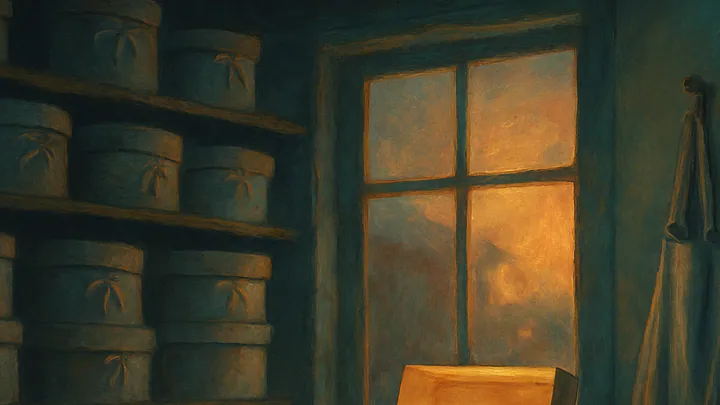
A bell coughed rather than rang. The smell inside was beeswax and old paper and something sweeter underneath, like a cake cooling two rooms away. Shelves climbed to a tin ceiling, stacked with shoeboxes labeled in fountain pen: March 4, 1987. October 19, 2002. A Tuesday, year unknown.
"Be with you in a moment," said a voice from the back. "I'm gluing a candle."
Owen took off his hat because his mother had taught him to, and because he did not know what else to do with his hands.
The repairman emerged wiping his fingers on a striped apron. He was older than Owen had pictured, with eyebrows like small grey awnings and a magnifying loupe pushed up onto his forehead. He looked Owen over without hurry.
"First time?"
"Is it that obvious?"
"People who've been before don't take off their hats. They know I don't stand on ceremony." He gestured to a stool. "Sit. Tell me which one."
Owen sat. The stool was warm, as though someone had just left it. "I'm sorry — which one what?"
"Which birthday. That's what I do. People bring me the ones that got missed, or rushed, or ruined by something outside the room. I tidy them up. Sometimes I can return them. Sometimes I can only put them somewhere safe."
Owen stared at his knuckles. He had rehearsed a sentence on the walk over and now could not find it.
"Take your time," the repairman said. He turned to a kettle on a hot plate and busied himself with two cups, as if Owen were not there at all. The small mercy of being unwatched loosened something in Owen's throat.
"My daughter's," he said. "Her seventh."
"Date?"
"April twelfth."
"Year?"
Owen told him. The repairman nodded and pulled down a ladder Owen had not noticed. He climbed it with the slow competence of a man who had climbed it ten thousand times, ran a finger along a row of boxes, and brought one down. It was the size of a hatbox and tied with green ribbon that had gone soft at the edges.
"Now," said the repairman, setting it on the counter, "what happened to it?"
Owen opened his mouth and closed it. The kettle whistled. The repairman poured.
"I was supposed to be home by four," Owen said finally. "There was a meeting. I told myself it would take twenty minutes. It took three hours. By the time I got back, the cake was in the fridge and she was asleep on the couch in her party dress with a paper crown still on her head. My wife had taken every photograph without me."
"And?"
"And I told myself I'd make it up to her at eight. Then ten. Then —" He swallowed. "There weren't as many birthdays after that as I expected."
The repairman did not ask him to clarify. He simply untied the ribbon.
Inside the box, neatly folded, was an afternoon. Owen could see it the way you see a landscape through a keyhole: a kitchen with sun on the linoleum, a yellow cake with uneven frosting, seven candles not yet lit, a girl in a paper crown standing on a chair to reach the streamers. The smell came up out of the box too — buttercream and crayon and the particular dust of a house that had been vacuumed in a hurry.
"It's in good shape, considering," the repairman said. "They usually are. People think the missed ones get damaged. They don't. They just sit here waiting."
"Can you —" Owen's voice failed him. He tried again. "Can you give it back to her?"
The repairman closed the lid gently, as if the afternoon inside might be startled. He looked at Owen with great kindness and no pity at all, which was somehow worse.
"No," he said. "I can only give it to the person who lost it. You lost it, Owen. Not her."
Owen had not told him his name.
"She had her birthday," the repairman went on. "She had the cake and the crown and her mother and the photographs. What's in this box isn't her day. It's yours. The one you didn't attend."
The shop was very quiet. Somewhere in the back, a clock ticked at half-speed, as though even time was being careful.
"What do I do with it?" Owen asked.
"That depends. Some people want me to keep it. They like knowing it exists somewhere, safe on a shelf. Some people take it home and open it once a year. Some people —" he smiled, just a little — "open it right here, because they can't wait another minute."
"And if I open it? Does anything change?"
"Outside this shop? No. Your daughter is still wherever she is. The years are still the years." He set his palm on the lid. "But you'll have been there. For the first time, you'll have been there. That's not nothing."
Owen thought of his daughter, who was thirty-one now, who lived across an ocean, who answered his emails politely and briefly. He thought of the paper crown, which his wife had kept in a drawer for years and which he had thrown out, in a fit of grief he had mistaken for tidiness, the week after the funeral.
"I'd like to open it," he said.
The repairman slid the box across the counter. "Take as long as you need. I'll be in the back gluing candles. The tea is yours."
He padded away. Owen sat alone with a hatbox and an afternoon.
He untied the ribbon a second time, slowly, and lifted the lid.
The kitchen rose around him like a tide. Sun on linoleum. A girl on a chair. Streamers crooked across the doorway because someone had hung them in a hurry and meant to fix them later. She turned at the sound of the door — which was him, he understood; he was the door — and her face opened into the uncomplicated delight of a child who has been waiting and is no longer waiting.
"Daddy," she said, "you're early."
Owen, who had spent a long life being late, sat down at the small kitchen table and stayed for the whole thing.
When he stepped back into the shop, the tea was still warm. He did not know how that could be. He folded the green ribbon and placed it on the counter beside the empty box.
The repairman came out wiping his hands. He glanced at the box, at Owen's face, and nodded once, the way a doctor nods when the news is good.
"Keep the ribbon," he said. "People always want something to keep."
Owen put it in his pocket. At the door he turned. "What do I owe you?"
The repairman considered this. "Come back next April," he said. "Bring me whatever you didn't attend this year. We'll see what we can do."
Owen put his hat back on, because his mother had taught him to, and stepped out into a street that looked the same and was not.