The Piano Tuner Who Listened for Ghosts
An aging piano tuner is called to a shuttered concert hall where the instrument insists on playing a song no one taught it. What he finds changes how he hears silence.
Drafted with AI. This version has not been reviewed by an editor, so it carries no ads — how we work.
The letter arrived on the kind of October morning that smells like wet iron, and it asked Ansel Marchetti to tune a piano no one had played in forty-one years. He read it twice over his cooling tea, because at seventy-three he had learned that most surprises deserved a second reading.
The concert hall on Vestry Street had been closed since a fire in the wing that never quite reached the stage. Ansel remembered the newspaper photographs — velvet seats singed at the aisle, the ceiling medallion black with smoke, the great Bösendorfer at center stage untouched, as if the flames had been polite enough to walk around it. The city had argued for a decade about restoring the building. Then it had simply forgotten to.
Now, apparently, someone had remembered.
He took the number 7 bus with his canvas roll of hammers and mutes in his lap. Every tuner he had ever apprenticed with was dead. He was the last of a small guild that had once fielded a bowling team. The thought did not sadden him; it only made him careful with his knees on the bus steps.
I.
A woman met him at the stage door. She was maybe forty, dressed in the plain gray of someone who worked with archives, and she introduced herself as Delphine Auger, acquisitions. The hall smelled of cold plaster and old rosin.
"We're selling the instrument," she said, walking him down a corridor lit by one bare bulb. "A buyer in Osaka. But he insists it arrive in tune. He heard — well. He heard it has a reputation."
"Pianos don't have reputations," Ansel said. "Pianists do."
She glanced back at him. Her eyes were the color of tea left overnight. "You haven't heard about this one."
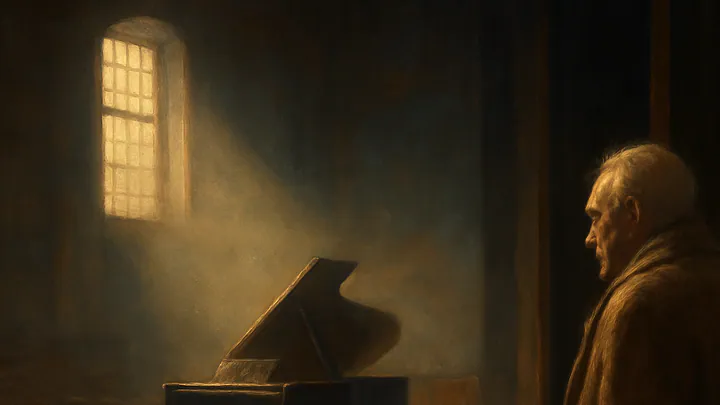
She pushed open a padded door and the stage opened before them like a held breath. Dust hung in the shafts of light from the high windows. And there, alone at center, sat the Bösendorfer, its lid propped as though someone had just stepped away for water.
"Every few years," Delphine said quietly, "the night watchman hears it. Always the same phrase. Eleven notes. Then nothing."
Ansel set down his roll. He had heard versions of this story before — old halls, old houses, the wood remembering weather. Wood did remember, in its way. Humidity, footsteps, the pressure of a certain kind of grief. He did not believe in ghosts, but he believed in resonance, which was almost the same thing and better mannered.
"May I?" he asked.
"That's why you're here."
He climbed the three steps to the stage. The piano was magnificent even under its film of dust — Vienna-made, ninety-seven keys, the extra bass notes running down into a register most players never touched. He ran his hand along the fallboard and it came away gray.
He sat. He struck middle C.
The note bloomed and held, only a shade flat. He struck it again. The hall answered — a long, generous decay, the acoustics still willing after all these years of solitude.
Then he began his work.
II.
Tuning is a kind of listening that most people never learn. You set one string, and then you set every other string against it, and you do this three thousand times, and by the end your ear has become a room the piano lives inside. Ansel worked for two hours before he noticed the cold.
Not the drafty cold of an unheated hall. A specific cold, like standing near an open refrigerator. It hovered at his left shoulder.
He kept working. He was too old to be startled by rooms.
When he reached the middle register, the piano did something odd. He struck an A, released it, and a G-sharp sounded a half-second later, quietly, as though the string had decided on its own. He looked. The G-sharp hammer had not moved. He put his hand flat on the strings to still them and struck the A again. This time nothing followed.
"All right," he said aloud, to no one, or to whoever. "All right."
He worked another hour. The cold at his shoulder did not leave. Once, when he leaned in to check a unison, he thought he heard breathing that was not his own — patient, the breathing of someone waiting to be asked a question.
At last he set down his hammer. He was tired in a way that had nothing to do with his back.
"You want to play it," he said. "Don't you."
The cold shifted, or he imagined it did.
He stood and stepped away from the bench. He walked to the wings and turned, and he watched the empty stool, and he waited.
Nothing happened for a long time. Long enough that he began to feel foolish, and to consider his bus schedule, and to remember he had left the kettle unplugged, probably. Long enough that he stopped watching.
Then the piano played.
Eleven notes. A descending phrase, tender, unhurried, in what he recognized after a moment as F minor. It was not a piece he knew. It had the shape of something unfinished — a question posed and abandoned, or maybe a question posed and answered so quietly he had missed the answer.
The last note held, and held, and faded into the rafters.
Ansel found that he was crying, which surprised him, because he had not cried at his wife's funeral and had assumed that particular door was closed.
He walked back to the bench. He sat. He put his hands on the keys, and he played the eleven notes back, exactly as he had heard them. Then he played what he thought might come after — a small resolution, four notes rising, the F minor opening at last into A-flat major, the way a window opens.
The cold at his shoulder eased. Just eased, like a hand unclenching.
He sat there a while longer. Then he closed the fallboard gently and went to find Delphine.
III.
"It's finished," he said.
She looked up from her clipboard. "The tuning?"
"That too."
She studied him. Whatever she saw in his face made her set the clipboard down.
"There was a composer," she said slowly, "who worked here. In the fifties. He died mid-piece — a heart, on the tram home. His widow donated the manuscripts, but the last one was incomplete. Eleven bars." She paused. "How did you know?"
"I didn't," Ansel said. "I just listened."
He picked up his canvas roll. His hands, he noticed, were steadier than they had been in months.
On the bus home he thought about the buyer in Osaka, who would receive a piano in perfect tune and would never know it had been waiting for someone to answer a question. He thought about his wife, and about the silences he had left unfilled, and about how many other rooms in the world might be holding phrases in reserve, patient as libraries.
He got off two stops early and walked the rest of the way through the wet leaves. When he reached his apartment he sat down at his own upright — the small honest instrument he had owned for fifty years — and he played the four notes he had improvised on the stage.
They sounded, in his own living room, exactly as they had sounded in the hall.
He understood then that he had not been listening for ghosts. He had been listening for the parts of the living that outlast us: a phrase, a question, the shape of a hand on a bench. And when he played the resolving chord, softly, so as not to wake the neighbors, he felt the whole quiet apartment lean toward him, like a room finally allowed to exhale.