How Ambient Intelligence Is Quietly Redefining Daily Life
Ambient intelligence is the layer of sensors, networks and AI that lets a room respond to you without being asked. Here's how it actually works, what it costs, where it fails, and how to build a setup that still works when the internet doesn't.
Rewritten with AI and republished automatically. Our editors set the standards and fix reported errors — how we work.

TL;DR: Ambient intelligence is technology that senses context and acts without being asked — lights, climate, alerts and care systems that respond to presence and habit. It works through sensors, local or cloud AI, and automation rules. A useful starter setup costs around $100–$250. Its biggest failure points are cloud dependence, motion-versus-presence confusion, and privacy.
What is ambient intelligence, exactly?
Ambient intelligence is a computing environment that senses human presence and behavior, interprets the context, and responds automatically — without the user issuing a command. It is also called context-aware computing or ambient computing, and it sits at the intersection of sensor hardware, wireless networking, and machine learning.
The distinction that matters: a smart home is remote-controlled, an ambient home is self-driving. If you are opening an app to dim the living room, the phone has simply replaced the wall switch. The ambient version notices that the TV started, the sun set 40 minutes ago, and two people are on the couch — and dims the room itself.
Adjacent entities worth knowing by name: Matter (the cross-vendor device standard), Thread (the low-power mesh network many Matter devices use), Zigbee and Z-Wave (older but still excellent local mesh protocols), mmWave radar (the sensor type behind modern presence detection), and platforms like Apple Home, Google Home, Amazon Alexa and the open-source Home Assistant.
How does ambient intelligence actually work, step by step?
Four stages, in order: sense, interpret, act, learn. Sensors gather raw signals; software turns those signals into a statement about context; an automation engine decides what to do; and over time the system tunes itself to the household's patterns.
- Sensing. Motion, presence, door contacts, temperature, humidity, light level, power draw, air quality, sound. Power draw is underrated — a washing machine drawing 4 watts instead of 400 is a reliable "cycle finished" signal with no extra sensor.
- Interpretation. The system combines signals into context. Presence in the kitchen plus 6:40 a.m. plus a weekday is a different situation from presence in the kitchen plus 11 p.m.
- Action. Lights, HVAC setpoints, locks, notifications, media. The good implementations act at a level you barely register; the bad ones announce themselves.
- Learning. Adaptive schedules, occupancy prediction, thermostat pre-heating. This is where on-device AI changes the economics — inference that used to require a round trip to a data center now runs on a $60 hub.
Where is ambient intelligence already being used?
It is already ordinary in four places: homes, workplaces, healthcare settings and transport networks. None of these are speculative — they are shipping products and installed infrastructure.
Homes
Occupancy-driven lighting, thermostats that pre-condition rooms before you arrive, leak sensors that shut a valve, and wake routines that raise light levels gradually. Entry points are a natural first project.
Workplaces
Occupancy sensing drives HVAC zoning, desk booking and cleaning schedules. The energy case is usually stronger than the productivity case: conditioning empty floors is expensive and easy to measure.
Healthcare and aging in place
Continuous vitals monitoring, fall detection, bed-exit alerts, medication reminders and inactivity flags for people living alone. These are assistive tools, not diagnostic ones — any monitoring plan for a vulnerable person should be designed with a qualified healthcare professional rather than assembled from consumer gadgets alone.
Transport
Adaptive traffic signals that respond to real queue lengths, transit displays that adjust to actual vehicle positions, and in-vehicle driver monitoring that watches for drowsiness.
How much does an ambient setup cost to get started?
Roughly $100–$250 gets a genuinely useful starter layer; $400–$900 covers a few well-automated rooms; whole-home builds run into four figures, mostly because of wired switches and installation labor. The table below shows what each tier realistically buys.
| Tier | Typical hardware | Rough cost | Setup effort | Works offline? |
|---|---|---|---|---|
| Starter | 2–4 smart bulbs or plugs, one presence sensor, a speaker or hub you may already own | $100–$250 | An evening | Partly — depends on brand |
| Room-level | Presence sensors in 3–4 rooms, smart thermostat, contact sensors, local hub | $400–$900 | A weekend, plus tuning | Yes, with a local hub |
| Whole-home | Wired smart switches throughout, multi-zone climate, leak and air-quality sensing, local server | $2,000+ | Weeks, often an electrician | Yes, by design |
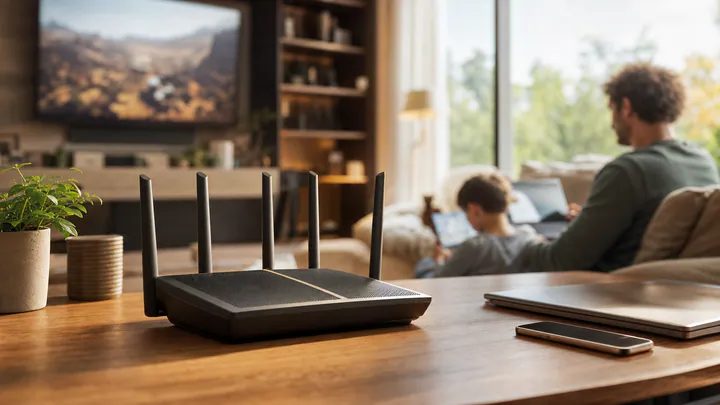
One cost most guides omit: your network. Dozens of always-connected devices put a different kind of load on a router than a laptop does. Before blaming individual gadgets for dropouts, it is worth reading our take on whether a Wi-Fi 7 router upgrade is worth it — though for sensors specifically, Thread and Zigbee are usually the better answer than more Wi-Fi.
What mistakes make ambient setups fail?
Three mistakes account for most abandoned smart homes: using motion sensors where presence sensors are required, buying cloud-only devices, and automating things that break the room when the automation misfires.
Motion versus presence — the costly one
A PIR motion sensor detects movement. Sit still to read, work or watch a film, and it decides the room is empty and kills the lights. Households then disable the automation entirely and the sensor becomes drawer clutter. A mmWave presence sensor detects the micro-movements of a stationary body, including breathing, and holds the room as occupied.
| Sensor type | Best for | Weakness |
|---|---|---|
| PIR motion | Hallways, closets, stairs, garages | Blind to stillness; false negatives |
| mmWave presence | Living rooms, offices, bedrooms | Detects fans, pets and people through drywall unless zones are tuned |
| Door/window contact | Entry triggers, security, fridge-left-open alerts | Tells you about the door, not the person |
| Power monitoring plug | Appliance cycle detection, standby waste | Only works for devices with clear load signatures |
| Camera with local vision | Package detection, identity-aware routines | Highest privacy cost; never in private spaces |
The edge case nobody warns you about
mmWave radar sees through plasterboard. Mount one on a shared wall and it will happily report your neighbor's living room as occupancy in yours — lights coming on in an empty room at midnight with no explanation. The fix is zone configuration and sensitivity limits, not a different sensor. Ceiling fans, curtains near a vent and a cat on the sofa cause the same false positives.
The decision rule to follow
If the automation fails, does the room still work? Every automated light must still respond to a physical switch. Every smart lock must still take a key. If the answer is no, either add a manual fallback or don't automate that thing. This single rule eliminates most of the horror stories.
A worked example: what does a good automation look like?
Take a bedroom wake routine. The naive version sets a light to 100% at 7:00 a.m. The ambient version looks like this:
- From 6:40, raise the bedside lamp from 1% to 40% over 20 minutes at a warm color temperature.
- At 7:00, if the bedroom presence sensor still reports occupancy, nudge the volume of a quiet audio cue rather than flooding the room with light.
- If the bedroom is already empty by 6:55 — someone woke early — cancel the whole sequence and start the kitchen routine instead.
- If today is a holiday in the calendar, skip it.
- The wall switch always overrides everything, immediately.
The gradual light ramp pairs naturally with a morning daylight habit, which does more for how you feel at 7 a.m. than any bulb will. Ambient systems are at their best when they support a behavior you already want, not when they try to invent one.
How do you protect privacy in an always-sensing home?
Prefer local processing, avoid cameras and microphones in private rooms, isolate devices on their own network segment, and audit what each vendor retains. Ambient intelligence earns its value from continuous observation, so privacy is not a bolt-on — it is a purchasing criterion.
Practical measures:
- Buy for local control. Thread, Zigbee, Z-Wave and locally-controlled Matter devices keep working with the internet unplugged. Anything that stops functioning offline has already told you where your data goes.
- Run inference at home. Presence, voice keywords and simple vision can now run on hardware in the house. Our guide to running AI models on your own device covers what is realistic on modest hardware.
- Segment the network. A separate VLAN or guest network for sensors and cameras limits what a compromised device can reach.
- Fix the account, not just the device. Most smart home breaches are account takeovers, not clever hardware hacks. Moving those logins to passkeys instead of reused passwords is the highest-value security change available to most households.
- Declare no-sensor zones. Bedrooms and bathrooms get contact and climate sensors at most. No cameras, no always-on microphones. Write the rule down and stick to it as the system grows.
This does not apply if you live in a shared house or rental where others have not consented to being sensed. In that case, restrict monitoring to your own space, and disclose anything that records audio or video.
How should you start without wasting money?
Start with one annoyance, not one product category. Pick the single most irritating recurring moment in your day, automate only that, and live with it for two weeks before buying anything else.
- Name the problem. "I carry laundry up dark stairs" is a buildable brief. "I want a smart home" is not.
- Choose the ecosystem before the gadget. Matter support plus a hub that does local control will save you from a drawer of orphaned devices.
- Buy one sensor and one actuator. A presence sensor and a smart bulb are enough to test whether you actually enjoy the behavior.
- Tune for a week. Adjust sensitivity, timeouts and brightness before adding rooms. Most failures are configuration, not hardware.
- Expand only where the payback is obvious. Climate, water leaks and lighting pay back. Automated blinds and voice-controlled kettles rarely do.
If budget is the constraint, treat the buildout like any other planned expense and fund it gradually. Spreading a smart home over twelve months also gives you twelve chances to discover you didn't want the next device.
What is genuinely coming next — and what is overhyped?
The credible near-term shift is that more interpretation moves onto local hardware, making responses faster, cheaper and more private. The overhyped part is emotion-sensing rooms and fully autonomous living spaces, which remain unreliable and ethically fraught.
Worth watching: better multi-sensor fusion so a system stops needing a dedicated gadget per signal; energy-aware automation that shifts loads to cheaper or greener hours; and standards maturity, where Matter finally delivers the cross-brand behavior it promised rather than the partial support most people encounter today.
Worth skepticism: any product claiming to read your mood from a room and act on it. Inference about emotional state from ambient signals is noisy, culturally variable, and a poor basis for automating anything that matters.
The best sign of a mature ambient environment is not how much it does. It is how rarely you think about it. If you notice the technology, it is still a smart home. When you stop noticing, it has become ambient.
Key takeaways
- Ambient intelligence means environments that sense context and act on their own — not devices you control from a phone.
- Use presence sensors (mmWave) where people sit still and motion sensors only in transit spaces; this one choice decides whether a setup survives.
- Every automation needs a manual fallback: if the room stops working when the automation fails, don't automate it.
- Prioritize local control and on-device processing — it improves speed, resilience and privacy at the same time.
- A useful starter setup is around $100–$250; expand one annoyance at a time rather than one category at a time.
- Health and elder-care monitoring should be planned with a qualified professional; consumer sensors are assistive, not diagnostic.
Frequently asked questions
What is ambient intelligence in simple terms?
Ambient intelligence is an environment fitted with sensors, connectivity and AI that senses what is happening and responds on its own, without you issuing a command. A hallway light that comes on at 20% brightness at 3 a.m. because it detected you and knows the hour is ambient intelligence; the same light turned on from a phone app is not.
Is ambient intelligence the same as a smart home?
No. A smart home is a collection of controllable devices; ambient intelligence is what you get when those devices sense context and act without input. Most homes marketed as smart are really remote-controlled — the phone simply replaced the wall switch. The shift to ambient happens when you stop opening the app.
How much does it cost to start with ambient intelligence?
A meaningful starter setup usually runs somewhere in the region of $100 to $250: a couple of smart bulbs or plugs, one good presence sensor, and a hub or speaker you may already own. A whole-home build with presence sensors in most rooms, smart switches and local processing typically climbs into the four figures, largely because of labor on wired switches.
Do ambient systems still work when the internet goes down?
That depends entirely on whether the logic runs locally or in the cloud. Devices using Thread, Zigbee, Z-Wave or local Matter control with a hub in the house generally keep working offline; cloud-dependent gadgets fail, sometimes leaving lights stuck in whatever state they were in. Check for local control before you buy, not after.
What is the difference between a motion sensor and a presence sensor?
A motion sensor (PIR) detects movement and goes blind when you sit still, which is why lights switch off on people reading or working. A presence sensor, usually mmWave radar, detects a body's micro-movements including breathing, so it keeps a room marked occupied. Presence sensors cost more and need careful zone tuning to avoid picking up fans, pets, or people through a wall.
Is ambient intelligence a privacy risk?
It can be, because the value comes from continuous observation. The practical mitigations are choosing devices that process data on the device or a local hub, avoiding cameras and always-on microphones in bedrooms and bathrooms, putting smart devices on a separate network segment, and reading what each vendor says it retains. Treat any device that cannot function without uploading your behavior as a deliberate trade, not a default.
Can renters use ambient intelligence?
Yes, but stick to non-destructive hardware: plug-in modules, bulbs, battery sensors with adhesive mounts and a tabletop hub. Skip wired wall switches, in-ceiling sensors and doorbell replacements unless your lease allows them. Renters also benefit from choosing systems that export configurations, so the setup moves with you.
Does ambient technology help older adults live independently?
It can support independence through fall alerts, medication reminders, stove shutoffs and activity patterns that flag unusual inactivity, and these are increasingly used in home and hospital settings. They are assistive tools, not medical devices or substitutes for care — any health-related monitoring plan should be discussed with a qualified healthcare professional.