Nine Across, Two Words, Forgive Me
For thirty-one years, Maud Kerrigan hid private messages inside the newspaper's cryptic crossword, certain nobody would ever notice. Then a solved grid arrived in green ink, signed with a letter she hadn't written in four decades.

For thirty-one years Maud Kerrigan had been hiding private messages where twelve thousand strangers could see them, and not one of them had ever noticed. Then, on a wet Tuesday in March, a letter arrived in green ink, and somebody had.
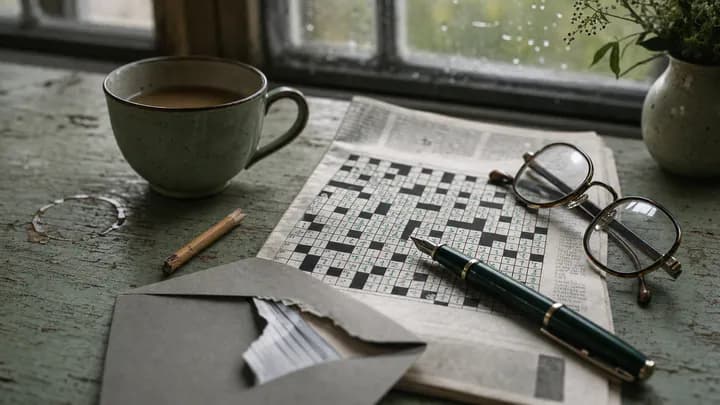
She found it on the mat under a supermarket flyer, and knew before she opened it that something had shifted, the way you know a room has been entered in your absence. The envelope was cheap, the handwriting slanted hard to the right like someone walking into wind. Inside was a page torn from the Ridderford Gazette — Saturday's crossword, number 1,609, completed in green fountain pen, every letter of it correct.
At the bottom, in the margin: Nine across was a cheat and you know it. THISTLE has grown thorns. — E.K.
Maud sat down on the third stair, which she had not done since she was nine.
She had been THISTLE since 1994, when the puzzles editor of the Gazette — a man who wore his glasses on his forehead and never once found them there — had asked her for a pseudonym and she had said the first word that came, because their mother had grown them along the back fence and refused to call them weeds. Prickly, purple, and it'll outlive the lot of us, their mother used to say, snipping. Like some people I could name.
Nobody knew. That was the pleasure of it. Maud Kerrigan, sixty-eight, retired from the county land registry, walked to the shops in a grey coat and was nobody at all, while THISTLE terrorised the breakfast tables of four postcodes with anagrams so tidy they made people put down their toast.
And in among the clues, she hid things. Not often. Once a year, perhaps twice. A Nina — a message spelled down the unchecked letters of the grid, invisible unless you were looking. MUM WOULD HAVE BEEN SEVENTY TODAY. I STILL HAVE THE BLUE JUG. ESS I AM NOT ANGRY ANY MORE. Letters dropped into a well so deep you never heard them land, which was the point. Saying a thing without the terrible risk of being heard.
Esther had been twenty-six the last time they spoke. Their mother's funeral, a February with ice on the church path, and Esther arriving eleven minutes late because she had driven through the night from Aberdeen with a broken heater and a dog in the back. Maud, ash-white with grief and organisation, had said, in front of four aunts: Of course. You'd be late to your own.
Six words. Forty-two years.
Neither of them had ever been able to work out who was supposed to move first, and so, in the manner of the Kerrigans, they had both stood perfectly still.
Twelve Weeks
On Thursday, Priya Bhandal rang from the Gazette. Priya was thirty-one, edited the entire paper from a desk that had once belonged to four people, and always sounded as though she were apologising for weather she hadn't caused.
"Maud. I hate this call."
"Then make it a short one."
"We're cutting the crossword. Twelve more weeks and then the page goes to property listings." A pause. "For what it's worth, I fought."
"I know you did." Maud looked at the green-inked grid, which she had propped against the sugar tin where she could see it. "Twelve weeks."
"You could do something with that," Priya said. "A farewell puzzle. Readers love a farewell."
Maud said she would think about it, and hung up, and thought about it for eleven days.
What she built in those eleven days was the best grid of her life and also, technically, a bad one. Fifteen by fifteen, symmetrical, the surfaces smooth as river stones. And at nine across, four and four, she wrote a clue that broke every rule she had ever held:
What the prodigal did, and what I'm asking (4,4).
COME HOME. No wordplay. No anagram, no hidden word, no charade. Just a definition standing in the open with its hands up. THISTLE had never, in 1,610 puzzles, used the word I in a clue. It was the most conspicuous thing Maud had ever done in her life, and only one person on earth would see it.
She sent it. It ran on the Saturday.
On the Wednesday, a second envelope came.
The grid was solved, again, in green. Beneath it, three lines:
Nine across was unfair, sentimental, and beneath you. I got it in four seconds. Station tearooms at Carrow Halt, Saturday, eleven o'clock. Bring a pencil, you'll need one. — E.
Maud read it standing up, then sitting, then standing again. What undid her was not the invitation. It was the ink. Esther had written her school homework in green because their mother said it was cheerful, and had gone on doing it at forty and sixty because some things simply set, like cement, and you walk on them for the rest of your life.
Carrow Halt
The tearoom smelled of toast and hot dust from the radiators, and the whole place shuddered gently whenever the eleven-oh-four went through without stopping. Maud arrived at twenty to and chose a table facing the door, then changed to one facing away, then changed back.
Esther came in at eleven exactly. She was smaller than Maud's memory of her and broader across the shoulders, with white hair cut close and a walking stick she clearly resented. She stood in the doorway a moment, taking in the room the way you check a grid for symmetry.
Then she sat down opposite and said, "You've got fat."
"You've got old."
"That's the deal, isn't it," Esther said, and something in both their faces let go at once.
They ordered tea. The pot came with a chipped lid. Esther poured, because Esther had always poured.
"Thirty-one years," Maud said at last. "How long have you known?"
"Nineteen ninety-seven." Esther stirred, unhurried, enjoying herself. "Puzzle two hundred and something. You clued PERSIMMON, and nobody in the whole of England has ever cared about persimmons except our mother, who grew one in a pot and talked to it. I sat in a caravan outside Tain with the paper on my knees and I said out loud, that's Maud."
"You never wrote."
"Neither did you, and you knew my address." Esther set the spoon down. "I subscribed. Twenty-eight years of a newspaper from a town I don't live in, for one page of it. My husband thought I was a lunatic." She looked up. "I found the hidden ones too. The down letters. Took me until about two thousand and four to notice you were doing it, and then I went back and did the lot, every puzzle I'd kept, and I'd kept them all."
Maud's throat closed. "All of them?"
"Boxes," Esther said. "I know about the blue jug. I know you weren't angry any more. I knew that in two thousand and nine and I still didn't get in the car, so before you start — we're both idiots and there's no league table."
Outside, a train went through, and the cups rang faintly in their saucers.
"I said a foul thing to you," Maud said. "At the church."
"You did. And I let you keep it for forty years because it was the only thing I had of you." Esther pulled a paper napkin towards her and took out the green pen. "Right. That's the apologies done, I can't be doing with more. Pencil."
Maud handed it over. Esther wrote on the napkin, turned it round, and slid it across the table.
Prickly, purple, grows where nothing else will (7).
"Thistle," Maud said.
Esther took the napkin back, crossed the word out, and wrote another one underneath.
"No," she said. "Sisters. Seven letters as well. Fits the same space — I checked."
Frequently asked questions
Why does Maud choose clues rather than a letter to reach her sister?
Because a clue lets you say a thing and not-say it at the same time, which is the only way proud people speak. Maud has spent thirty-one years perfecting a language of concealment; asking her to write plainly would be asking her to arrive unarmed.
What does the green ink signify in the story?
It is the one detail Maud cannot argue with — a habit from childhood homework that survived forty years of silence. The story suggests that what endures between people is rarely the grand gesture but the small, unconscious fingerprint.
Is the failing newspaper more than background?
The Gazette's decline gives Maud a deadline, and deadlines are how the stubborn get moved. It also quietly asks what a community loses when its shared daily ritual disappears — and answers that some rituals were carrying messages nobody knew about.
Why end on the word "sisters" instead of "thistle"?
Because Esther refuses to let the pseudonym have the last word. Swapping one seven-letter answer for another turns Maud's lifelong disguise into an admission, and lets the reconciliation happen in the only grammar the two women share.