My Mother's Tenth Frame Was a Choice
A daughter comes home to empty her mother's house and finds an old scoresheet folded into eighths. The famous 299 on the wall of Windrow Lanes was never the mistake everyone thought it was.

The plaque beside the shoe counter has my mother's name on it and the wrong number underneath. Two hundred ninety-nine, it says. Margo Vance, March 8, 1987. One pin short of the only perfect this game admits.
Windrow Lanes smells exactly the way it smelled when I was six: lane oil and floor wax and the sugary scorch of a fryer that has never once been replaced. Twelve lanes, eight of them lit. A bell the size of a soup pot bolted above lane one, green with age.
My daughter Junie is seven and has already decided the ball return is a personal friend. She keeps putting her hand flat on the vent and shrieking at the warm air.
"Don't," I say. "Fingers."
"It's breathing."
I have four days to empty my mother's house and a work phone that will not stop lighting up in my coat pocket. I came here because the house got loud in the way empty houses do — every drawer another small argument — and because Junie asked, and because the sign out front says THANK YOU WINDROW, 52 YEARS and gives a closing date in April.
The man oiling lane three is about eighty and built like a folding chair. He looks up, squints, and says my mother's name as a question.
"Her daughter," I say. "Nadia."
"Gil Ostrander." He wipes his hand on his thigh before he offers it. "I racked pins here when it was pins and not machines, and I've fixed the machines since. I'm sorry about Margo. She was one of the ones who bowled like she was arguing with the lane."
That is so precisely her that I have to look at the ceiling tiles for a second.
I tell him about the house. I tell him about the boxes, and how I have been sorting forty-one years of a woman into keep, donate, and a third pile I haven't named. And then I do the thing I told myself in the car I wouldn't do, which is take the scoresheet out of my bag.
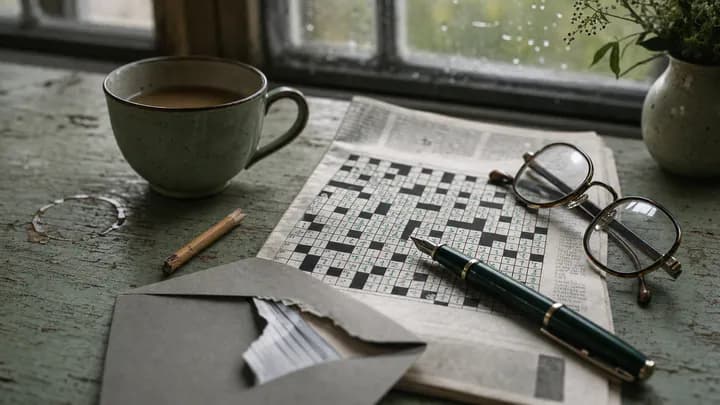
It was in a cigar box with her high school ring and a hotel key from a city she never mentioned. Pencil, carbon-smudged, folded into eighths so long ago the creases have gone soft as cloth. Eleven X's in a row. And in the tenth frame, the last ball circled twice, hard enough to dent the paper, with three words in her tall slanting hand.
Best thing I did.
Gil holds it at arm's length. He is quiet long enough that the pinsetter on lane three finishes its cycle and clanks itself still.
"Huh," he says. "She kept it."
"Everybody in this town told that story like it was a tragedy. My aunt still says the year your mother lost the three hundred, like it was a war."
"Your aunt wasn't standing where I was standing." He hands the sheet back, carefully, by the edges. "You want to sit down for this or you want to bowl?"
"I'd rather bowl."
"Good. Talking's easier sideways."
What Gil Saw
He puts us on lane six. Junie gets bumpers and a ball the color of grape soda, and she throws it with both hands from between her knees, and every single time she turns around before it has traveled four feet to check that I am watching. I am. I make sure I am.
Gil talks while she rolls.
"March of '87. Monday night mixed league, which was the good league, the one where people cared. Snow coming. Your mother goes out in the first with a strike and doesn't stop. By the seventh frame the other lanes have quit bowling. By the ninth there's maybe sixty people standing behind lane one with their coats on, not making a sound. You ever hear a bowling alley go silent? It's a hell of a thing. All you can hear is the blowers."
"She never described it."
"She wouldn't." He rubs his thumb along the ball rack. "Tenth frame. Strike. Strike. One ball left. And old Delmar who ran the house then, he's already got his hand on the rope for that bell, and the fella from the county paper is there with a flashbulb, because a three hundred in Windrow was front page and free lanes for life and your picture up on that wall until the building fell down."
"And she left the ten-pin."
"She threw it light," Gil says. "Way light. Three boards outside anything she'd thrown all night. I was standing at the foul line end of the machine with my head in the works, so I had the one angle in the building where I could see her face while the ball was still going."
He stops. Junie's ball knocks down four and she does a small violent dance.
"And?" I say.
"She wasn't watching the ball. She was looking back over her shoulder at the chairs behind the ball return." Gil looks at me the way you look at someone you're about to hand something heavy. "There was a kid asleep in one. Little thing, maybe six, coat on, shoes still rented, head hanging off the side like kids do."
The blowers hum. The pinsetter on lane eight cycles.
"Me," I say.
"You," he agrees. "Now, a three hundred is not a ball. A three hundred is an hour and a half. It's the bell and the round of drinks and everybody wanting to shake your hand and the paper fella taking eleven pictures because the flash keeps failing. Your dad was on nights that winter, I remember that much. She'd have had to wake you up and set you on a stool and let you watch strangers be happy at her until eleven o'clock."
He shrugs, and it is not a careless shrug.
"So she left the ten-pin, and she laughed, and she said a word I won't repeat in front of your girl, and everybody groaned and clapped and bought her a beer anyway, and inside of nine minutes she had you over her shoulder and out the door. Snow starting. I held the door."
I sit down on the plastic bench because my legs have gone conversational.
"She could have just come back the next week," I say. "She could have had both."
"Sure. And she'd have been the woman who got her picture on the wall." Gil nods at the plaque, small and brass and slightly crooked. "Instead she's the woman with the two ninety-nine. People have been telling that number in this town for thirty-eight years. Nobody in the history of Windrow ever told a story about a guy who bowled a three hundred, because there's nothing in it. It's just a number that behaved."
We bowl until nine. Junie breaks fifty with the bumpers and demands that this be written down somewhere permanent, so I write it on the back of a shoe-rental slip and put it in my coat with the phone I have not looked at in two hours.
Around the eighth frame something odd happens to me. I stop counting. It's not a decision — it's more like a muscle finally letting go, one I didn't know had been clenched since roughly 2009. I throw strikes in the eighth and the ninth and hear Gil, over by the oil machine, make a small interested noise.
And then the tenth frame, and two more that go clean, and Gil is standing up now, and there is no bell anymore and no county paper, and I turn around with the ball against my hip and look at the chairs behind the ball return.
Junie is asleep sideways with her coat still on, rented shoes hanging off the end of the seat, mouth open, entirely undefended.
The score doesn't mean anything. I know that. It's a Tuesday in a building that closes in April, and there is no version of this night that gets written down.
But I understood my mother for the length of one breath, and I wanted to hold it a little longer.
I rolled the last ball three boards outside of anything I'd thrown all night. I left the ten-pin standing exactly where she left hers, and I carried my daughter out into the cold, and I never once looked back at the score.
Frequently asked questions
Why does the plaque matter so much to Nadia before she learns the truth?
Because she has spent her life reading the world as a scoreboard, where one pin short means failure. The plaque is the first proof she ever had that her mother was fallible, and she has quietly organized her own ambitions around not repeating it.
What does Gil represent in the story?
He is the last living witness, the man who watched the ball go wide and understood it. In a town that turned the 299 into folklore, he keeps the smaller, truer version, and he gives it away only when someone finally asks the right question.
Is the ending a rejection of excellence, or something else?
It is not a rejection of excellence so much as a reordering of it. Nadia discovers that her mother measured a good night by who got carried home asleep, and she decides, for one evening at least, to use the same arithmetic.
Why does the story withhold the scoresheet's three words until so late?
Because Nadia herself cannot read them until she has a context for them. Held back, the phrase 'Best thing I did' turns from a puzzle into a verdict, and the reader arrives at it at the same moment she does.