The Smoke Was Lit in Greenhouse Eleven
A short story about a foreman on an Azorean pineapple farm, told backwards across nine days, as he hunts for whoever is secretly smoking one greenhouse at night before the Lisbon owners arrive.
Drafted with AI. This version has not been reviewed by an editor, so it carries no ads — how we work.
Story Time is original short fiction. The characters, places and events in this story are invented.
Friday, 8 November 1996
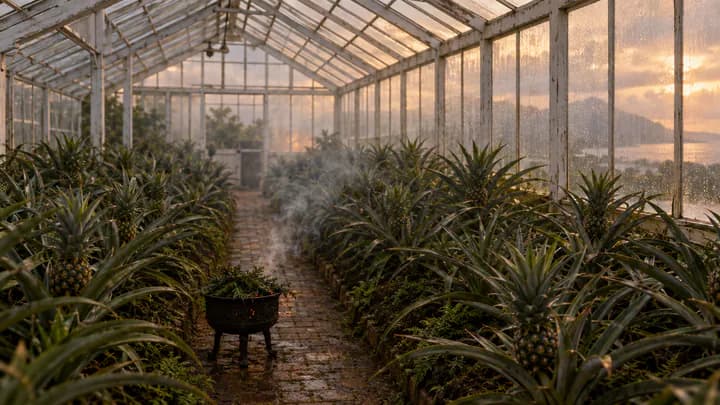
Duarte pulled the door of greenhouse eleven open at ten past five in the morning and the smoke came out to meet him, grey and resinous, rolling along the inside of the whitewashed glass. He had sat in the dark of the packing shed since midnight with a torch he never switched on, and his knees were stiff from it. Crouched beside the iron brazier, a bundle of green incenso across her lap, feeding it one branch at a time, was Dona Leonor Medeiros in her black cardigan.
"Close the door," she said. "You're letting it out."
He didn't. He took the bundle from her, the way you take scissors from a child, and laid it on the brick path. The leaves were wet; that was the trick of it, green wood that smouldered and never caught. Jacinto Medeiros had taught him that when he was nineteen. Jacinto had taught half the parish.
"Nine nights, Dona Leonor."
"Eight. Sunday the rain came in sideways and the matches wouldn't take." She looked along the beds, the long grey swords rising out of black fern soil, and in the centre of nearly every rosette the small red heart. "They've turned."
"They've turned," he agreed. "The Lisbon people land at eleven tomorrow. Their paper says this house is cut in the last week of April. Rui wanted me to call the GNR about Fátima and her boy."
"I heard. I'm sorry for that part." She did not say she was sorry for the rest. "You told me the date yourself, you know."
He knew. He helped her up, walked her to the gate, watched her go down the lane toward Fajã de Baixo with her empty basket. Then he went into the office, rolled a fresh sheet into the typewriter and sat looking at the export schedule for a long time. Lot one, last week of March. Lot two, last week of April. Greenhouse nine was pencilled to be smoked on Monday for lot one.
He moved eleven into March. He moved nine into April and wrote its smoking in for the end of the month. The fruit counts came out within forty of each other. On the fax to Dr. Quintela he typed: Early induction in house eleven due to ventilation fault. Corrected by re-sequencing. Contract volumes unaffected.
When Rui came in at seven Duarte told him to tell the Câmaras the matter was closed. A vent fault. His own mistake.
Rui looked at the blackened brazier sitting outside the office door. "Your mistake."
"Mine," Duarte said, and fed the fax through.
Wednesday, 6 November
"If it's the seasonals, let them go," Dr. Quintela had said on the telephone that afternoon, his voice thin across the line from Lisbon. "We are buying a schedule, Senhor Duarte. Not a mood."
So at ten that night Duarte sat in the packing shed with every light on and Tiago Câmara across the crate from him, because the boy had asked to sit the watch. To show, he said. Twenty years old, hands still green from stripping suckers.
"Rui says it's us because we're from Ribeira Grande," Tiago said. "Outsiders."
"Rui says the moon is from Ribeira Grande."
Tiago didn't laugh. "My mother needs this winter's money. Why would we burn the thing that pays us?"
Duarte had no answer that would help, so he took out what he'd found that morning in the ash: the charred end of a bundle, the branches cut cleanly with secateurs, not hacked, and bound with raffia wound twice and tucked under itself. He turned it in the light. He had tied that knot a thousand times. He had learned it from a man who was eight months dead.
"What is it?" Tiago asked.
"Somebody's habit," Duarte said.
Nobody came that night. Nobody would come, he understood around three, with every bulb in the shed burning like a lighthouse. He would have to sit in the dark.
Sunday, 3 November
The Atlantic was coming over the island in long grey sheets, rattling the panes, and Duarte walked the beds of eleven with a clipboard and counted red hearts. Two hundred and twelve of six hundred. By Friday it would be most of them.
Fátima Câmara was waiting under the eave when he came out, her scarf soaked dark. "Rui says you wrote down whose boots were at the door last night."
"I wrote down who was here."
"We're always the last here. We do the work you people don't like." She held his eye. "You think I'd smoke a house to lose my own wages? You've known me four seasons."
"I don't think it," he said, and found it was true, and found also that it would not matter to Lisbon what he thought.
He telephoned Dr. Quintela from the office with the door shut and said there was an irregularity. He did not say fire. He said he would have it resolved before Saturday. He hung up and listened to the rain and thought that whoever it was, they would not come tonight, not in this.
Friday, 1 November
The glass of eleven had a film on its inside face that morning, a faint brown bloom against the whitewash. Duarte put his palm to the brazier on the path. Warm.
He opened the smoking book on the shelf by the door. Eleven: 25 November, ten days. Nothing before it. He had opened the roof vents himself at six the evening before, and they were shut.
"Did you smoke anything, Rui?"
Rui shrugged, unhappy at being asked. "Smoke what? It's All Saints."
At noon Duarte went down to the cemetery with his sister's chrysanthemums and found Dona Leonor at the wall beside her husband's stone, scraping old wax off the marble with a fingernail. She asked after the farm.
"Good," he said. "Eleven is looking beautiful. That was always his."
"Always," she said. Her hands smelled of smoke, and he thought nothing of it, because every hand in the cemetery smelled of candles that day.
Wednesday, 30 October
He was padlocking the office when she came up the lane at dusk with a wicker basket on her arm and a bundle of something green laid across it. She had not been to the farm since the funeral. Since the Lisbon people bought it, and kept him on, and gave him the keys.
"I want to sit in his house a while," she said. "If the new owners don't mind."
"The new owners are in Lisbon," Duarte said. "Sit as long as you like."
She asked him how it was going, and he told her more than he meant to, because he was proud of it: the contract, the two lots, a schedule worked out to the week. "I can tell you the day a fruit will be ready before it's even flowered," he said. "Smoke on the right night and it's five months and a little. If the winter's kind."
"So if a person wanted fruit for the eighteenth of March."
It was the date on the stone. He heard that only later. At the time he laughed. "Then a person would have to start smoking tonight. Eleven isn't scheduled until the end of November."
"Tonight," she said, as though he'd told her the price of bread.
He offered to walk her in and she said she knew the way better than he did, which was true. He kicked his moped into life and rode down between the stone walls, and at the bend by the hydrangeas he looked back. Through the wet whitewashed glass of eleven a match flared, small and orange, and a figure in black bent low over the path, close to the ground, as if to a grave.
A candle for Jacinto, he thought, and crossed himself, and rode on home to his supper.