Picking Board Games That Fit Your Group Size and Time
The player count on the box tells you what a game allows, not what it is good at. Here is how to match games to a couple, four friends or a party of ten, by best player count, real playtime and rules weight.
Drafted with AI and published automatically. Our editors set the standards and fix reported errors — how we work.
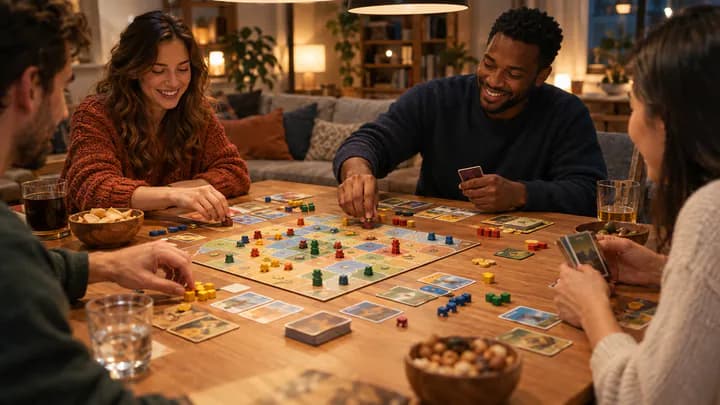
The player count printed on a board game box tells you what the game allows, not what it is good at. A box that says 2–5 players may be tense and fun at four, flat at two and slow at five. If you keep buying games that sit on the shelf because they never suit the people who actually show up, the fix is to check three things before you buy: the count the game is best with, how long it really runs, and how heavy its rules are. This guide matches games to the group you have, whether that is a couple, four friends or ten people in a living room.
It is written for someone building a small, useful shelf, not for experienced hobby gamers who already track ratings, and not for parents picking games for young children, where reading level and attention span matter more than anything here.
Why the box player count misleads
Publishers print the widest range a game technically supports, because a broader range sells to more households. The rules may function at every count on the box, but the experience changes a lot from one end to the other.
Three things usually go wrong at the edges of the range:
- Too few players: the board feels empty and there is little competition for space or cards. Some games patch this with special rules for two, which work but rarely feel like the full game.
- Too many players: waiting time between turns grows. In a game where each turn takes a minute of thinking, five players means four minutes of watching before you act again.
- Mismatched length: the box time assumes players who already know the rules. A table of first-timers runs long, and a game that overruns the evening gets abandoned halfway.
The three numbers that matter
Best player count
BoardGameGeek, the largest community database of board games, runs a poll on each game's page where users vote on every supported player count as Best, Recommended or Not Recommended. The page summarizes the result next to the official range, so you might see the box range alongside a narrower community range and a single best count. That best count is the most useful number on the page. If it does not match the group you usually host, keep looking, however good the reviews are.
Read the poll with some sense: if only a handful of people voted, treat it as a hint. On popular games with many votes, the pattern is usually reliable.
Real playtime
Box times assume everyone knows how to play. A practical rule of thumb: add roughly 50% to the upper box time for a first play with new players, which covers the teach, the questions and the slower first few turns.
Worked example: Ticket to Ride lists 30–60 minutes. Taking the upper figure, 60 × 1.5 = 90 minutes for a first game with newcomers. Azul lists 30–45 minutes, so 45 × 1.5 is about 68 minutes, call it 70. If your game night realistically has a 90-minute window after food and chat, Azul fits comfortably on a first play and Ticket to Ride fills the whole evening.
Once everyone knows the rules, playtime drifts back toward the box figure, and often below it.
Rules weight
BoardGameGeek also shows a weight, a community complexity rating from 1 (light) to 5 (heavy). As a working guide for casual groups:
- Around 1 to 2: teachable in about ten minutes; good for mixed groups and people who say they are not into games.
- Around 2 to 3: needs a proper explanation and a first game where people are still learning; fine for groups who enjoy a puzzle.
- Above 3: rulebooks run long, and first plays can take a whole evening. Leave these alone until your group asks for more.
Weight measures rules burden, not quality. A light game is not a lesser game; it is one more people will say yes to.
Games that shine with two players
Couples and two-person households often end up playing multiplayer games at their weakest count. Games designed for exactly two avoid that problem, because every rule is built around the head-to-head tension.
Patchwork is a quilt-building game: you buy fabric pieces with buttons and time, then fit them into your own 9×9 board like a puzzle. It is light, quick and easy to teach, and the time track means a player who falls behind gets to take several turns in a row, so games stay close. Expect around half an hour.
Jaipur is a card game about trading goods at a market. You choose between grabbing one card, swapping several, or selling a set, and the best prices go to whoever sells first. It fits on a small table, plays in about half an hour, and its push-your-luck selling decisions suit players who like a bit of needling.
If you want something with more to chew on, 7 Wonders Duel is a two-player game of building a civilization from a shared layout of cards, a step up in rules but still well under an hour once learned.
The trade-off with dedicated two-player games is obvious: they do nothing for you when a third person arrives. If your evenings are sometimes two and sometimes four, a game that is genuinely good at both counts, such as Azul, may earn its shelf space better.
Sweet spots for three to five players
This is where most popular games sit, and where checking the best count pays off most.
Ticket to Ride (2–5 on the box) has you collecting colored train cards to claim railway routes between cities on a map. It is light enough for newcomers, but its fun comes from competition for routes. With two or three players, the rules close one track of each double route, which helps, yet the map still feels roomy. At four the board gets crowded in the good way; at five it is tightest, with the longest wait between turns. If your group is usually four, this is a strong pick.
Azul (2–4) is a tile-drafting game: players take colored tiles from shared factory displays and place them on personal boards to score patterns. The number of factory displays scales with the player count (five at two players, up to nine at four), so it holds up better at two than many games do. Turns are fast, it looks good on the table, and it stops at four, so it cannot stretch to a fifth guest.
For short nights or groups of five, Sushi Go! (2–5) is a card-drafting game where everyone picks a card and passes the rest of their hand. Turns happen at the same time, so adding players barely adds time. For groups who want a meatier evening, Wingspan (1–5) is a medium-weight engine-building game about attracting birds to wildlife preserves; budget a long first play.
Party games for six or more
With six or more people, turn-by-turn strategy games collapse under waiting time. Team games and games where everyone acts at once work far better, and they keep rules short enough to explain while people are still arriving.
Codenames splits the room into two teams. A grid of 25 word cards sits on the table, and each team's spymaster gives a one-word clue plus a number to steer teammates toward their own words while avoiding the other team's and one assassin card. The box says it plays from two, but it really wants four or more, ideally six to eight, so both teams have people to debate the guesses. Rounds are short, so late arrivals can join between games.
Wavelength is also team-based: one player sees a hidden target on a dial between two opposites, such as hot and cold, and gives a clue; their team then argues about where to turn the dial. The box goes up to 12 players, and the arguments are the game, so it improves as the group grows. It needs almost no rules knowledge, which makes it a good fit for people who claim they do not like board games.
The limit of party games is depth: they are fun for an hour and then repeat. They also fall flat with three or four quieter players. Keep them for the nights the room is actually full.
Matching group size, time and rules tolerance
Use this table to pick from the games covered above. Times assume at least one person already knows the rules.
| Group size | Under 45 minutes, minimal rules | About an hour, some rules | Longer night, happy to learn |
|---|---|---|---|
| 2 players | Patchwork, Jaipur | Azul, 7 Wonders Duel | Wingspan |
| 3–5 players | Sushi Go! | Azul (up to 4), Ticket to Ride | Wingspan (up to 5) |
| 6 or more | Codenames | Wavelength | Alternate Codenames and Wavelength, or split into two tables |
If your group is between rows, say five or six, lean toward the larger row. A party game that is slightly underfilled still works; a strategy game that is overfilled drags.
Building a five-game shelf that covers every night
A small shelf works when each game covers a different situation rather than five variations on the same one. One good split: one dedicated two-player game, two games for three to five, and two party games so you have a backup when the first one has run its course.
| Game | Covers | Approximate price |
|---|---|---|
| Patchwork | Two players, short and light | $20–$30 |
| Azul | Two to four, quick and puzzly | $30–$40 |
| Ticket to Ride | Four or five, a full evening for newcomers | $40–$55 |
| Codenames | Six to eight, fast team rounds | $15–$25 |
| Wavelength | Large groups, almost no rules | $30–$40 |
Adding the low ends gives $135 ($20 + $30 + $40 + $15 + $30), and the high ends give $190 ($30 + $40 + $55 + $25 + $40). Expect to spend somewhere between those, depending on sales and edition. If that is more than you want to spend at once, buy in the order of how often each situation actually happens at your house: a couple who hosts friends once a month needs Patchwork or Azul long before Wavelength.
Before each new purchase, check it against your shelf: does its best count fill a gap, does its real first-play time fit your usual evening, and is its weight something your regulars will sit through? A game that passes all three will get played; one that only looks good in reviews will join the pile you were trying to stop building.