The Understudy for the Aurora
On nights when the northern lights refuse to appear, someone has to take their place. Mira has been doing it for eleven winters, and tonight a stranger is watching.
Drafted with AI and published automatically. Our editors set the standards and fix reported errors — how we work.
The sky was empty again, and Mira was already lacing her boots. Eleven winters into the job, she could tell from the pressure behind her eyes whether the aurora would show on its own or whether the night belonged to her.
Tonight belonged to her.
She zipped her parka, shouldered the long canvas case, and stepped out of the cabin into air so cold it had a flavor — iron and pine and the faint sweetness of woodsmoke from the village four kilometers down the valley. The dogs in the kennel didn't even lift their heads. They knew her quiet nights.
The path to the ridge was packed hard by her own footsteps, eleven winters deep. She climbed without thinking. Halfway up, where the spruces thinned and the world opened into snowfield, she stopped and looked back.
There was a light on in her cabin.
She was certain she had turned it off.
Mira considered going back. Then she considered the sky, which had begun its slow, expectant hush — the particular silence that meant the real aurora had decided, somewhere over the pole, not to come tonight. People had traveled. People were waiting. Buses had idled outside lodges. Children had been bundled into snowsuits and promised wonders.
She kept climbing.
The Ridge
At the top, she unpacked the case. Inside were three brushes of different weights, a folded square of something that looked like silk but wasn't, and a small wooden bowl. She set the bowl in the snow and breathed into it until it filled with a pale, pulsing fog. This was the part she could not explain, not even to herself. Her grandmother had shown her once, on a ridge much like this one, and then refused to ever speak of it again. Some jobs choose you, the old woman had said. You only get to choose how gracefully you do them.
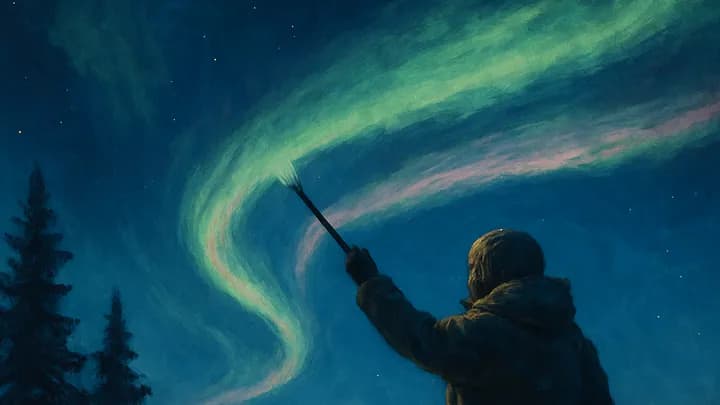
Mira dipped the largest brush into the bowl and lifted it to the sky.
The first stroke was always the hardest — a long, slow arc from the eastern horizon up through the zenith. The light that followed her brush was thin at first, a smear of green so faint it might have been imagined. She made herself patient. She layered. A second pass, deeper. A third, with a twist of the wrist that her grandmother had called the river turn. The green thickened, began to ripple, began to drift on a wind that wasn't there.
From the village below, someone gasped. She always heard it, even from this distance. It was the sound that paid her.
She was working the pinks in along the lower edge — pinks were harder, they took a different breath — when she heard boots on the path behind her.
She did not turn around.
"You're not supposed to be up here," she said.
"I know." A young man's voice, out of breath. "I followed your tracks."
"Then you can follow them back down."
He didn't move. She could hear him not moving. After a moment she sighed and lowered the brush, and the pinks held themselves where she had left them, patient as laundry on a line.
He was maybe twenty-two. City coat, wrong boots, a camera around his neck that he was holding like an apology.
"My grandmother sent me," he said.
Mira waited.
"She said to tell you: the river turn, but slower at the end. She said you'd know what it meant."
Mira set the brush down very carefully in the snow.
"What's your grandmother's name?"
"Aune. She lives in Rovaniemi now. She can't climb anymore. Her knees." He paused. "She said there used to be three of you."
The Conversation
Mira had not heard Aune's name spoken aloud in nineteen years. She had assumed, the way one assumes about people who vanish into cities, that Aune had simply stopped. That she had decided the job was foolish, or impossible, or someone else's problem.
"She told you about this," Mira said. It was not a question.
"She told me last week. She thought she was dying. She wasn't, it turned out, but she'd already said it." He gave a small, embarrassed laugh. "She said someone has to learn before you get tired. She said you'd been tired for a while."
Mira looked up at her half-finished sky. The greens were holding. The pinks were beginning to thin at the edges, the way they did when she stopped feeding them. In an hour they would be gone, and the people in the village would say weren't we lucky and go inside to drink something warm.
She had been tired for a while.
"What's your name?"
"Eero."
"Eero. Do you understand that this is not a hobby. That if you learn it, you will have to come up here on nights when you are sick, and nights when you are heartbroken, and nights when you would rather be anywhere else, because somewhere down there a child has been promised something."
"Yes," he said. Too quickly.
"No," she said. "You don't. But you will."
She picked up the medium brush and held it out to him, handle first.
He took off his gloves with his teeth. His hands were shaking, from cold or from the rest of it, she couldn't tell. She showed him how to breathe into the bowl. His first breath produced nothing. His second produced a thin curl of fog that immediately dissipated. On his third, the bowl filled, and he made a small sound in his throat that she remembered making, on a ridge much like this one, when she was nineteen.
"Now," she said. "The pinks need finishing. Start at the western edge. Don't push. Let the brush find the place it wants to go."
He lifted the brush. He hesitated.
"What if I ruin it?"
"You will," she said. "Tonight, probably. People down there will say that was a strange one. They'll blame the solar wind. They always blame the solar wind." She almost smiled. "Go on."
He touched brush to sky.
The pink that bloomed under his hand was the wrong shade — too orange, too eager — and it wobbled at the edges like a child's drawing. From the village below, no one gasped. But no one was disappointed either. They saw what they were always going to see: light where there had been none, color where the dark had been, a sky doing something they would tell their grandchildren about.
Mira watched him work. She watched his shoulders unknot. She watched him forget, for whole seconds at a time, to be afraid.
Above them the real aurora, wherever it was tonight, kept its own counsel. It did not come. It did not need to.
When Eero finally lowered the brush, his face wet with cold and something else, he turned to her and said, "How long have you been doing this alone?"
"Long enough," she said.
She bent and began, slowly, to pack the case. She would leave the brushes out tonight. He would need them again tomorrow, and the night after, and for a great many nights she would no longer have to climb for.
The sky held its borrowed colors a little longer than usual, as if it, too, were grateful.