The Piano Tuner's Weather Report
Every Thursday, Halim tuned the old upright in the community hall and told the caretaker what kind of week was coming. He was rarely wrong, and never once explained how.
Drafted with AI and published automatically. Our editors set the standards and fix reported errors — how we work.
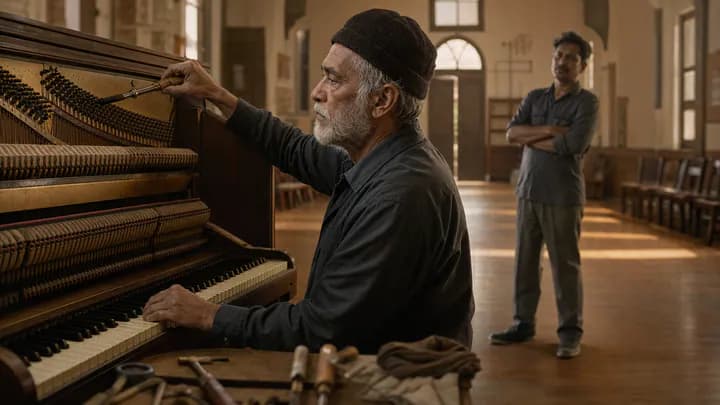
Every Thursday morning, Halim laid his tools on the felt cloth in a neat crescent and told the caretaker what kind of week was coming. He was rarely wrong, and he had never once explained how.
The community hall on Ainsworth Street was older than most of the people who used it. It had a slanted floor, a radiator that ticked like a metronome trying to remember four-four time, and an upright piano the color of steeped tea. The piano had been donated in 1962 by a widow who claimed it had once belonged to her mother's music teacher, though nobody had ever verified the story and nobody had ever needed to. It was the hall's piano now. It had earned itself.
Halim arrived at eight. He was a small, tidy man in his early sixties with hands that always looked freshly washed, even at the end of the day. He greeted Nell the caretaker with a nod, hung his coat on the third hook from the left because the other hooks were unreliable, and sat down on the bench.
"Well?" Nell said, as she always said, pouring tea into two mugs that did not match.
Halim did not answer yet. He pressed middle C and listened. Then G. Then the D two octaves above. He turned his head slightly, the way a bird turns its head when it hears something under the grass.
"Rain Tuesday," he said. "Not heavy. And a cold snap Friday night, but only after dark. Tell the knitting group to bring cardigans."
Nell wrote it on the whiteboard by the kitchen. She had been writing his forecasts on the whiteboard for eleven years. In that time, the knitting group had never once been cold on a Friday when they had been warned to bring cardigans.
How He Came To It
He had not always known. As a young man, Halim had tuned pianos for a concert hall in a city with a river running through it, and he had heard exactly what other tuners heard: overtones, dissonance, the small flat cry of a string that has been too long ignored. Weather was weather. Music was music.
Then, one winter, he had been called to a farmhouse to tune a piano that had been sitting under a leaky roof for three seasons. The wood was warped, the pins loose, the felt swollen. It should have been firewood. But when he pressed the keys, the piano told him, quite clearly, that the barn behind the house would flood by Sunday.
He had not said this out loud. He had simply asked, on his way out, whether the family kept anything valuable in the barn. The farmer's wife had frowned and said only the seed for spring. Halim had suggested, gently, that she might move it. She had, without knowing why she agreed. On Sunday the creek jumped its bank and put four feet of water where the seed had been.
After that he had listened differently. It turned out many pianos had things to say. Most of them said nothing more urgent than my A is drifting or the humidity in this room is uncivilized. But a few — the old ones, the loved ones, the ones that had absorbed decades of a single building's breath — those spoke about the weeks ahead the way a farmer speaks about his knees.
On this particular Thursday, Halim worked slowly. The upright had a stubborn E-flat in the middle register, and he coaxed it back into agreement with its neighbors, muting the adjacent strings with a wedge of soft rubber. Outside, a delivery van reversed and beeped. A child laughed somewhere down the corridor. Nell washed a saucer.
He pressed a chord and held it. The sustain pedal was tired but honest.
Something in the sound made him stop.
He tried the chord again. Then he played a slow ascending scale, listening not to the notes but to the small silences between them, the way one listens for a heartbeat under a coat.
"Halim?" said Nell. She had come to stand in the doorway with a tea towel in her hand. "You've gone quiet."
"Have I?"
"You always talk to it. You're not talking to it."
He rested his hands on his knees. On the whiteboard behind Nell, in her looping script, was last week's forecast: Mild Wed. Wind picking up Sat. Tell Mr. Peverill his gutters. Mr. Peverill's gutters had, indeed, needed the warning.
Halim looked at the piano. The piano, in the way pianos have of looking back, seemed patient.
"Nell," he said, "how long have you been the caretaker here?"
"Twenty-two years next April. You know that."
"And before you, it was Mrs. Ottway."
"For thirty. Yes."
He nodded slowly. He pressed the E-flat, now behaving, and let it fade all the way into the wood.
"The hall will close," he said. "Not this month. Perhaps not this year. But soon."
Nell's tea towel stopped moving.
"The council?"
"I don't know the reason. The piano doesn't tell me reasons. It tells me weather."
"That's not weather, Halim."
"No," he agreed. "But it's the same kind of listening."
Nell sat down on the folding chair by the door, which she almost never did during his visits. She looked around the hall — at the noticeboard with its overlapping flyers, at the stacked chairs, at the small kitchen where she had made ten thousand cups of tea for people who came in from the cold.
"How long do we have?" she asked.
"Long enough," Halim said, "to be careful with it."
He finished the tuning at half past ten. He packed his tools into the crescent-shaped case in reverse order — the last tool out was the first tool in — and drank the rest of his tea, which had gone lukewarm and was better for it.
At the door he paused. Nell had wiped the whiteboard clean of last week and was standing with the pen uncapped, waiting.
"Rain Tuesday," he said again, so she would have something to write. "Cold snap Friday after dark. Cardigans for the knitting group."
She wrote it down. Then, under it, in smaller letters, she wrote: Be gentle with the hall.
Halim buttoned his coat. Outside, the sky was the color of a key that had not yet been struck. He walked home the long way, past the allotments and the shuttered bakery and the bench where the old men played chess on days warm enough for it, and he listened, all the way, to a town that did not yet know what it was about to be told.