Two Trucks, One Staircase, July the First
A short story about a Montreal moving-company dispatcher who discovers on Moving Day 1998 that she has sent one crew to two families swapping apartments on the same spiral staircase.
Drafted with AI. This version has not been reviewed by an editor, so it carries no ads — how we work.
Story Time is original short fiction. The characters, places and events in this story are invented.
The Bouchards called at 1:12 to ask where their truck was, and the Pierre-Louis family called at 1:14 to thank her, because their truck had just pulled up. Josée held the cordless phone against her shoulder and flipped between two pages of her clipboard, and there it was in her own blue ink, twice: 4417 rue Garnier. Once with en haut after it. Once with en bas.
Truck three. Benoît and Yannick. Her only free truck on the busiest afternoon in Quebec.
"Josée." Luc Lacasse leaned back from the other desk with a slice of all-dressed folded in his hand. Above the hardware store on Mont-Royal, the office fan pushed the heat from one wall to the other and back. "You've got the face. Papa used to say you had a face for when a piano didn't fit."
"Nothing is wrong with a piano."
"Then what?"
She told him. Luc put the pizza down, which was serious, and picked up the other phone to call his brother on the mobile in truck one. Josée listened to half the conversation, which was enough.
"Réjean says cancel one," Luc reported. "The Pierre-Louis, they booked second. Refund the deposit, apologize, done. Ten minutes."
"They're moving into an apartment that still has the Bouchards in it."
"That's a problem for the Bouchards."
"Luc. It's the same building. The Bouchards are moving downstairs. The Pierre-Louis are moving upstairs. They swapped."
He looked at her for a moment the way his father used to look at a staircase. "So nobody can move in until somebody moves out."
"And nobody can move out until somebody moves in. Because there's nowhere to put anything."
"Câline."
Twenty-six Moving Days. Twenty-six first-of-Julys without a single job left on the sidewalk, without a single family sleeping on a mattress in a lane, without a single complaint letter in the green folder. She was retiring next June. She had already picked out the cake, in her head. It said 26/26 in white icing, and it was a little vain, and she did not care.
She called the brick of a mobile phone that lived on the dashboard of truck three. Benoît answered on the sixth ring, breathing like a man at the bottom of a well.
"Josée. Good. Listen. Do you know there's two families here?"
"I know."
"Because Yannick is on the staircase with a mattress going down, and the father from downstairs is on the staircase with a dresser going up, and they've met. At the turn. Nobody is moving. The little boy is under the dresser holding a lamp."
"Is anyone hurt?"
"Nobody is hurt. Everybody is polite. It's very bad." A pause, a horn, somebody shouting about a fridge. "Also there is a man from the city writing a ticket on the truck. He's got a little book. He licks the pencil."
"I'm coming."
"You don't come. You never come. You're the clipboard."
"Then the clipboard is coming," Josée said, and hung up on him.
Rue Garnier was four blocks east and fourteen degrees hotter than the office, or felt it. Every curb on the Plateau had sprouted a couch: plaid couches, velour couches, one leather couch with a sign taped to it that said FONCTIONNE, which Josée did not understand and did not stop to investigate. Pizza boxes sat open on balcony railings like offerings. Somewhere a radio played a hockey anthem in July for no reason. A rental truck reversed up the wrong way of a one-way street with a teenager walking behind it, waving his arms, saying OK, OK, OK, non.
At the corner of Gilford the cordless phone in her hand gave a long electronic sigh and went quiet. She had carried it out of habit. She kept carrying it.
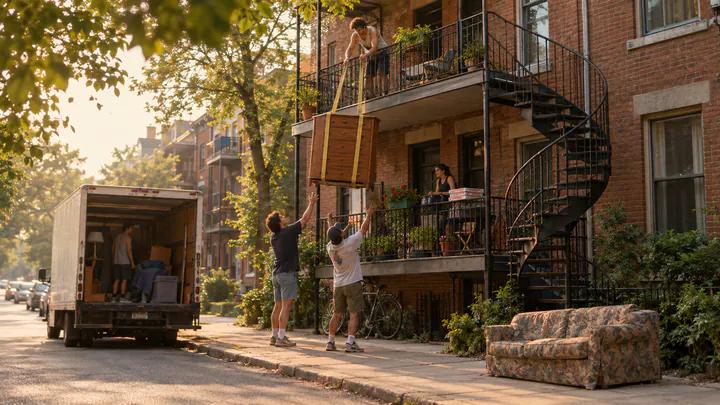
4417 was a grey-brick triplex with a black iron staircase curling up its front like a dropped spring. On the bottom step sat Fernand Bouchard in a lawn chair, which was the reason for everything: his hip had decided last winter that it was finished with stairs, and so the Bouchards were going down, and the Pierre-Louis, with three children and a fourth arriving in October, were going up to the extra bedroom. The two wives had arranged it in March over a fence. Josée could picture the conversation exactly. It would have been very reasonable.
Now the staircase held, from top to bottom: Yannick, a queen mattress, a dresser, Jean-Robert Pierre-Louis, and a boy of about eight with a brass lamp, all wedged at the turn like a sentence that had lost its verb.
"Madame," said the man from the city, without looking up from his book. He wore a short-sleeved shirt and a hat that was too warm. "This vehicle is obstructing the circulation."
"Monsieur Thibodeau," read Josée from his badge. "Everything on this street is obstructing the circulation. There is a couch in the middle of Gilford."
"The couch is not my department." He licked the pencil.
Huguette Bouchard came out onto the upper balcony holding a pot of geraniums against her chest. Marjorie Pierre-Louis came out onto the lower gallery, directly beneath her, holding a baby monitor that was not plugged into anything. They looked at Josée with the identical expression of two women who had been patient since nine o'clock that morning.
"You're the office," said Huguette.
"I'm the office."
"Your young man says one of us has to wait until tomorrow."
"Nobody waits until tomorrow," said Josée, and took the pen from the clip of her board.
She did what she had always done. She drew a line down the middle of a fresh page and wrote times. Bouchard boxes down, two to three. Pierre-Louis boxes up, three to four. Furniture after. But the Bouchard boxes had nowhere to go down to, because the downstairs was full of Pierre-Louis, and the Pierre-Louis had nowhere to go up to, because the upstairs was full of Bouchard. She drew an arrow. She drew a second arrow pointing back at the first. It looked like a diagram of a dog chasing its tail.
From the step, Fernand Bouchard said, "In 1971 I took a piano out of a window on Saint-Urbain."
"With a crane?"
"With my brothers."
Josée looked up. Not at the staircase. Past it. The upper balcony hung directly over the lower gallery, two metres and a bit of air between Huguette's geraniums and Marjorie's monitor, the iron railings painted the same tired green. On the upper balcony, the boy's older sister had already given up waiting and was handing a lamp shade through the rails to her mother below, who took it without even looking, the way you take a plate at dinner.
Josée set the clipboard down on a pizza box on the gallery rail. It slid a little in the grease, and she let it.
"Benoît," she called. "How many straps on the truck?"
"Eight. Nine with the broken one."
"Get them. Yannick, bring the mattress back up. Monsieur Pierre-Louis, I'm sorry, the dresser goes back down. Nothing else goes on that staircase today except people."
"Then how does anything—" Jean-Robert began, and then he looked where she was looking, and stopped.
"Madame Bouchard hands down," said Josée. "Madame Pierre-Louis hands up. The boys do the heavy end. You don't carry anything around. You just pass it over the rail to each other."
Huguette regarded the drop over her geraniums. "My china cabinet."
"Your china cabinet comes down on two straps, with Benoît on top and your husband telling everybody they're doing it wrong."
"He will," Huguette agreed, and went inside to empty it.
It went faster than anything Josée had ever written on a page. The Bouchards' kitchen chairs came down one by one into the hands of the eight-year-old, who stacked them on the gallery with enormous dignity. The Pierre-Louis crib went up in pieces, the sister reading out the screw sizes from the instructions. The china cabinet descended on its straps like a bishop, Benoît leaning over the rail, Yannick and Jean-Robert underneath, Fernand calling doucement, doucement from his lawn chair. Marjorie and Huguette, at the rail, began finishing each other's sentences about the landlord.
Thibodeau tore off his ticket and held it out.
"Benoît," said Josée, "move the truck to the lane. We don't need it."
The inspector looked at the ticket, and then at the empty space where the truck had been, and then at the china cabinet. He put the ticket in his pocket instead of on a windshield. "I'll be back at five," he said.
"We'll be gone," said Josée.
Only the Bouchards' plaid couch defeated them. It would not fit through the ground-floor door at any angle. It ended up on the sidewalk with the others, where the eight-year-old sat on it, eating the last slice from somebody's box, and declared it his.
Truck three called in finished at 4:20, forty minutes ahead of its sheet.
Back at the office, Luc had put the fan on the floor and his feet beside it. "So which one did you refund?"
"Both, a little. Neither of them used a truck."
"Réjean won't like it."
"Réjean can come and pass a china cabinet over a railing next year."
She opened the green log, the one that held twenty-six summers of clean lines, and on today's page under 4417 Garnier she wrote: Double-booked. Dispatcher error. J. She underlined it once, neatly.
Luc leaned over and read it. "You don't have to write that. It worked out."
"It was double-booked," Josée said. "I wrote it twice."
The cordless phone, back in its cradle, came to life and began to ring. It was a woman on Fabre whose new apartment still had a waterbed in it. Josée left the clipboard where it was and picked up a pen.